

Monofilament Filter Cloth
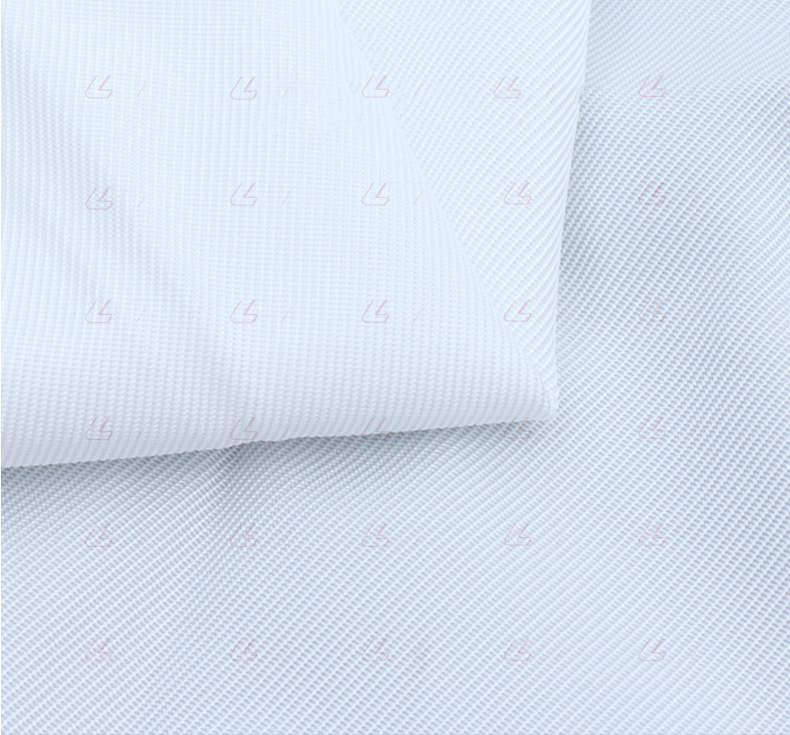
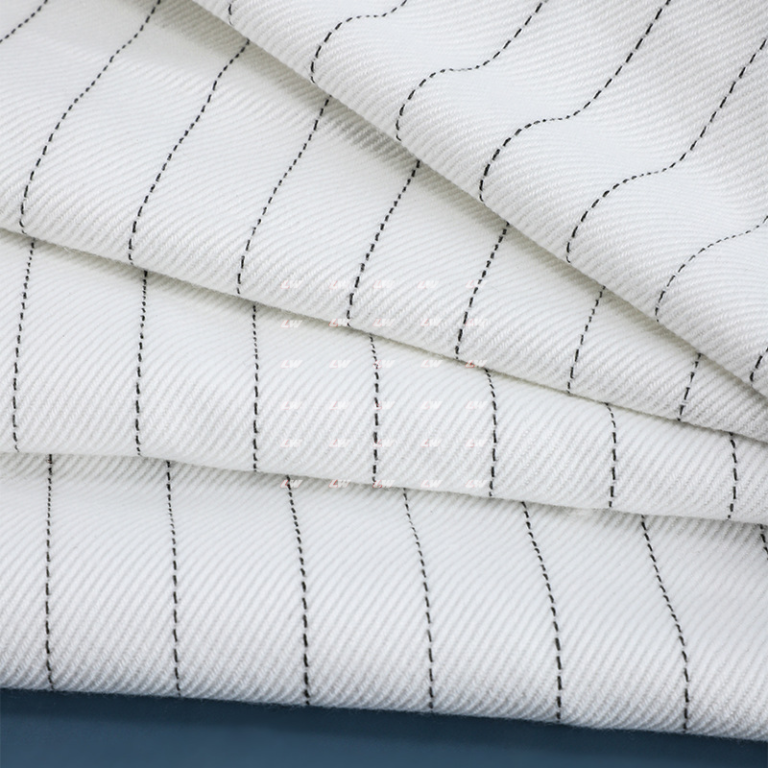
Monofilament filter cloth is woven from single extruded filaments — one smooth fibre per thread, rather than a bundle. The result is a regular, open pore structure that drains quickly and releases cake without scraping. It is the structure we specify first when the cake is sticky or the cycle time matters more than filtrate clarity.
- Pore size20–100 µm
- Weight350–650 g/m²
- PolymersPP · PET · PA

What the structure does
Because each thread is a single smooth filament, there are no loose fibre ends to trap solids. Pores stay open through the cycle, so flow resistance rises more slowly and the cloth blinds later. The same smoothness is why cake drops away: there is little mechanical key for the cake to grip.
The trade-off is retention. An open, regular pore passes fine particles that a multifilament structure would capture, so filtrate is less clear. Where clarity is the priority, a multifilament or a mono-multi composite is the better starting point. We will say so rather than sell the wrong cloth.
How the cake forms, and why the rating undersells the cloth
Monofilament cloth relies on bridging. In the first seconds of a cycle, particles span the smooth, regular pores; once that first cake layer is down, the cake becomes the filter and the cloth becomes its support. Retention therefore improves as the cycle runs — the opposite of what the pore-size number alone suggests.
This is why the rating is quoted conservatively. A 50 µm monofilament cloth routinely captures particles finer than 50 µm once the cake is up, provided the slurry forms a coherent cake. Judge the cloth by the filtrate after the first half-minute, not by the first seconds.
Plain, twill or satin
- Plain monofilament — the default. Square pores, the highest retention for the rating, and the most rigid cloth on the plate.
- Twill monofilament — denser packing and a smoother face; the route to finer ratings without giving up drainage.
- Satin monofilament — fastest cake discharge of the three; used for sticky, platey cakes such as pigments and clay slips.
Where it works
- Mining tailings and concentrate — fast drainage at high solids load, where a tight weave would blind within days.
- Municipal and industrial sludge — sticky cake releases cleanly, reducing manual scraping and cycle time.
- Stone and ceramics wastewater — abrasive fines with a cake that tends to smear.
- High-throughput filtration — where the press is cycle-limited rather than clarity-limited.
Where it does not fit
Do not choose monofilament where the filtrate must be optically clear, where the solids are finer than about 20 µm and must be captured, or where the slurry contains fibrous material that wraps around open pores. In those cases the open structure passes what you are trying to remove.
Fitting and care
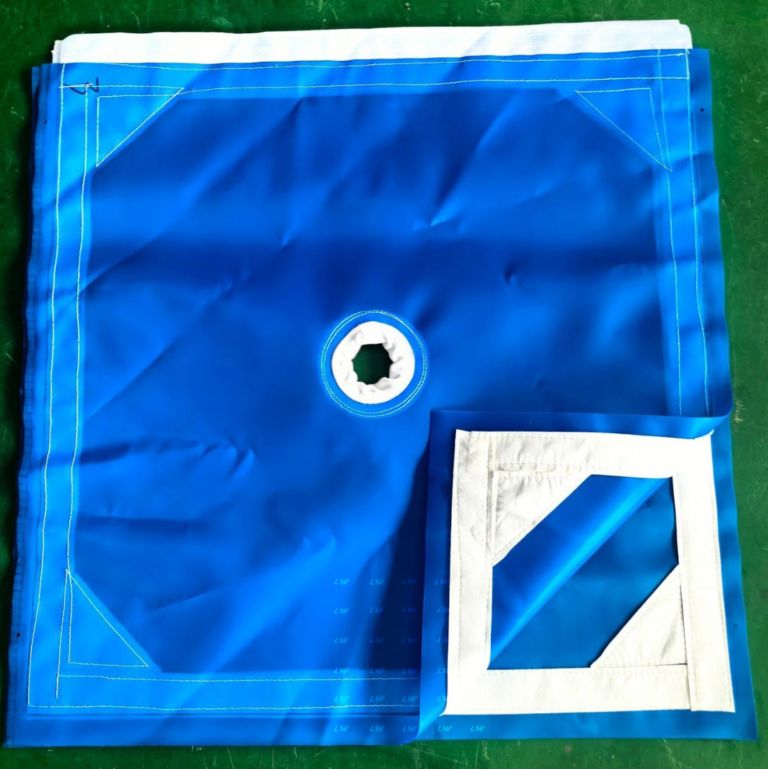
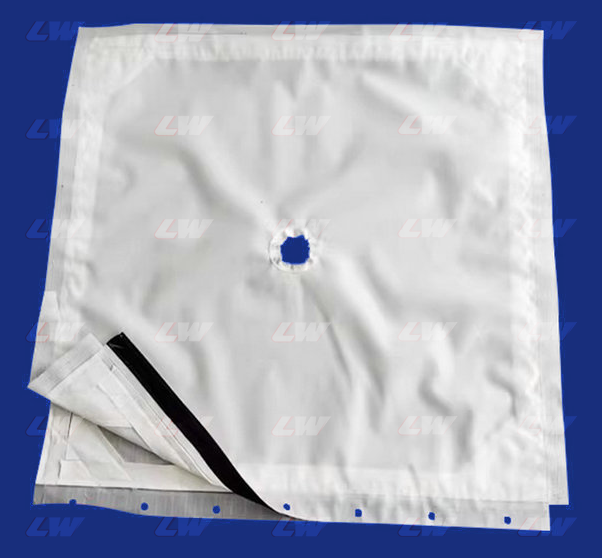
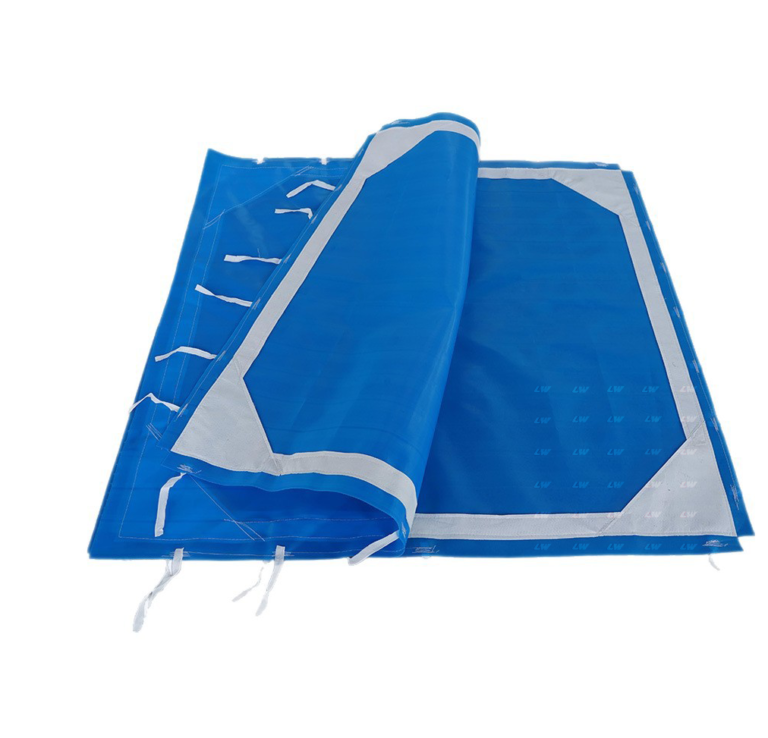
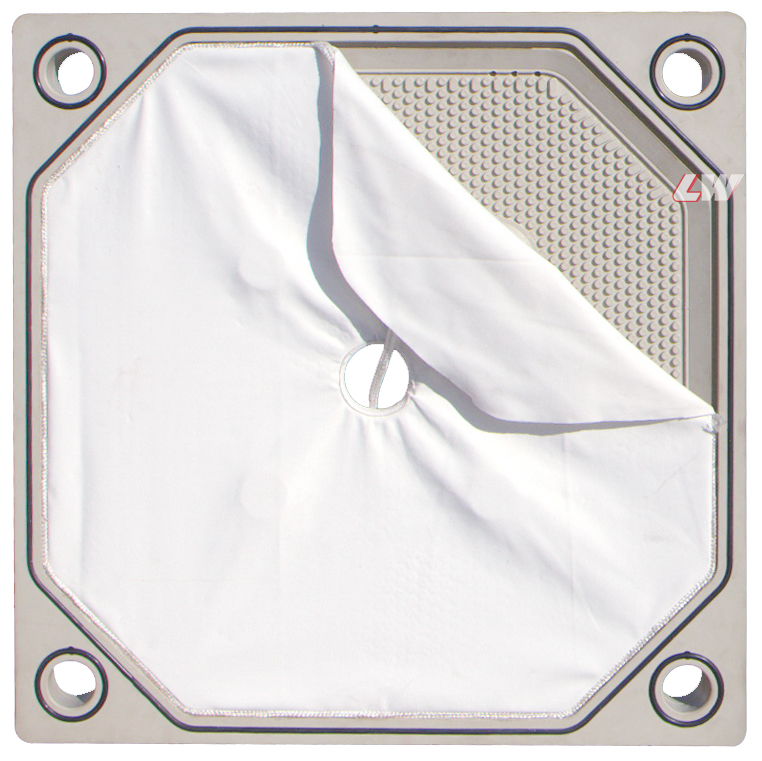
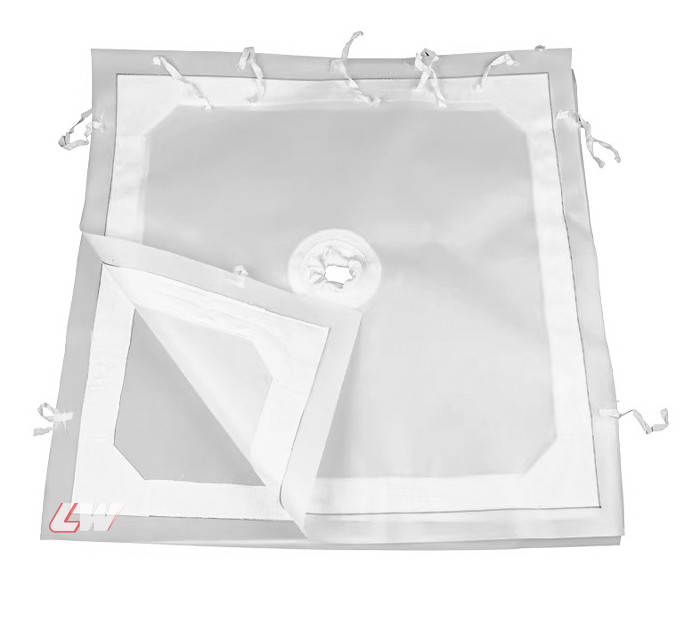
Monofilament cloth is cut to your plate drawing and finished with the neck or gasket style your plates use. Between cycles, wash with low-pressure water: high-pressure jets stretch the weave locally and open the pores permanently, which shows up later as a cloth that runs fine at the edges and coarse in the middle.
At each change-out, inspect the two places monofilament wears first: the cloth around the feed eye, where slurry velocity is highest, and the sealing edge, where clamping pressure works the cloth every cycle. Thinning at either point means the set is due for rotation or replacement. Store flat, out of sunlight, and avoid folding along the same line repeatedly.
Specification Range
| Parameter | Range |
|---|---|
| Polymer | Polypropylene, polyester, nylon |
| Pore size (bubble point) | 20–100 µm |
| Weight | 350–650 g/m² |
| Thickness | 0.7–1.2 mm |
| Air permeability | 30–120 L/m²/s at 200 Pa |
| Continuous temperature | PP 90 °C · PET 130 °C · PA 100 °C |
| Weave | Plain, twill, satin |
| Edge and neck | Stitched, welded or bonded; barrel neck, CGR or overhang |
Ranges are common weaving ranges for this cloth family. The final specification is confirmed against your slurry data and plate drawing.
Cloth Finishing at Loway
Weaving, finishing and cutting are handled in our own workshop, so replacement cloth is cut to your plate drawing rather than to a catalogue size.
Request a Quote
Frequently Asked Questions
Monofilament or multifilament — which should I choose?
Choose monofilament when cake release and cycle time matter and the filtrate can carry some fines. Choose multifilament when the filtrate must be clear and the cake does not stick. If you need both, a mono-multi composite is the usual compromise.
What micron rating should I specify?
Match the rating to the smallest particle you must retain, then expect the cloth to run slightly tighter as a cake builds. Ratings in this range are measured by bubble point on the finished cloth, not converted from a mesh count.
Will it work on a membrane press?
Yes, provided the cloth is cut for the membrane plate's recess and the neck style matches. Membrane plates move during squeeze, so the cloth needs the correct overhang to avoid being pulled at the feed hole.
How long does monofilament cloth last?
In tailings duty, plan on replacing by condition rather than calendar — watch for thinning at the feed hole and rising turbidity. Abrasive slurries wear the cloth at the edges first.
Can it be repaired?
Small tears away from the sealing edge can be patched. Damage at the neck or gasket cannot: the seal is the function, and a patch there will leak.
Why is the first filtrate cloudy, then clear?
That is bridging: particles are still spanning the smooth pore mouths in the first seconds of fill. Once the cake layer forms, the cake does the fine filtering and the filtrate clears. Cloudiness that never clears is the sign the rating is too open, not a defect in the cloth.
Which structure washes cake better?
Monofilament. The open, regular pores let wash water pass through the cake evenly instead of channelling, so wash consumption drops and residual mother liquor in the cake is lower. This is one of the quieter reasons monofilament wins on cycle economics.
Get a Cloth Specification
Send your plate drawing and slurry data — pH, temperature and particle size — and we will confirm the structure and polymer.