

Twin-Shaft Channel Grinders & Sewage Macerators
High-torque dual-shaft grinders for pump protection, FOG capture, and rag shredding in municipal and industrial headworks. SS304 or SS316 cutters, IP55 or IP68 drive — sized to the solids you actually handle, not a catalog curve.
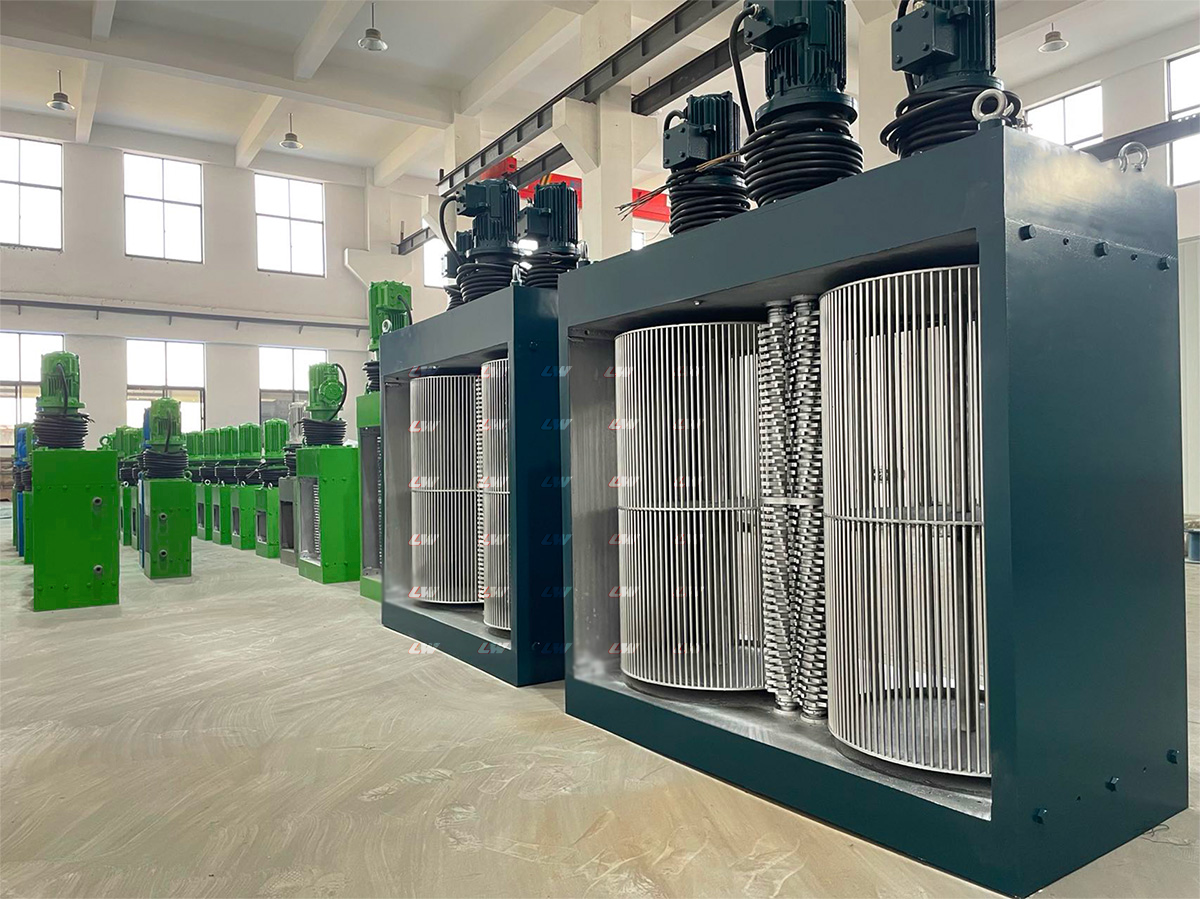
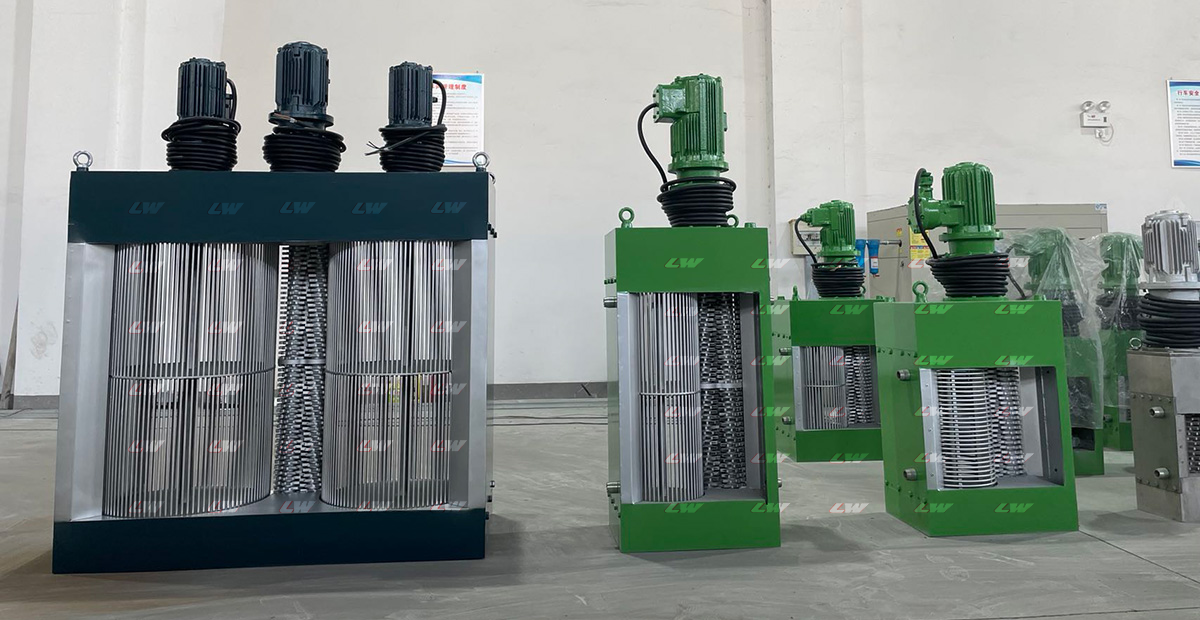
Three Failure Modes a Grinder Prevents
A twin-shaft macerator isn’t a luxury — it’s the cheapest insurance at the headworks. Every clogged pump, every rag-wrapped impeller, every bypass event traces back to solids that should have been intercepted upstream.
Stop Rag and Rag-Ball Damage
Rags, wipes, hair mats, and feminine products wrap pump impellers within hours of a heavy flow event. Cutting them to 6–10 mm particles at the channel wall prevents cavitation loss, seal damage, and the emergency callout that follows.
Thicken What Reaches the Press
Coarse fibers inflate sludge volume and bleed through downstream screens, choking screw presses and increasing polymer demand. Maceration at the inlet produces a denser, more uniform feed for dewatering and a steadier cake on filter presses.
Stop FOG Balls Reaching the Aeration Tank
Fats, oils, and grease congeal into rag-balls that float through bar screens and accumulate on diffusers. Sheared early, FOG stays in the primary stage where it can be skimmed, not in the activated sludge where it kills aeration efficiency.
How the Twin-Shaft Shears Solids
Two hexagonal shafts, each studded with heat-treated alloy cutters, counter-rotate at a controlled differential. Solids are not crushed — they are caught, guided into the cutting gap, and sheared against the stationary comb below.
Mandatory Interception
Solids in the channel flow are captured by the cutter gaps. There is no straight-through path — every object entering the cutting zone must be sheared before it can pass.
Guided Shredding
The differential rotation of the two shafts creates a scissors action. Long fibers are pulled into the cutting gap and progressively shortened, rather than wrapped around a single rotating drum.
Differential Shearing
Cutters are sized to the working gap, and the gap is held to a tolerance in the 0.1–0.3 mm range. The result is a clean shear, not a tear — particles stay inside the designed PSD band instead of smearing.
Safe Flow-Through
Sheared particles leave the cutting zone suspended in the mainstream flow. Liquids pass with no measurable head loss at design flow; only oversize objects ever touch the cutters.
Build Details That Matter in the Field
A grinder running 24 hours a day needs more than torque. It needs shafts that don’t bend, cutters that don’t chip, drives that survive a flooded channel, and a control system that clears a jam before an operator has to drive in.
Hexagonal Shaft Design
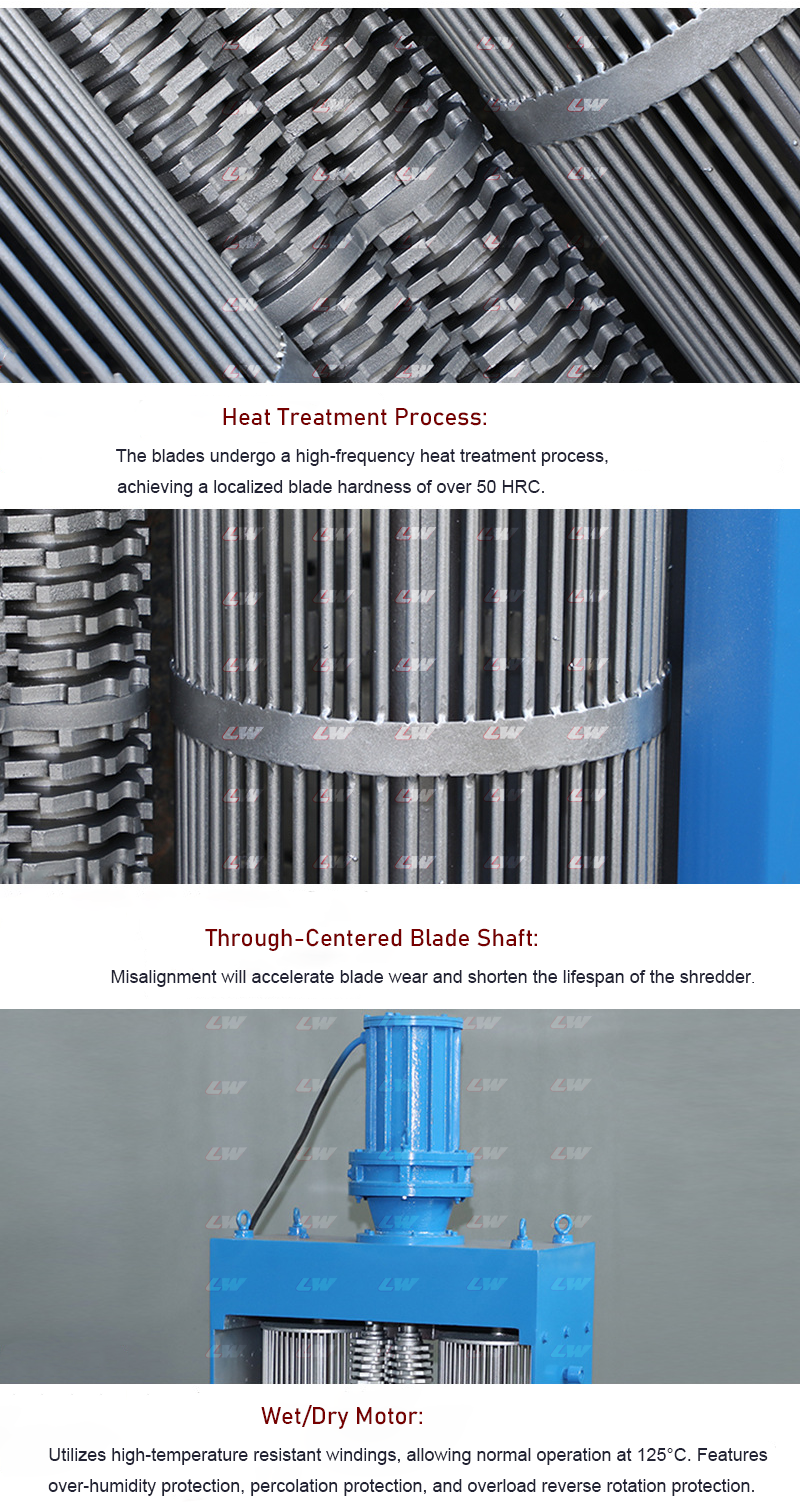
Solid hex shafts (not round tubes) carry torque across the full cutter stack without twisting under a peak load. Each cutter is keyed to the shaft so backlash stays zero over the bearing life.
Heat-Treated Alloy Cutters
Cutter tips are vacuum-degassed alloy steel, quenched and tempered to 58–62 HRC. Hard enough to shear abrasive wipes, tough enough not to chip on a stray metal fragment that bypasses upstream screening.
Intelligent Auto-Reverse (Anti-Jam)
Current sensing on each shaft triggers a programmed reverse cycle when torque exceeds the jam threshold. The grinder clears itself, logs the event, and returns to forward rotation without an operator call-out.
IP68 Submersible Drive
Flooded-channel duty rated: the gearmotor is sealed to IP68 for continuous submergence. For dry-channel installations, the IP55 footprint-saved drive reduces headroom requirements.
Twin-Shaft Channel Grinder — Model Range
Indicative ranges for typical headworks duty. Final sizing depends on solids profile, channel geometry, peak vs. average flow, and duty cycle — confirm with bench test against your actual rag, FOG, and grit mix.
| Model | Channel Width | Throughput | Drive Power | Shaft / Cutter | Cutter Material | Working Gap | Drive IP |
|---|---|---|---|---|---|---|---|
| TSC-300 | 300 mm | 5–25 m³/h | 1.5–3 kW | Hex 40 / 5-tooth | SS304 / SS316 | 0.2 mm | IP55 / IP68 |
| TSC-450 | 450 mm | 15–45 m³/h | 3–5.5 kW | Hex 50 / 5-tooth | SS304 / SS316 | 0.2 mm | IP55 / IP68 |
| TSC-600 | 600 mm | 30–70 m³/h | 5.5–11 kW | Hex 60 / 7-tooth | SS304 / SS316 | 0.25 mm | IP55 / IP68 |
| TSC-800 | 800 mm | 50–110 m³/h | 11–22 kW | Hex 80 / 7-tooth | SS316 standard | 0.3 mm | IP68 |
All figures are typical for clean water at 20 °C with a 6–25 mm working gap. Throughput drops as solids loading rises — confirm with a bench test against your worst-case rag and FOG mix before final sizing. Lubricant, sacrificial cutter, and cutter-replacement service kits are specified per channel width.
Match the Build to the Solids
A grinder is not one part number. Shaft configuration, cutter count, material grade, drive type, and control package each move with the application. Pick the combination, not the model.
Shaft configuration and material are not interchangeable in the field — confirm both at order entry. Auto-reverse PLC is recommended on any channel above 600 mm width where manual unjamming requires confined-space entry.
Where Twin-Shaft Channel Grinders Earn Their Keep
Five application streams where macerators are specified rather than optional. Each pairs with a Loway installed base; click through to the matching industry page for case studies.

Municipal Headworks
Pump-station wet-wells, primary screens, and sludge lines in municipal sewage plants.
Municipal Sewage Sludge

Food & Beverage Plants
Process-water streams, FOG-rich effluent, and solids from washing/cleaning lines.
Food & Beverage

Pulp & Paper Mills
Rejects handling, fiber recovery lines, and screening of broke and recycle streams.
Pulp & Paper Case

Mining & Metals Tailings
Slurry conditioning lines, tailings dewatering feed, and concentrate handling.
Mining Tailings

Battery & Cathode Plants
Lithium-ion precursor streams, brine pretreatment, and lithium carbonate filtration feed.
Battery Materials
Five Questions Before You Spec
Walk these with the engineer who knows the channel, not the catalog. Most misapplied grinders fail on at least one of these points.
What is the peak channel flow, and how often does it occur?
Use peak wet-weather flow, not average daily flow — that’s the duty the cutter gaps must pass without head-loss complaints from upstream.
What is the channel width and the available headroom?
Shaft configuration, drive housing, and racking all need to fit inside the channel wall — measure the wetted width and the lid-to-floor clearance before selecting TSC-300 vs. TSC-800.
What is the worst-case rag and FOG mix?
Personal-care wipes, hair matting, and FOG rag-balls demand a tougher build than a dilute industrial fiber stream. Send us a sample of the worst rag you’ve actually pulled off a screen — that drives cutter density, not a default.
Flooded or dry channel — drive rating?
A grinder mounted in a wet-well needs IP68 submersible rating throughout the drive. A dry-channel installation is fine on IP55 and gains headroom on the motor.
How will the operator clear a jam — and from where?
Auto-reverse PLC handles 95% of jams in normal service. For larger channels, plan access for confined-space entry and have a spare cutter cartridge on the shelf before commissioning.
Twin-Shaft Channel Grinder FAQs
Short, technical answers to the questions our engineering team hears most often. If yours isn’t here, ask — quoting is free.
How does a twin-shaft grinder differ from a single-drum grinder?
A twin-shaft grinder uses two counter-rotating shafts to create a scissor-like cutting action. It handles fibrous, stringy, and high-strength solids (wipes, rags, hair matting) without the wrapping risk that plagues single-drum units. A single-drum grinder is a better fit for low-strength, FOG-rich effluent where higher throughput per kW matters more than peak torque.
What particle size comes out of the cutter?
Particle size is set by the cutter diameter and the gap between the two shafts, typically 6–10 mm for standard build. The working gap is held to ±0.1 mm tolerance so the particle-size distribution stays consistent across the PSD curve, not skewed by cutter wear.
Can the grinder run dry?
Brief dry runs during commissioning are fine, but the cutter bearings and shaft seals are rated for fully-flooded or fully-submerged duty — not continuous dry operation. A dry-channel installation should still carry a low-level float switch to prevent dry-running in seasonal low-flow periods.
What is the difference between IP55 and IP68 on the drive?
IP55 protects against water jets, dust, and the typical wet-channel ambient. IP68 is rated for continuous submergence to a specified depth and is required for wet-well and below-grade installations. Both use the same cutter stack and controller — only the gearmotor seal differs.
How do you handle a jam?
An auto-reverse PLC monitors current on each shaft. When the jam threshold is exceeded, the drive reverses for a programmed period, then attempts forward rotation. If the jam persists, the drive trips to a fault state with a remote alarm — operators clear via the access hatch above the cutting zone, not the channel wall.
What spare parts should we keep on the shelf?
One full set of cutters (matched pairs), one set of shaft seals, and one cutter-cartridge extraction tool. On units above 600 mm channel width, we recommend keeping a spare PLC controller module if there’s no on-site Loway service partner.
Need a Twin-Shaft Grinder for Your Headworks?
Send us your channel width, peak wet-weather flow, and a sample of the worst rag you’ve actually pulled off a screen. We’ll size the model, cutter grade, and drive package against your duty cycle — and quote it in writing.
Spec Sheet & Drawing
TSC model sheet + GA drawing, in PDF and DWG, sent within one working day.
Request file
Spare Cutters & Service
Cutter cartridges, shaft seals, and on-site commissioning quoted with the unit.
Ask the team
Complementary Equipment from Loway
A grinder is the upstream guard for the rest of the headworks. The four units below are the next stop after maceration in a typical Loway-installed line.