

Chamber Filter Press for Recessed Plate Dewatering
The workhorse of mechanical dewatering. PP recessed plates form sealed chambers; slurry is pumped in under pressure, solids build as cake, filtrate drains clear. Built for mining tailings, municipal sludge, chemical and food-industry slurries — sized from your bench test, not a guess.
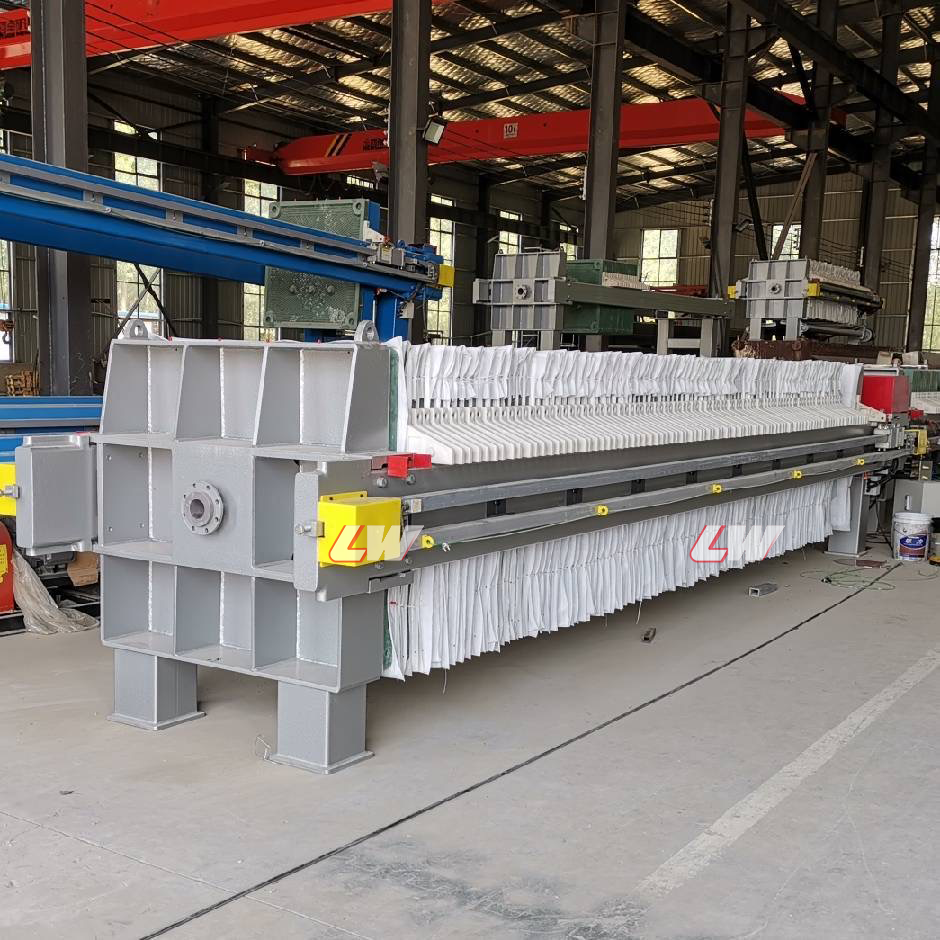
Where a Chamber Press Fits in the Filter Press FamilyThree plate configurations, one engineering team
Loway builds recessed-chamber, membrane, and plate-and-frame presses in the same factory. Each suits a different cake-dryness target and budget. Use this map to confirm the chamber press is the right platform before requesting a quote.
Chamber Filter Press
Recessed PP or cast-iron plates. Simpler mechanism, lower capex. Typical cake moisture 30–60% (slurry-dependent). The standard choice when extreme dryness is not the #1 priority.
Membrane Filter Press
Adds a flexible diaphragm behind the plate face. A secondary squeeze step at 1.0–1.6 MPa removes another 10–15% moisture. Longer cycle but drier cake, smaller disposal volume.
Plate & Frame Press
Flat plates and frames alternating, no recessed cavity. Best for very thin cakes, low solids, or clarification duty. Smaller batches, simpler maintenance.
Anatomy of a Recessed Chamber PlateWhat makes the chamber form and the seal hold
Every chamber in a filter press is the gap between two recessed plates. The recess is the cake cavity. The plate is the filter media support and the seal. The Loway standard plate stack ships in eight sizes — from 420 mm pilot frames to 1500 mm industrial lines.
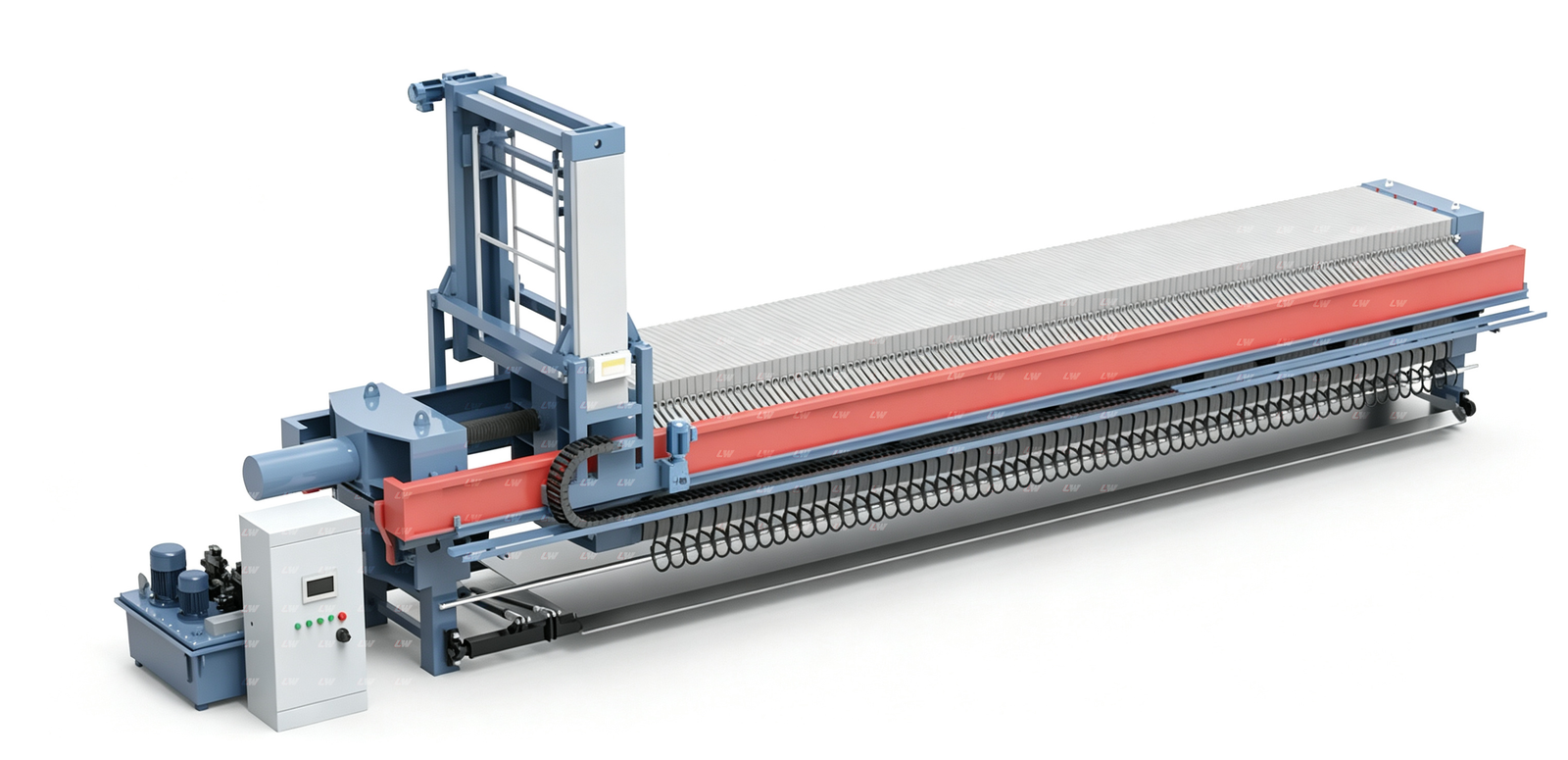
- Virgin PP bodyAcid- and alkali-resistant, cast in-house. No recycled resin in contact surfaces.
- Diamond + Strip pipsThe raised dot pattern supports the cloth and gives filtrate a clear drainage path. Strips guide the wash flow evenly across the cloth.
- Central feed holeSlurry enters through the bore in every plate. On 800+ sizes the bore is reamed to a precise tolerance so two-plate wash flow remains balanced.
- Sealing face flatness ≤ 0.1 mmCNC-milled sealing surface. Zero leakage up to rated feed pressure. Maintains a leak-tight cavity across thousands of cycles.
- Eight plate sizes stocked420 / 500 / 630 / 800 / 920 / 1000 / 1250 / 1500 mm. Larger or non-standard geometries cast on request with 4-week lead time.
- Cloth-on-plate designFilter cloth is matched to the plate geometry. We supply Loway cast plates and source cloths through qualified OEM mills.
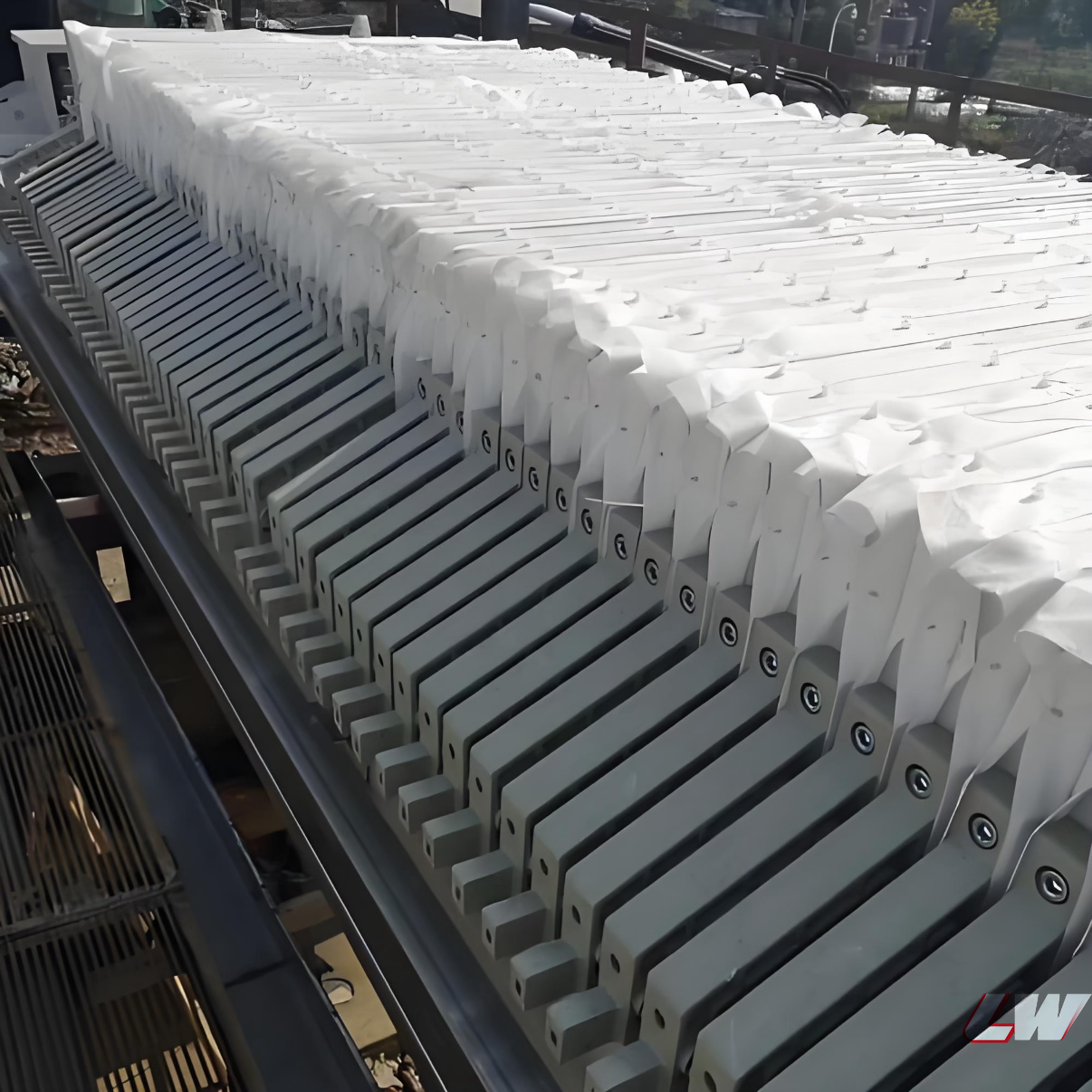
How a Chamber Filter Press WorksA four-step cycle, repeated for every batch
One cycle fills the chambers, presses the cake, discharges the solids, and resets the press. Total cycle time depends on slurry solids, cake thickness, and feed pump capacity — typically 20–45 minutes for a standard chamber build.
-
Close & seal the plate pack
The hydraulic cylinder drives the moving head against the plate stack. Automatic pressure keeping holds the pack leak-tight throughout filtration.
-
Fill & filter
The feed pump fills every chamber simultaneously through the central bore. Filtrate drains through the cloth and out the drain ports; solids build against the cloth face.
-
Air blow (optional)
Compressed air pushed through the cake displaces residual filtrate. Drops final moisture by a few points and shortens downstream drying.
-
Open & discharge
The plate pack opens automatically or manually. Cake falls by gravity onto the conveyor or pan below. A cloth-wash spray bar resets flux for the next cycle.
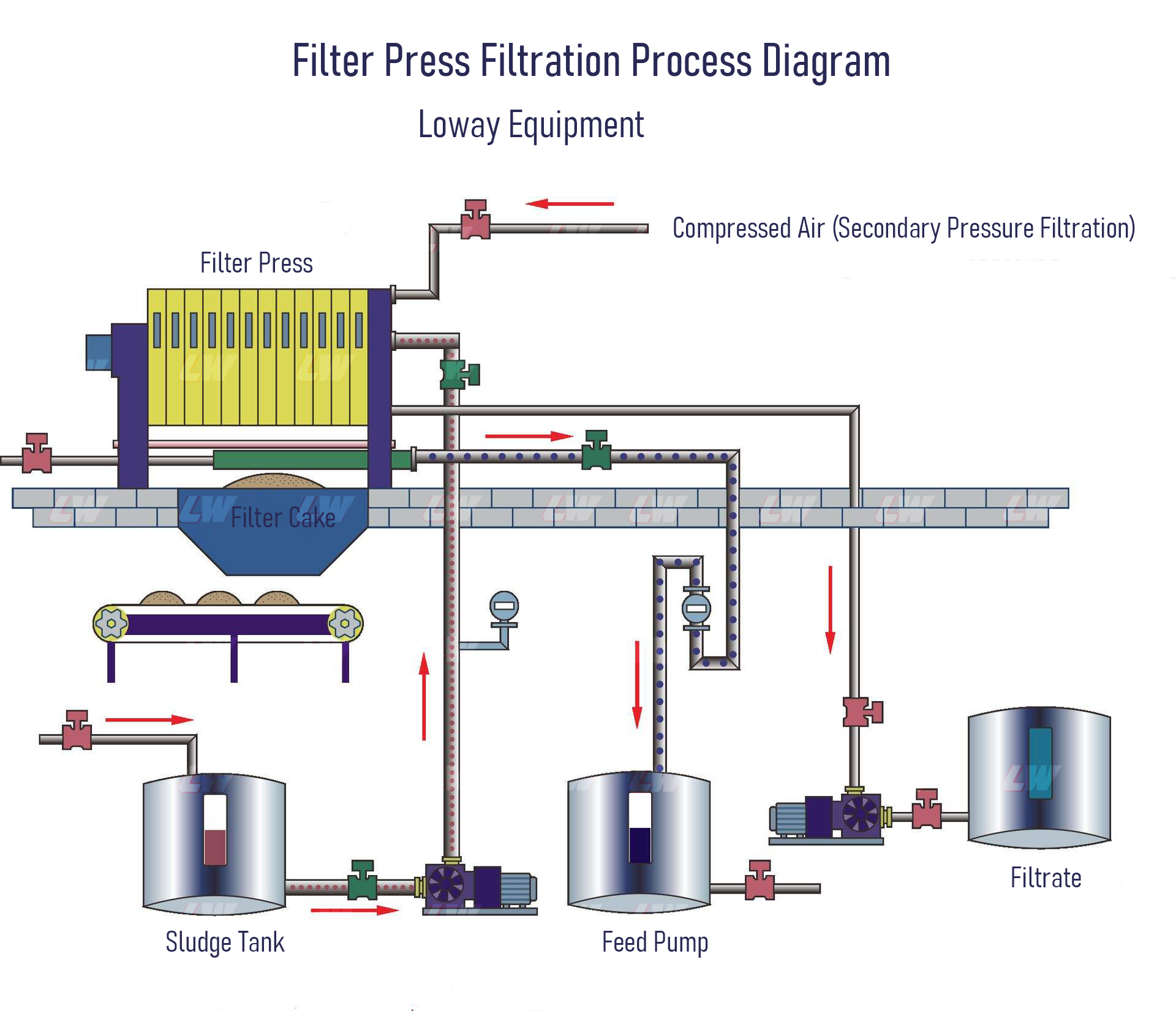
Plate Sizes and Filtration AreasStandard 800, 1000, 1250, and 1500 mm plate series — full tables below
All figures are typical values for a standard recessed-chamber build with automatic plate shifter and hydraulic closing. Larger non-standard geometries and reinforced frames are available on request. Numbers below are based on our current production series; final sizing is confirmed by bench test on your slurry.
| XA MYZ20–80 / 800-U(BK) Chamber Filter Press — Technical Parameters | ||||||||||
|---|---|---|---|---|---|---|---|---|---|---|
| Model | Filter area (m²) | No. of plates | Cake thickness (mm) | Chamber volume (L) | Foundation length L (mm) | Total length L1 (mm) | Machine dimensions (mm) | Weight (t, ref.) | ||
| Width | Height | |||||||||
| XA MYZ20 / 800-U(BK) | 20 | 21 | 30 | 320 | 2135 | 2260 | 2755 | 1210 | 1270 | ~3.2 |
| XA MYZ30 / 800-U(BK) | 30 | 31 | 480 | 2735 | 2875 | ~4.4 | ||||
| XA MYZ40 / 800-U(BK) | 40 | 41 | 640 | 3335 | 3100 | ~5.4 | ||||
| XA MYZ50 / 800-U(BK) | 50 | 51 | 800 | 3935 | 3450 | ~6.4 | ||||
| XA MYZ60 / 800-U(BK) | 60 | 61 | 960 | 4535 | 3700 | ~7.4 | ||||
| XA MYZ70 / 800-U(BK) | 70 | 71 | 1120 | 5135 | 4000 | ~8.4 | ||||
| XA MYZ80 / 800-U(BK) | 80 | 81 | 1280 | 5735 | 4300 | ~9.4 | ||||
| Plate 800 × 800 × 60 mm · working stroke 380 mm · max stroke 410 mm · auto plate shifter foundation lengthens L1 by ~135 mm. | ||||||||||
| XA MYZ32–120 / 1000-U(BK) Chamber Filter Press — Technical Parameters | ||||||||||
|---|---|---|---|---|---|---|---|---|---|---|
| Model | Filter area (m²) | No. of plates | Cake thickness (mm) | Chamber volume (L) | Foundation length L (mm) | Total length L1 (mm) | Machine dimensions (mm) | Weight (t, ref.) | ||
| Width | Height | |||||||||
| XA MYZ32 / 1000-U(BK) | 32 | 21 | 30 | 480 | 2200 | 3910 | 3170 | 1380 | 1450 | ~4.6 |
| XA MYZ40 / 1000-U(BK) | 40 | 25 | 600 | 2530 | 4260 | ~5.6 | ||||
| XA MYZ50 / 1000-U(BK) | 50 | 31 | 750 | 2950 | 4548 | ~6.8 | ||||
| XA MYZ60 / 1000-U(BK) | 60 | 37 | 900 | 3250 | 4880 | ~7.8 | ||||
| XA MYZ70 / 1000-U(BK) | 70 | 43 | 1050 | 3610 | 5146 | ~8.9 | ||||
| XA MYZ80 / 1000-U(BK) | 80 | 49 | 1200 | 3980 | 5436 | ~10.0 | ||||
| XA MYZ90 / 1000-U(BK) | 90 | 55 | 1350 | 4350 | 5734 | ~11.0 | ||||
| XA MYZ100 / 1000-U(BK) | 100 | 61 | 1500 | 4720 | 6024 | ~12.0 | ||||
| XA MYZ110 / 1000-U(BK) | 110 | 67 | 1650 | 5100 | 6318 | ~13.1 | ||||
| XA MYZ120 / 1000-U(BK) | 120 | 73 | 1800 | 5500 | 6612 | ~14.2 | ||||
| Plate 1000 × 1000 × 60 mm · working stroke 480 mm · max stroke 510 mm · auto plate shifter foundation lengthens L1 by ~160 mm. | ||||||||||
| XA MYZ100–300 / 1250-U(BK) Chamber Filter Press — Technical Parameters | ||||||||||
|---|---|---|---|---|---|---|---|---|---|---|
| Model | Filter area (m²) | No. of plates | Cake thickness (mm) | Chamber volume (L) | Foundation length L (mm) | Total length L1 (mm) | Machine dimensions (mm) | Weight (t, ref.) | ||
| Width | Height | |||||||||
| XA MYZ100 / 1250-U(BK) | 100 | 39 | 30 | 1500 | 3910 | 7000 | 5080 | 1750 | 1600 | ~13.5 |
| XA MYZ110 / 1250-U(BK) | 110 | 44 | 1650 | 4138 | 7350 | ~14.6 | ||||
| XA MYZ125 / 1250-U(BK) | 125 | 49 | 1875 | 4510 | 7750 | ~16.1 | ||||
| XA MYZ140 / 1250-U(BK) | 140 | 55 | 2100 | 4822 | 8150 | ~17.6 | ||||
| XA MYZ160 / 1250-U(BK) | 160 | 63 | 2400 | 5270 | 8750 | ~19.6 | ||||
| XA MYZ180 / 1250-U(BK) | 180 | 70 | 2700 | 5770 | 9250 | ~21.6 | ||||
| XA MYZ200 / 1250-U(BK) | 200 | 78 | 3000 | 6190 | 9800 | ~23.6 | ||||
| XA MYZ225 / 1250-U(BK) | 225 | 87 | 3375 | 6760 | 10450 | ~26.4 | ||||
| XA MYZ250 / 1250-U(BK) | 250 | 97 | 3750 | 7330 | 11200 | ~29.0 | ||||
| XA MYZ300 / 1250-U(BK) | 300 | 116 | 4500 | 8470 | 12550 | ~34.0 | ||||
| Plate 1250 × 1250 × 60 mm · working stroke 750 mm · max stroke 830 mm · weight figure includes frame, plates, hydraulic system, and shifter. | ||||||||||
| XA MYZ200–600 / 1500-U(BK) Chamber Filter Press — Technical Parameters | |||||||||||
|---|---|---|---|---|---|---|---|---|---|---|---|
| Model | Filter area (m²) | No. of plates | Cake thickness (mm) | Chamber volume (L) | Foundation length L (mm) | L2 stage (mm) | Total length L1 (mm) | Machine dimensions (mm) | Weight (t, ref.) | ||
| Width | Height | ||||||||||
| XA MYZ200 / 1500-U(BK) | 200 | 51 | 30 | 3000 | 5625 | — | 7160 | 2040 | 1950 | ~28 | |
| XA MYZ224 / 1500-U(BK) | 224 | 55 | 3360 | 6045 | ~30 | ||||||
| XA MYZ250 / 1500-U(BK) | 250 | 62 | 3750 | 6605 | ~33 | ||||||
| XA MYZ280 / 1500-U(BK) | 280 | 70 | 4200 | 7165 | 5000 | ~36 | |||||
| XA MYZ315 / 1500-U(BK) | 315 | 79 | 4725 | 7865 | 5000 | ~39 | |||||
| XA MYZ340 / 1500-U(BK) | 340 | 85 | 5100 | 8285 | 5500 | ~42 | |||||
| XA MYZ400 / 1500-U(BK) | 400 | 101 | 6000 | 9405 | 5500 | ~48 | |||||
| XA MYZ450 / 1500-U(BK) | 450 | 112 | 6750 | 10385 | 6000 | ~53 | |||||
| XA MYZ500 / 1500-U(BK) | 500 | 125 | 7500 | 11365 | 6000 | ~58 | |||||
| XA MYZ560 / 1500-U(BK) | 560 | 140 | 8400 | 12485 | 6500 | ~65 | |||||
| XA MYZ600 / 1500-U(BK) | 600 | 150 | 9000 | 13500 | 6500 | ~70 | |||||
| Plate 1500 × 1500 × 70 mm · working stroke 800 mm · max stroke 1000 mm · automatic pressure keeping system. L2 stage required for area ≥ 280 m²; non-stage build available to L=250. | |||||||||||
All figures are typical for standard builds with hydraulic closing and automatic plate shifter. Final numbers depend on plate count, cloth selection, and slurry behaviour. Sizing is confirmed against a bench test on your sample.
Smaller series: 420, 500, 630, 920 mm plate sizes (pilot & small-batch duty)
| 420-U / 500-U Chamber Filter Press — Technical Parameters | ||||||||
|---|---|---|---|---|---|---|---|---|
| Model | Filter area (m²) | No. of plates | Cake thickness (mm) | Chamber volume (L) | Foundation length L (mm) | Length | Width | Height |
| XA MSJ2 / 420-U(BK) | 2 | 9 | 25 | 32 | 972 | 1132 | 596 | 770 |
| XA MSJ3 / 420-U(BK) | 3 | 13 | 48 | 1172 | 1332 | |||
| XA MSJ4 / 420-U(BK) | 4 | 17 | 64 | 1372 | 1532 | |||
| XA MSJ5 / 420-U(BK) | 5 | 21 | 80 | 1622 | 1782 | |||
| XA MSJ6 / 420-U(BK) | 9 | 26 | 96 | 1822 | 1982 | |||
| XA MYJ4 / 500-U(BK) | 4 | 11 | 25 | 50 | 1110 | 1345 | 705 | 835 |
| XA MYJ6 / 500-U(BK) | 6 | 16 | 75 | 1360 | 1595 | |||
| XA MYJ8 / 500-U(BK) | 8 | 21 | 100 | 1610 | 1845 | |||
| XA MYJ10 / 500-U(BK) | 10 | 26 | 125 | 1860 | 2095 | |||
| XA MYJ12 / 500-U(BK) | 12 | 31 | 150 | 2110 | 2345 | |||
| XA MYJ14 / 500-U(BK) | 14 | 36 | 175 | 2360 | 2595 | |||
| Plate 420 / 500 — 50 mm thickness. Working stroke 360 mm, max stroke 400 mm. Typical for lab, pilot, and small-batch production lines. | ||||||||
| 630-U Chamber Filter Press — Technical Parameters | ||||||||
|---|---|---|---|---|---|---|---|---|
| Model | Filter area (m²) | No. of plates | Cake thickness (mm) | Chamber volume (L) | Foundation L (mm) | Total length | Width | Height |
| XA MY5 / 630-U(BK) | 5 | 9 | 25 | 70 | 1130 | 1700 | 1030 | 1020 |
| XA MY8 / 630-U(BK) | 8 | 13 | 112 | 1330 | 1920 | |||
| XA MY10 / 630-U(BK) | 10 | 17 | 140 | 1530 | 2110 | |||
| XA MY15 / 630-U(BK) | 15 | 23 | 210 | 1930 | 2500 | |||
| XA MY20 / 630-U(BK) | 20 | 31 | 280 | 2330 | 2900 | |||
| XA MY25 / 630-U(BK) | 24 | 38 | 336 | 2730 | 3300 | |||
| XA MY30 / 630-U(BK) | 30 | 45 | 420 | 3130 | 3700 | |||
| XA MY32 / 630-U(BK) | 32 | 49 | 448 | 3280 | 3850 | |||
| Plate 630 — 50 mm thickness. Working stroke 360 mm, max stroke 400 mm. Common in pharmaceutical, fine chemical, and small wastewater lines. | ||||||||
| XA MYZ40–100 / 920-U(BK) Chamber Filter Press — Technical Parameters | ||||||||
|---|---|---|---|---|---|---|---|---|
| Model | Filter area (m²) | No. of plates | Cake thickness (mm) | Chamber volume (L) | Foundation L (mm) | Total length | Width | Height |
| XA MYZ40 / 920-U(BK) | 40 | 33 | 30 | 640 | 3050 | 4565 | 1300 | 1350 |
| XA MYZ50 / 920-U(BK) | 50 | 41 | 800 | 3500 | 5050 | |||
| XA MYZ60 / 920-U(BK) | 60 | 49 | 960 | 3970 | 5540 | |||
| XA MYZ70 / 920-U(BK) | 70 | 57 | 1120 | 4500 | 6030 | |||
| XA MYZ80 / 920-U(BK) | 80 | 65 | 1280 | 5000 | 6520 | |||
| XA MYZ90 / 920-U(BK) | 90 | 72 | 1350 | 5410 | 7010 | |||
| XA MYZ100 / 920-U(BK) | 100 | 80 | 1500 | 5900 | 7490 | |||
| Plate 920 × 920 × 60 mm · working stroke 480 mm · max stroke 510 mm · mid-size industrial line, common in ceramics, kaolin, and mine backfill duty. | ||||||||
Frame, Hydraulic, Plate Pack — What Loway BuildsIn-house casting and fabrication, qualified cloth supply
The press frame, hydraulic system, and recessed plates are designed and built in the Loway facility. Cloths and consumables are matched through qualified OEM mills — the same parts that fit a Loway press fit a Loway press after 5,000 cycles or 5 years.
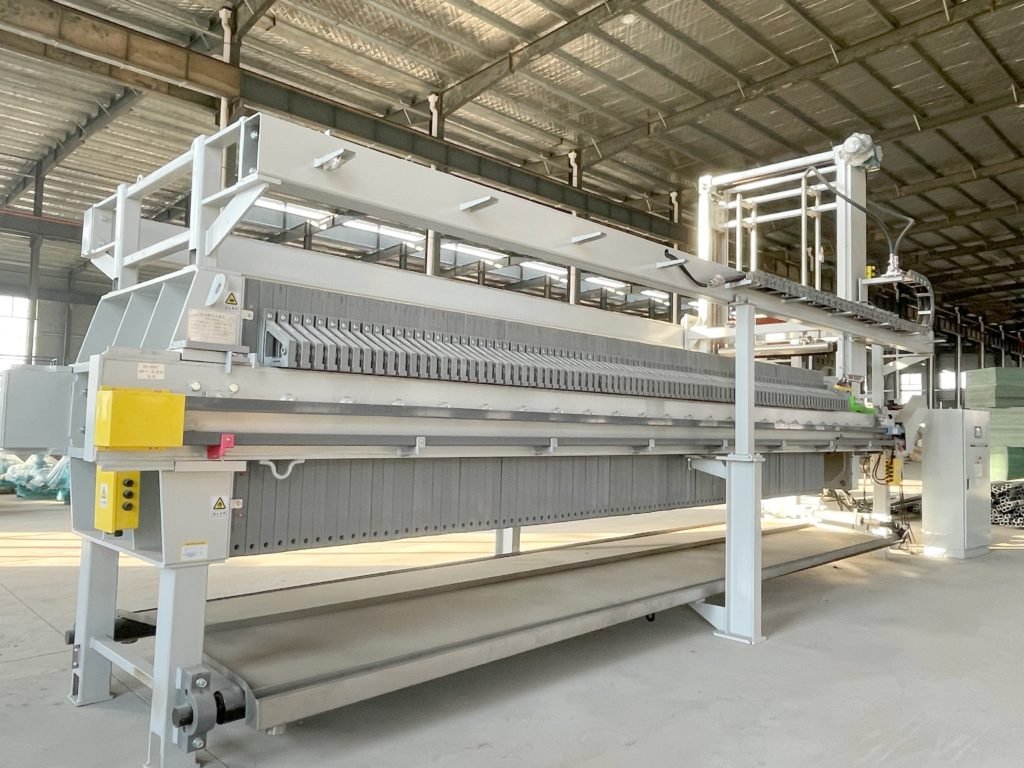
Frame & hydraulic closing
The main beam is fabricated from Q345B carbon steel with automatic submerged-arc welding. Sandblasted to Sa 2.5 and coated with three layers of marine-grade epoxy for corrosion resistance in humid plant rooms.
- Main beam Q345B carbon steel, submerged-arc welded
- Surface prep Sa 2.5, three coats marine epoxy
- Designed with a 2.0× safety factor on closing force
- Hydraulic closing cylinder with automatic pressure keeping
- Overpressure protection and travel limits as standard
- 1500-U(BK) ships with automatic pressure keeping system
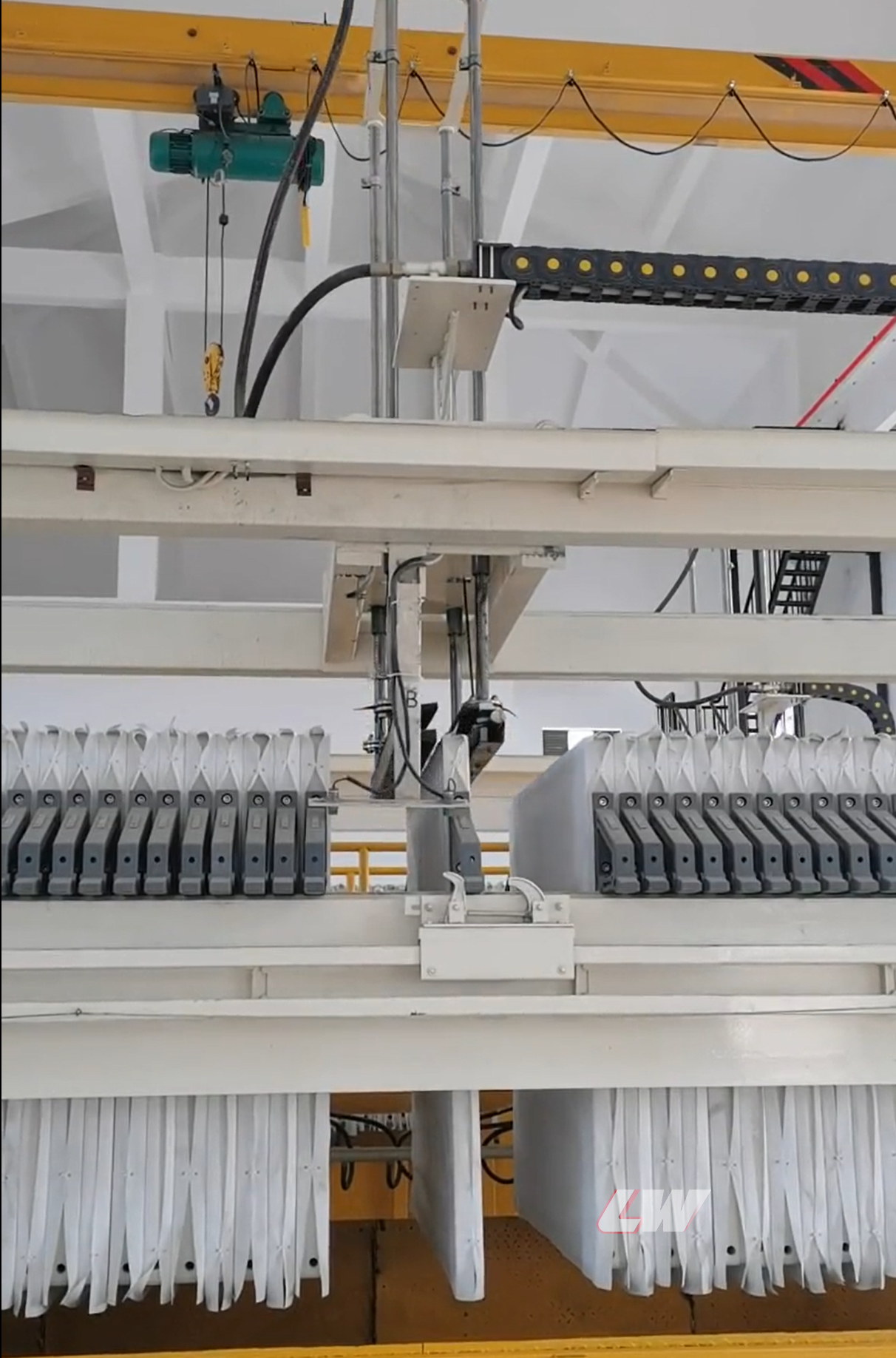
Plate pack & cloths
Recessed plates cast in PP, cast iron, or stainless steel to match slurry chemistry. Filter cloths are matched to plate geometry and slurry particle size — sourced through qualified OEM cloth mills with cloth-life test reports on file.
- PP plate body, acid- and alkali-resistant
- Cast iron and stainless plate options on request
- Diamond + Strip pip pattern for drainage and cloth support
- CNC-milled sealing face, flatness ≤ 0.1 mm
- Cloth materials: polyester, polypropylene, nylon
- Cloth weaves: monofilament, multifilament, laminated
Automation OptionsFrom manual operation to fully unmanned systems
Configure the press to your labour budget. Every option below is available as a factory fit on a new build, or as a retrofit on a running press. Speak to engineering about which combination matches your cycle time and operator availability.
PLC control system
Siemens or Schneider PLC with HMI touch screen. One-button operation covers pump feeding, pressing, and discharge. Recipe storage for repeat batches.
Auto plate shifter
Hydraulic or motor-driven mechanism opens plates one by one or in groups. Eliminates heavy manual plate pulling. Cuts discharge time to 2–5 minutes per cycle.
Auto cloth washing
High-pressure water spray bar (50–80 bar) traverses the open plate pack and washes both cloth faces. Prevents blinding and restores flux without manual scrubbing.
Automatic drip tray
“Bomb bay” door design catches drips during the filtration cycle. Keeps the workspace dry and collects filtrate for return to the feed tank or recycling.
Selection GuideFour questions to size the right chamber press
Use these four questions to bracket your build. The exact model is confirmed after a bench test on your slurry at the Loway lab — but this gives our engineers a starting point for the quotation.
What is being dewatered?
Material type, particle size distribution, viscosity, pH, temperature, and feed solids concentration. Each points to a plate material (PP / cast iron / stainless) and a cloth grade.
Send a 5–10 L slurry sample for bench test → Lab page
How many cubic metres per day?
Daily slurry volume and target cake moisture set the required filter area. Combined with feed pump capacity, this determines the plate count and the cycle time.
For sizing, share daily m³, target cake %, and shift pattern
How dry does the cake need to be?
Chamber presses deliver cake moisture of 30–60% typical, slurry-dependent. If you need below 25% (mining) or 45% (municipal), a membrane press or a thermal stage downstream may be the better fit.
If target < 25%, consider a membrane press
What labour budget for operation?
Manual, semi-auto, or full-auto determines whether you need PLC, auto plate shifter, cloth wash, and drip tray. Cycle time on a full-auto 1000U with 60 plates is roughly half the manual version.
Full-auto suits 24/7 operation; semi-auto suits 1- or 2-shift duty
ApplicationsIndustries and slurries where a chamber press is the standard build
The chamber press is the most widely installed dewatering platform on the market. Where feed solids are above 2% and cake moisture below 60% is acceptable, a chamber build is the cost-effective choice.
Mining & tailings
Concentrate, tailings, and backfill dewatering.
Municipal wastewater
Secondary and digested sludge from WWTP.
Chemical & catalyst
Catalyst recovery, pigment filtration, brine clarification.
Food & beverage
Brewers grain, juice clarification, sugar refining.
Ceramics & kaolin
Clay slip, kaolin concentrate, and glaze filtration.
Coal & coking
Coal slurry, coking wastewater, and FGD gypsum.
Frequently Asked Questions
The questions buyers ask most often. If yours is not below, our engineering team replies within one working day.
Q1. What is the difference between a chamber press and a membrane press?
A chamber press dewaters the cake using feed pressure only. It is simpler, has fewer moving parts, and costs less. A membrane press adds a flexible diaphragm behind the plate face and applies a secondary squeeze at 1.0–1.6 MPa to remove an additional 10–15% moisture.
Choose a chamber press when extreme dryness is not the #1 priority or when capex is the constraint. Choose a membrane press when disposal cost per ton makes drier cake worthwhile — view the membrane press page.
Q2. Why is the filter cake coming out wetter than expected?
Four common causes, in order of frequency:
1. Feed pressure below rated. The pump is not reaching 0.4–0.6 MPa at the press inlet — usually a pump wear or pipe-blockage issue.
2. Cloth blinding. Weekly chemical cleaning (acid or alkaline soak matched to slurry chemistry) restores flux.
3. Fine particles slipping through cloth. Add 0.1–0.3% flocculant upstream of the feed tank to build a stronger cake.
4. Inadequate hydraulic holding force. Check the cylinder seal and the pressure-keeping valve; leakage drops effective closing pressure.
Q3. Can Loway customize the voltage and electrical components?
Yes. We build for global export. The electrical system can be configured to 380 V / 415 V / 480 V / 600 V at 50 Hz or 60 Hz, with component brands chosen from Siemens, ABB, or Schneider to match your local standards. ATEX-rated builds for hazardous-area plants are available on request.
Q4. What parameters do you need for selection?
For an indicative quotation we need: material type (e.g., municipal sludge, tailings, kaolin slip), feed solids %, pH, particle size, viscosity, daily treatment volume, target cake moisture, automation level, site dimensions, and ambient conditions (temperature, humidity, hazardous area).
A bench test on a 5–10 L slurry sample at the Loway lab produces the final sizing — see how to send a sample.
Q5. Do you offer installation and commissioning support?
Every shipment includes detailed manuals, wiring diagrams, and video guidance. Remote diagnostics over video link are standard. On-site commissioning by a Loway engineer is available on request — quoted separately based on location and duration.
Q6. What is the lead time?
Standard models (420–1500 plate series with manual or semi-auto configuration) typically ship in 15–20 working days from order confirmation. Customized large-scale units or full-auto PLC configurations may take 25–60 working days depending on the build.
Get a Sized Chamber Press Quotation
Send your slurry characteristics, daily volume, and target cake moisture. Our engineering team will propose a plate series, plate count, and cloth grade, and quote a complete line including feed pump and conveyor if needed.
Related PlatformsOther filter press configurations and dewatering lines
The chamber press is one of seven filter press platforms Loway builds. If your duty points to a different configuration, here are the natural next reads.
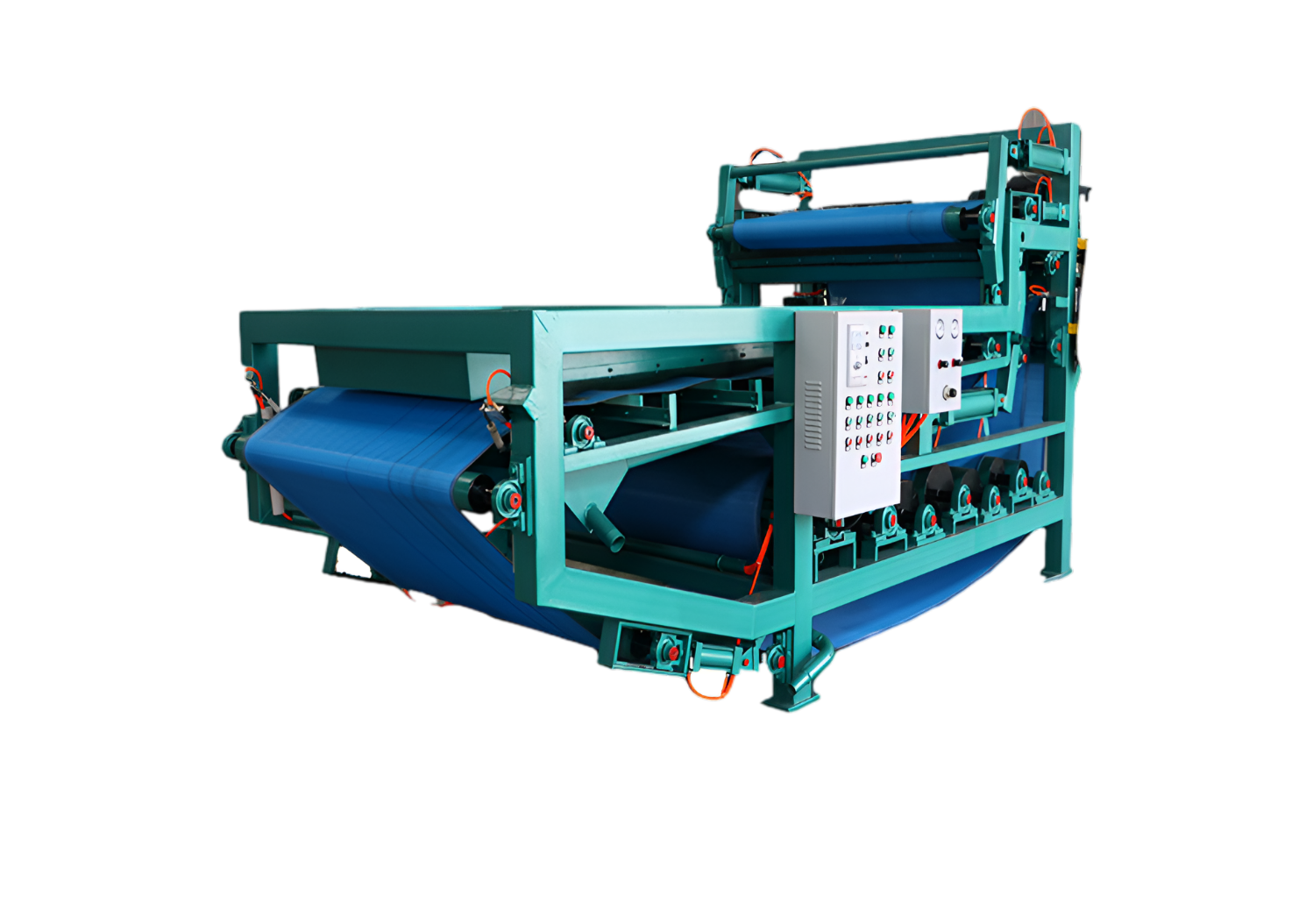
Belt Filter Press
Continuous dewatering for difficult or fibrous slurries.
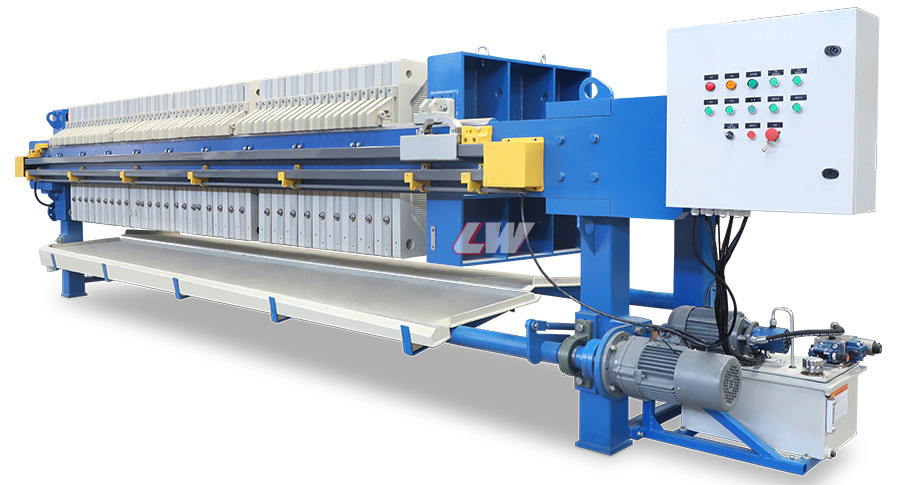
Membrane Filter Press
Secondary squeeze for the driest cakes in the family.

Mobile Filter Press
Skid-mounted press for temporary sites and pilot duty.
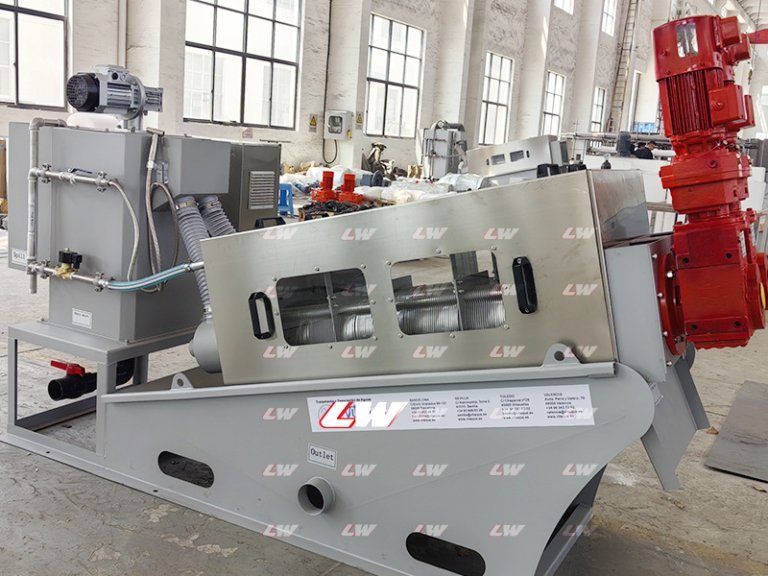
Dewatering Screw Press
Continuous mechanical dewatering for high-solids sludge.