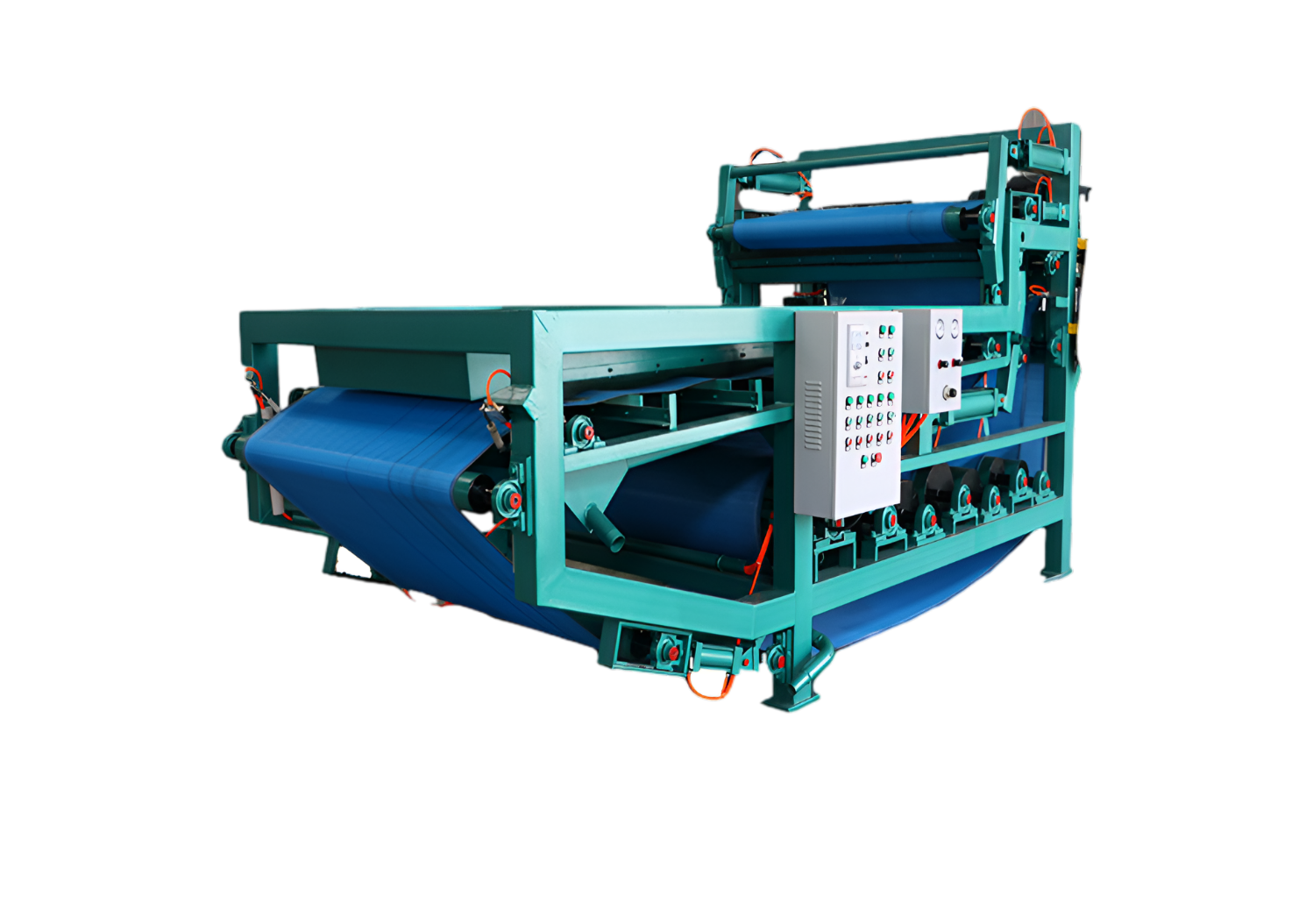
Sludge Dewatering Equipment, Explained by the Numbers.
Your sludge type sets your dryness ceiling. Your conditioning decides how much of it you reach. Your machine moves it a few points. This guide shows you those numbers — no brochure talk.
You Are Not Hauling Sludge. You Are Hauling Water.
Disposal is priced by tonne and by truck. Dewatering is a logistics problem — and the lever is pure arithmetic.
980 kgof every tonne at 2% DS is water
20%cake = 10.0 t/d hauled at 2 tDS/d
38%cake = 5.3 t/d hauled at 2 tDS/d
$51,600saved per year between those two machines
The first points are the most expensive. From 20% to 25% cake you stop hauling 2 of the 10 daily tonnes. From 35% to 40%, the same five points save just 0.7. That curve times your solids times your disposal rate is the real budget for this upgrade. For the machine side of that math — chamber count, filtration area, cycle time — see our filter press sizing & capacity calculation guide.
The proof, in one frame
From 98% Water to a Cake You Can Stack.
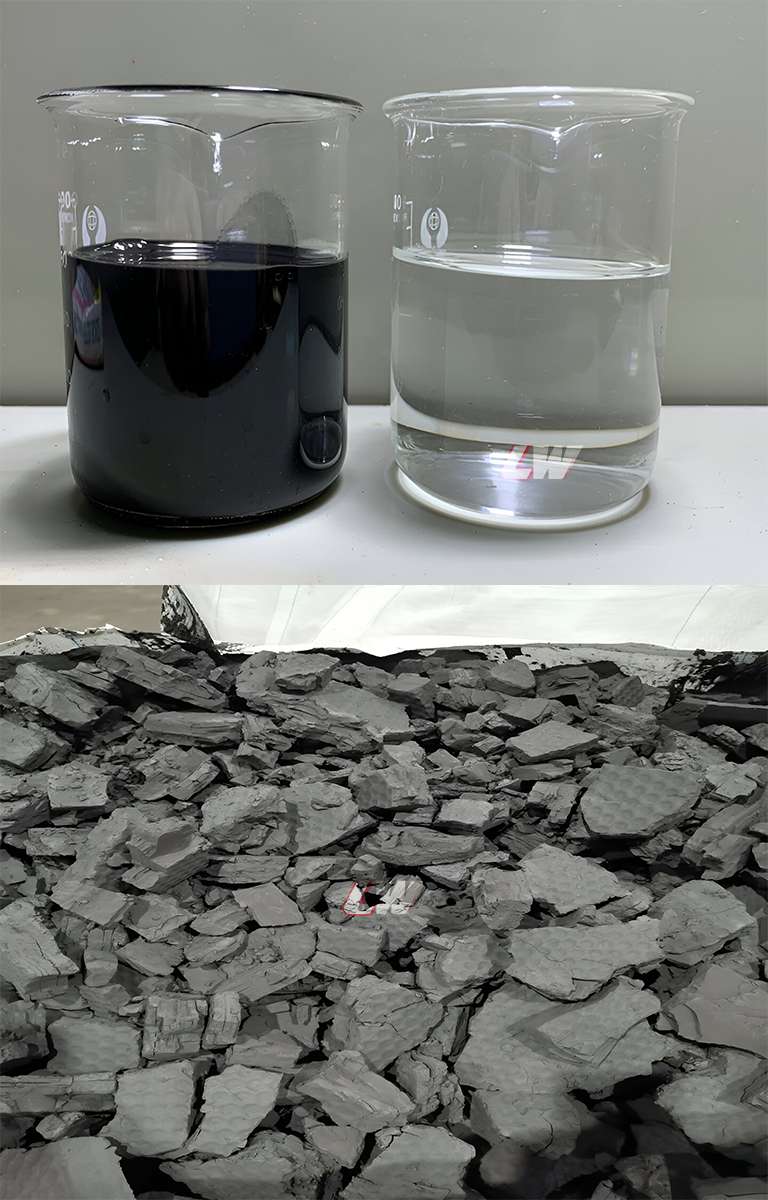
Same tonne of solids. The one on the left you pay to truck away as liquid; the one on the right stacks, spades and hauls for a fraction of the cost. That is the transformation dewatering buys.
010203
The same sludge, three states.
One sample, one pass. The dark liquor on the left is what enters the press; the clear liquor drains away; the cracked cake below is what you haul instead of water.
01
In — feed sludge2–4% dry solids. 96–98% of every tonne is water, and it is priced by the tonne.
02
Out — filtrateClear discharged liquor. Every litre leaving is a tonne you stop paying to haul.
03
Ship — dry cakeCracks, holds its shape, spades. Roughly 90% less water to move for the same solids.
Photo: Loway filter-press lab sample — the same sludge shown entering (2–4% DS), dewatering (filtrate) and finished (dry cake). Typical cake dryness shown for membrane-pressed and mineral sludges; your sludge determines where on the range you land (see Section 02).
Field footage · filter press
Watch: cake discharge at the end of a cycle.
This is the moment the arithmetic from Section 01 becomes a physical object. The cake leaves the press dry enough to crack, stack and ship — the filter pass did the selling, not a brochure.
Source: Loway filter-press project footage. On the live page, load this video lazy (preload on scroll) to keep the page fast.
02 — Start here, not at the machine
Your Sludge Type Sets Your Ceiling.
Most dewatering disappointment is a machine bought for the wrong sludge. Find your row, then find your press.
Ranges are typical published values for well-conditioned sludge on correctly sized equipment. Actual results depend on origin, conditioning and operation. A 5-litre sample tells us in a week which end of each range your sludge sits at.
The Evidence Rule: anyone who quotes you a guaranteed dryness before testing your sludge is guessing. Ask every vendor for the basis of their number. We publish ranges, then test before we quote.
Four Lab Tests That Predict Your Full-Scale Result
Every dewatering failure we are called into has the same root cause: a purchase made without filterability data. These four cost almost nothing relative to the machine.
Test
What it measures
How to read it
TS / VS Total & volatile solids
The mass balance your whole project is sized on. Volatile fraction flags biological character.
VS above ~75% predicts difficult dewatering. Also fixes your polymer dose basis in kg/tDS.
CST Capillary suction time
How fast water leaves the sludge — a 10-minute filterability screen.
Under 20 s: presses easily. 20–60 s: workable with conditioning. Over 60 s: fix the conditioning before choosing the machine.
SRF Specific resistance to filtration
The cake's resistance to flow under pressure — the classical filtration number.
Below ~5×10¹¹ m/kg: filter-press friendly. Above ~10¹³: long cycles or change conditioning.
Bench press + polymer curve
A lab plate press at several polymer doses — the only test that produces an actual cake.
Predicts full-scale cake DS within a few points, and sets your dose baseline. This is the test we run on every submitted sample.
Test methods we follow: TS/VS and CST per Standard Methods (2710 G); SRF by the Coackley filter-leaf procedure; the paint-filter test referenced in the case below per EPA Method 9095B. Your lab report, not this table, is the sizing basis.
Conditioning Is Where Half Your Dryness Is Won or Lost.
A perfectly selected press on badly conditioned sludge will lose 5–10 points. This is the cheapest performance you will ever buy.
1 · Polymer type
Cationic polyacrylamide, 40–60 mol% charge density, for biological sludge. Metal hydroxide and oily sludges often respond better to ferric chloride + lime.
2 · Dose ranges
Primary 1.5–3 kg/tDS · blended 3–5 · digested 3–6 · metal hydroxide 4–8. Outside these bands, suspect something upstream before the press.
3 · Make-down & mixing
0.1–0.3% active, 30–60 min maturation, then 30–60 s rapid dispersion followed by gentle flocculation. Mixing energy matters as much as dose.
4 · Feed consistency
A blend tank ahead of the press is not optional at variable plants. Feed swinging 1% to 4% swings your cake dryness right with it.
Both directions cost you. Under-dosing sends fines through the cloth into your filtrate. Over-dosing builds gluey flocs that blind the cloth and squeeze a wet, sticky cake with a dry crust and a wet core.
05 — The machine, finally
How the Five Machines Actually Compare
Read the "watch out" column honestly. It is where most buyer's remorse lives.
Not a final dewatering step — do not buy it as one
Filtrate numbers assume normal conditioning and sound cloth/screen condition. Press filtrate returns to the head of the works — it is a hydraulic load, part of the plant mass balance.
How to Dewater Sludge: What a Complete System Contains
The press is the visible 30%. The other 70% is what makes its performance repeatable on Tuesday morning after a long weekend.
01Screening 3–10 mm
Rags, wipes and plastics are the #1 cause of pump, valve and cloth failures downstream.
02Blending & equalization
Consistent feed DS is the single biggest controllable variable in cake dryness.
03Polymer make-down
Paced to flow and density, not a timer. Automatic stock switching for unattended sites.
04Thickening if feed < 2%
A drum or gravity belt ahead of the press roughly halves the machine size you need to buy.
05Dewatering machine
Press, belt or screw — chosen from Sections 02 and 05, not a brochure.
06Cake conveyance
Shaftless screw or conveyor to skip or truck. Cake that re-liquefies in the bin wastes everything upstream.
07Filtrate + PLC
Filtrate returns to the head of the works. Fully automatic sludge dewatering systems sequence cycles, washes and faults unattended.
08Why the rest matters
We quote systems, not machines, because the machine alone is what fails in year two.
07 — The arithmetic applied
Three Decisions, Run Through the Numbers
Illustrative projects. Numbers are representative, not a specific plant.
Municipal wastewater sludge dewatering · blended primary + WAS
50,000 PE plant — membrane press over belt press
1.8 t/ddry solids at 3% feed DS
32% vs 21%cake DS, membrane vs belt
−2.9 t/dhauled cake (5.6 vs 8.6 t/d)
~$29k/yrdisposal saving at $30/t, 330 d/yr
Bench press showed 30–33% achievable with 4.2 kg/tDS cationic polymer. Blending primary into WAS improved drainability (Section 02). The higher capex pays back in roughly year three at this plant's per-tonne price — on a per-m³ contract it would not have.
Industrial · Lime neutralization sludge
Chemical plant — chamber press, zero polymer
25 m³/dneutralization sludge at 6% DS
52%cake DS, no polymer dosing
2.9 t/dcake output (vs 5.4 on prior centrifuge)
Passpaint-filter liquids test — landfill-direct
Dense lime sludge self-conditions (Section 02, row 5). The driver was not hauling cost but regulation: the centrifuge cake at 28% failed the paint-filter free-liquids test and needed solidification at $18/t. The chamber press runs polymer-free with clear filtrate returned to neutralization.
Mining · Fine tailings
Aggregate washing plant — membrane press for dry stacking
180 m³/htailings at 18% solids
82%stacked cake DS
>90%process water recovered to washing
0 dischargedependency on tailings pond
Here the machine choice was set not by disposal price but by water balance: every m³ not recovered from the cake had to come from the wash-water circuit. High feed solids and abrasive character made plate specification (Section 05) the critical item.
Close the loop on Sections 02–04
Send Us 5 Litres. Get Your Numbers, Not a Brochure.
Ship a sample and our lab runs the full sequence from this guide: TS/VS, CST, SRF, polymer screening and a bench-press cake — reported as the dryness range your sludge can defend, with the sizing behind it. Seven working days.
My cake is 4–6 points wetter than the pilot run. What changed?
Almost always one of four: feed solids swinging outside the design band, polymer make-down drift, cloth or screen fouling, or shortened cycles to chase throughput. Diagnose in that order — it covers about 90% of the calls we take.
Can WAS be dewatered without polymer?
Almost never. Well-digested sludge sometimes presses at reduced dose, but raw WAS will blind a cloth in minutes at full scale. The honest lever is dose optimization via the bench curve (Section 03), not elimination.
Should we thicken before dewatering?
If your feed is below ~2% DS, yes — machine size scales roughly with flow, so a drum thickener can halve the press you need. Above 3–4% feed solids, thickening adds cost without benefit.
Does blending primary with WAS actually help?
Yes, measurably. Primary fibers form drainage channels through the blended cake — it dewaters better than WAS alone on almost every machine type. The cheapest dryness upgrade most plants own and never use.
How much does the membrane squeeze really buy?
Typically 5–10 points over an equivalent chamber press at the same cycle length. Whether it is worth the capex is purely your disposal arithmetic (Section 01).
What filtrate quality should we expect — and where does it go?
Presses: below 500–1,000 mg/L suspended solids. Belt and screw presses: 1,500–2,500 mg/L. All of it returns to the head of your works — it must be in the plant mass balance, not assumed away.
Continue the engineering
Go Deeper on the Machine You Narrowed To
The product pages carry the specifications and configurations; the industry pages apply this same sludge-first logic to your sector. Locate your row above, then go one level deeper on the route that fits.
We Would Rather Lose the Order Than Guess Your Dryness.
Loway is a sludge dewatering equipment manufacturer building filter presses, belt presses, screw presses and screening for industrial and municipal solid-liquid separation — specified from sludge data, not catalogs. Send the sample; we will tell you what your sludge can do before you commit capital.