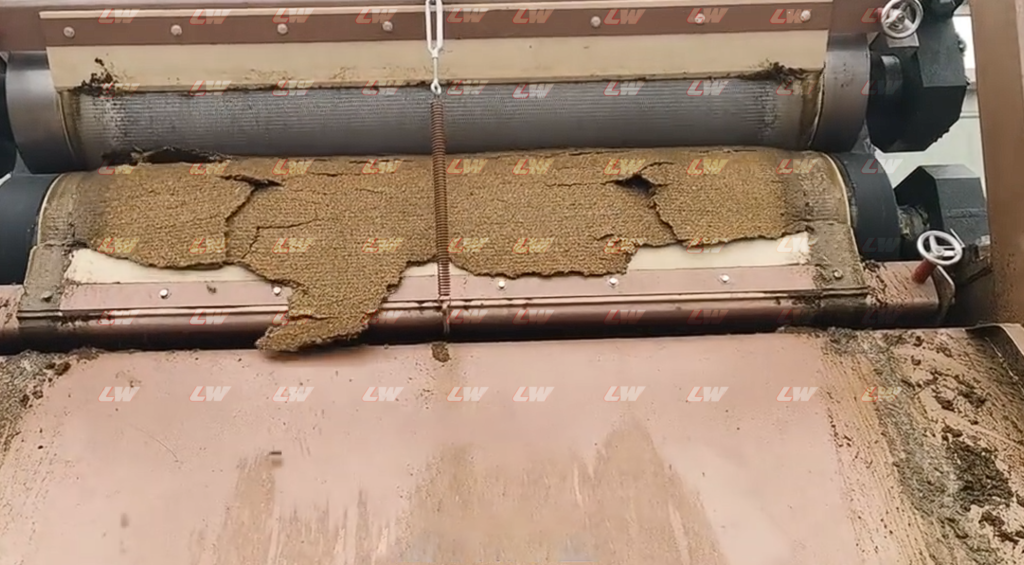
• Scale: 5,000 Head Dairy Farm • Daily Capacity: 300 Tons of Raw Manure • Equipment: Loway High-Pressure Belt Filter Press Series (Heavy-Duty)
The Challenge: The client was operating under significant financial pressure due to the rising cost of sand bedding and strict local environmental discharge limits. With raw manure moisture at 85%, traditional screw presses could not lower the moisture enough for immediate reuse, leading to massive stockpiles and odor issues. They required a solution that could turn this liability into a sterile, usable asset.
Pre-treatment: Automated removal of large debris to protect downstream equipment.
Deep Dewatering: We deployed our signature 8-roller system. By applying hydraulic pressure up to 200kg, we mechanically forced out capillary water that standard machines miss.
Thermal Process Integration: The output solids (50% moisture) are immediately fed into a 65°C+ high-temperature aerobic fermentation system. This 24-hour cycle ensures the complete elimination of pathogens like E. coli and Salmonella.
Bedding Self-Sufficiency: The farm now produces 120 tons of hygienic bedding daily. The material is fluffy, highly absorbent, and has improved cow lying time and comfort.
Energy Generation: Excess solids are mixed with straw (7:3 ratio) to create biomass pellets with a calorific value of 14MJ/kg, replacing 1,200 tons of coal annually for the farm’s heating boilers.
ROI Verification: With $570k in annual combined savings and revenue, the project achieved a full ROI in 1.8 years.
Case Study 02: The Efficiency Model
Reducing OpEx by 40% for Mega-Farm Operations via Managed Services
Project Overview:
• Scale: 6,870 Head Stock (Industrial Scale) • Model: Third-Party Managed Service (BOO Model) • Key KPI: Cost per ton & Discharge Compliance
The Challenge: For this mega-farm, logistical efficiency was paramount. Traditional manure handling was labor-intensive and costly ($8.00+/ton). The client needed a “hands-off” solution that guaranteed compliance and bedding supply without distracting from their core business of milk production.
Our Technical Solution: The facility utilizes Loway’s High-Pressure technology as a Secondary Dewatering Stage.
Process Stability: Unlike batch processing, our system runs continuously. The automated belt correction and self-cleaning nozzle systems allow for 24/7 operation with minimal human supervision.
Chemical Optimization: Through precise PAM (Polyacrylamide) dosing control, we optimized the flocculation effect, reducing chemical consumption to just $0.17/ton.
Dramatic Cost Reduction: Total processing cost was driven down to ~$4.90/ton, a 40% reduction compared to the previous operational model.
Environmental Compliance: The system achieved a true “Zero Discharge” loop. 100% of the solids are reused as bedding or fertilizer, and the filtrate is recycled, reducing the farm’s carbon footprint by 3,000 tons/year.
Reliability: The equipment has maintained an uptime of >98%, ensuring the farm never faces a waste backlog.
Case Study 03: The Cooperative Model
Centralized Processing Hub: Driving Community Wealth through Bio-Resources
Project Overview:
Structure: Regional Cooperative serving 3 distinct farms (3,200 Head Total)
Focus: Commercial Organic Fertilizer & Fuel Production
The Challenge: Individual small-to-mid-sized farms often lack the capital for advanced waste treatment. This cooperative needed a centralized, robust machine capable of handling varying manure consistencies from different sources while producing high-value commercial products to subsidize operational costs.
Our Technical Solution: We installed a rugged, high-throughput Loway Belt Filter Press designed for versatility.
Adaptive Controls: The system can adjust belt speed and pressure to handle fluctuations in influent sludge consistency.
Product Versatility: The dewatered cake (50% moisture) is the perfect baseline for two product lines: 1. Premium Fertilizer: Mixed with humic acid and trace elements to create N-P-K granules. 2. Bio-Fuel: Compressed into high-density fuel rods for local heating.