Step 1 · Solids load
Turn slurry flow into dry solids per day
Feed slurry is mostly water. The number that drives the whole design is the dry solids mass per day:
MDS = Qfeed × ρfeed × CDS
MDS = dry solids, kg/day · Qfeed = feed volume, m³/day · ρfeed ≈ 1000 kg/m³ · CDS = feed solids fraction (3% = 0.03).
Example: 60 m³/day at 4% DS = 60 × 1000 × 0.04 = 2,400 kg DS/day. Typical feed solids by sludge type are tabulated in the data section.
Sludge density is close to water below ~5% DS. Above that, measure density rather than assuming 1000 kg/m³.
Step 2 · Cake target
Set the cake dryness your downstream step needs
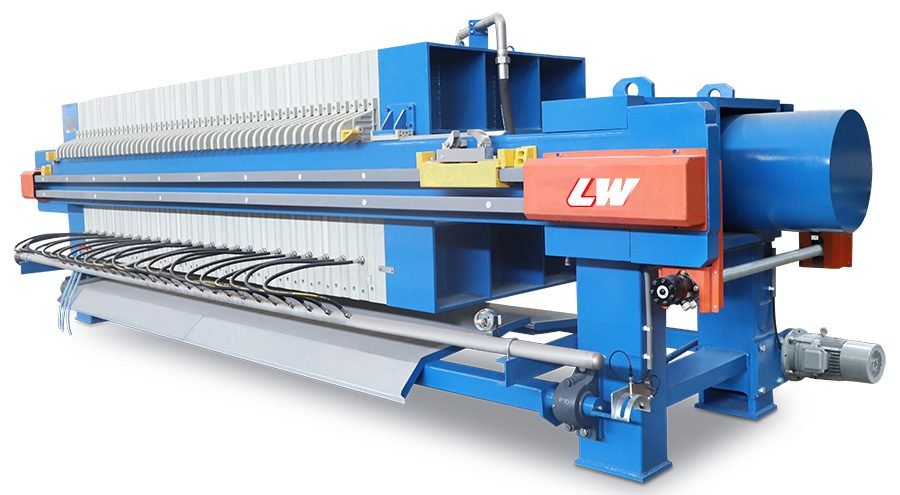
The cake dryness target is dictated by disposal or recovery — landfill rules, incineration feed, haulage cost or a downstream drying step. It also decides the press type:
- Need 28–35% DS (typical municipal disposal) → recessed chamber filter press.
- Need 35–45% DS (lower haulage, incineration, high-value recovery) → membrane filter press with a squeeze stage.
- Cake must be dry enough to stack or pass a paint-filter test → plan a pilot to prove it.
Wet cake mass per day is simply the dry solids divided by the cake fraction:
Mcake = MDS ⁄ Ccake
Mcake = wet cake, kg/day · Ccake = target cake DS fraction (35% = 0.35).
Never promise a cake dryness without knowing your sludge. Conditioning chemistry (lime, ferric, polymer) and pressure dominate the result — see cake moisture & dry solids.
Step 3 · Chamber volume
Calculate the chamber volume you must install
A filter press chamber is a mould: one cycle fills it with cake, and the next cycle cannot start until it is emptied. So the required chamber volume is set by the wet cake volume per cycle:
Vch = ( MDS ÷ Ncyc ) ÷ ( Ccake × ρcake ) × F
Vch = required nominal chamber volume, m³ · Ncyc = cycles/day · ρcake = wet cake bulk density, kg/m³ (≈1000 + 4 × cake DS%) · F = design factor ≈ 1.25 (covers ~90% chamber utilisation plus ~10–15% operating reserve).
Chambers are never filled to 100% — cake compacts, cloth seats, and the pack settles. The combined design factor keeps the press honest on a bad week.
⚠️Rule of thumb check: a full municipal cake carries roughly 300–460 kg of dry solids per m³ of nominal chamber volume at 28–42% cake DS. If your arithmetic lands far outside that band, re-check the cake dryness or the feed solids figure.
Step 4 · Plate pack
Choose plate size and count, then read off the filtration area
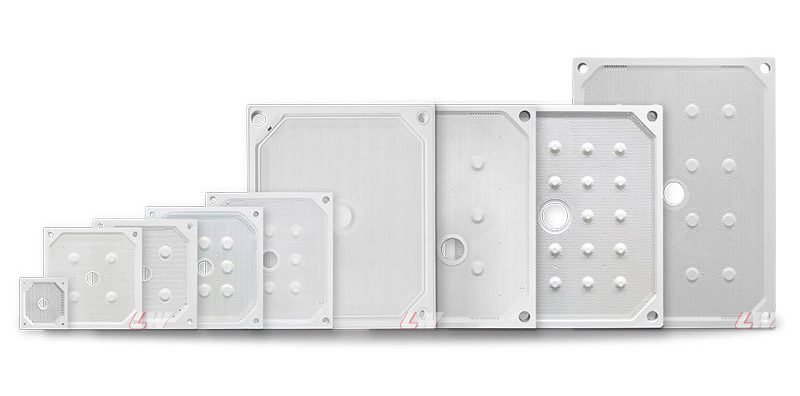
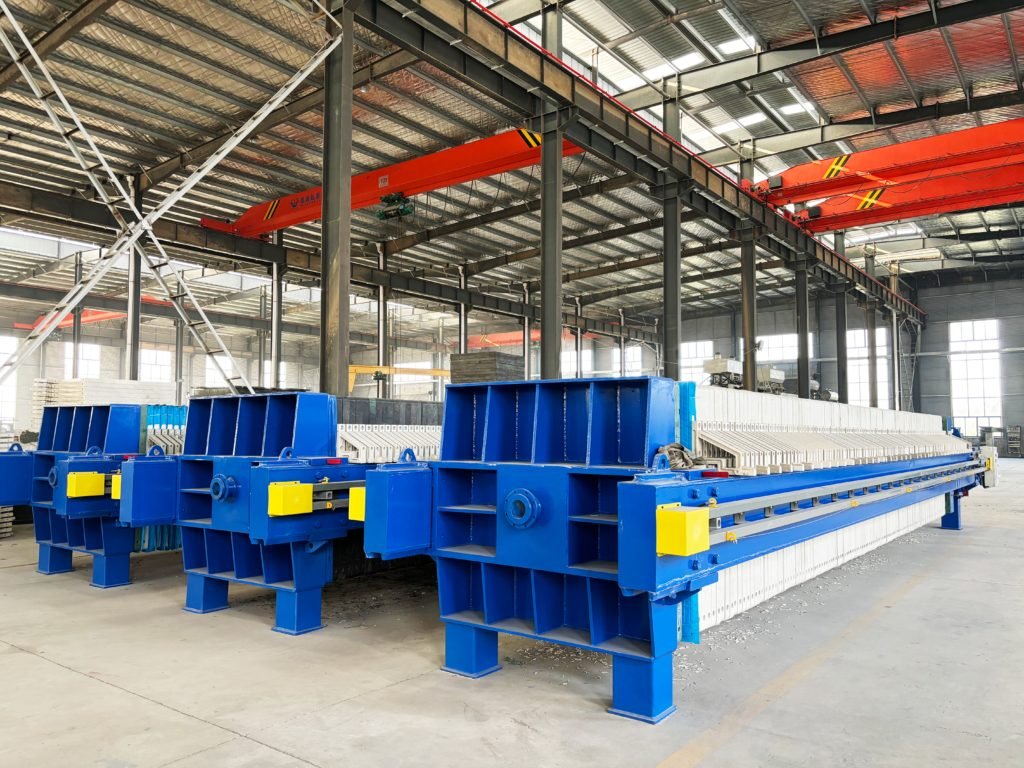
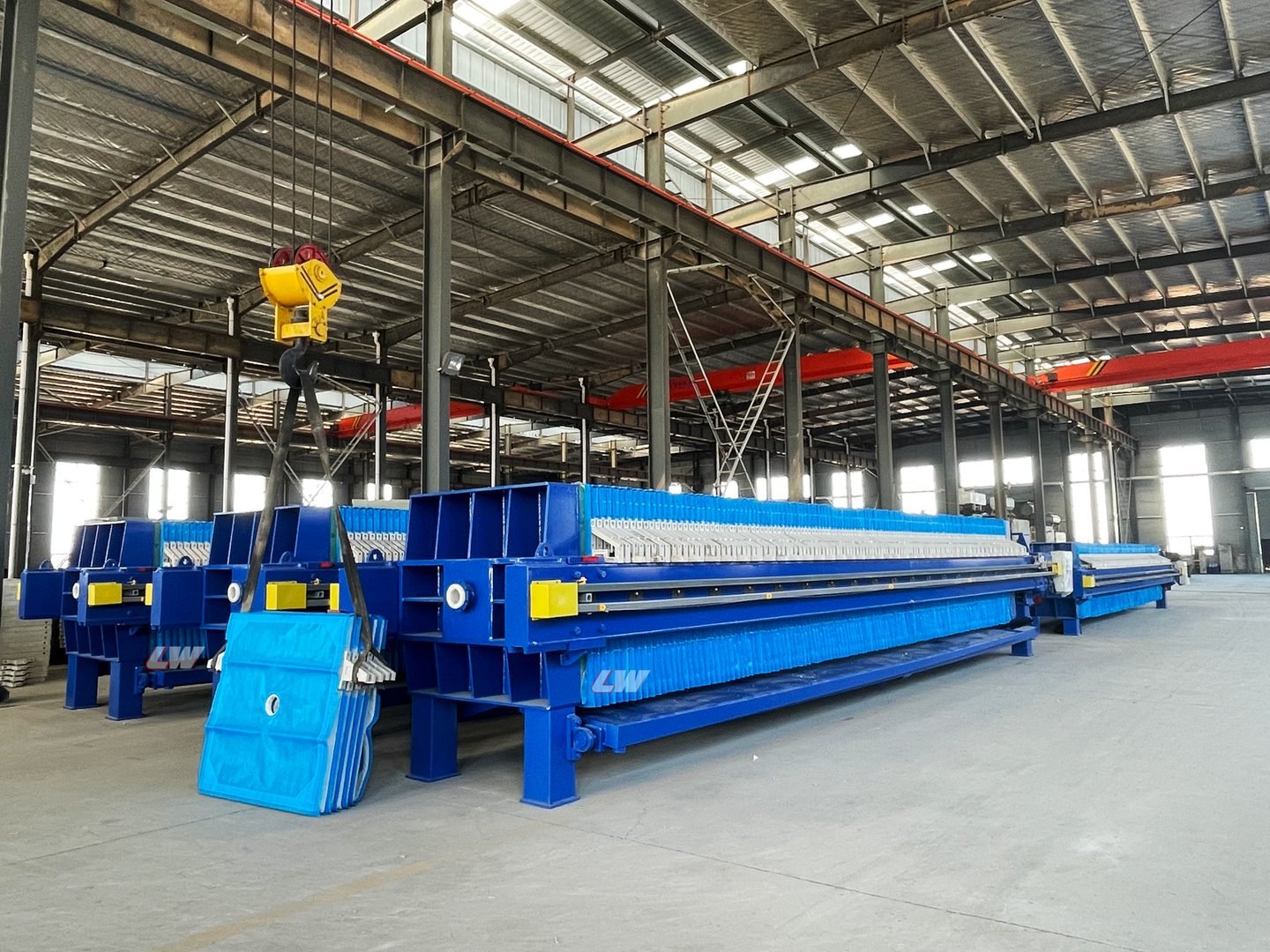
Chamber volume is delivered as a plate pack. Pick a plate size that fits your building and budget, then divide the required volume by the volume per chamber of that plate family — in plain terms, this answers the everyday question of how many plates the press needs:
Plates ≈ Vch ÷ Vplate → Atotal ≈ Plates × Aplate
Vplate = nominal chamber volume per plate · Aplate = filtration area per plate. Indicative values for 30 mm recessed chamber plates are in Table 2.
Round up to a realistic plate count (most presses run an even number) and re-check that the installed volume still exceeds the step-3 requirement. Larger plates reduce plate count and footprint but increase cloth area per chamber and press cost — a trade-off your budget decides.
Filtration area drives hydraulic capacity (how fast a cycle can run); chamber volume drives cake capacity (how much cake a cycle holds). Size the chamber first, then confirm area with the loading check in step 5.
Step 5 · Duty check
Check the cycle against your working day
The press must complete Ncyc full cycles in the available operating hours, including feed, squeeze, cake blow, opening, discharge and cloth wash:
tcycle,max = Operating hours per day ÷ Ncyc
If the required cycle is longer than the available window, you have three levers (see below): add cycles by shortening the cycle, add chamber volume, or reduce the per-cycle duty. A final hydraulic sanity check: most full-chamber municipal cycles load roughly 10 kg DS per m² of cloth area (range ~7–15 depending on feed solids and cake depth) — a useful flag when a quoted press looks either heroic or timid.
Cycle time is a function of filterability, not just volume. For fast-filtering mineral slurries the same press may cycle in 40 minutes; for hard-to-filter biological sludge the fill phase alone can exceed two hours. This is exactly why sludge testing precedes firm quotes.