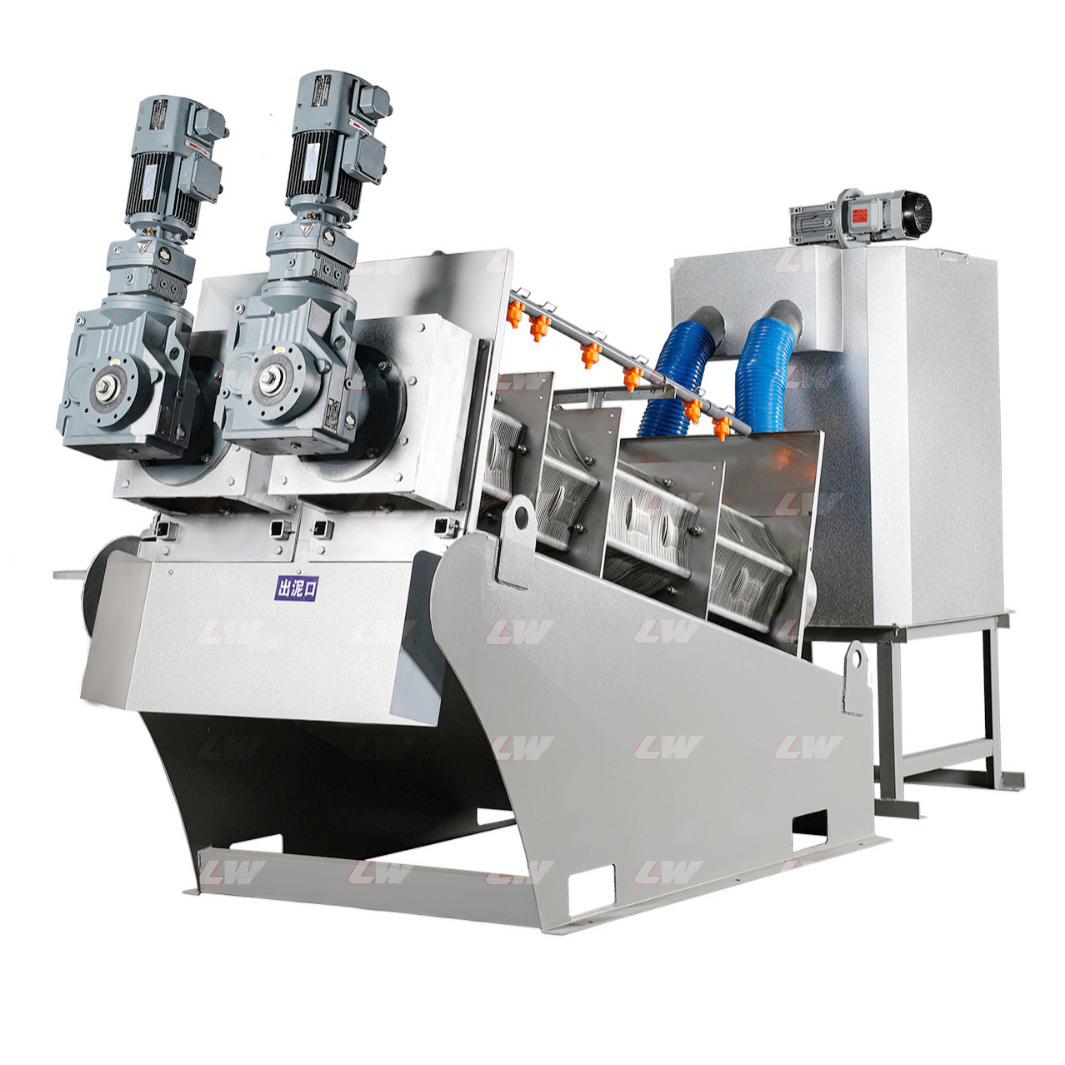
Internal Rotary Drum Fine Screen Loway Equipment

The Filtration Challenge Most Standard Equipment Doesn't Solve

Engineers working on advanced wastewater treatment, water reclamation, or industrial pretreatment projects know the usual filtration options well — fiber disc filters, sand filtration, membrane systems, basic microscreens. Each has its place, but none of them cover every situation.

Fiber disc filters rely on cloth media that fouls quickly when wastewater carries oil or coarse fiber, and the filter cloth needs frequent replacement, which adds up in operating cost. Sand filtration requires significant civil works and floor space, the media tends to compact over time, and backwashing consumes more water and power than most operators would like. Standard drum microscreens use a single continuous screen, so a localized blockage means shutting down the whole unit for repair. Ultrafiltration and microfiltration membranes deliver fine separation, but they come with a high upfront and maintenance cost, and a spike in influent suspended solids can damage the membrane fibers.

The gap shows up most clearly on projects with long fibers, distillery or brewery solids, fine plastic fragments, limited site space, tight civil budgets, or a requirement for continuous operation without downtime. These are exactly the conditions where conventional filtration equipment tends to underperform — clogging media, incomplete backwash, or simply too large a footprint for the site.

How the R Series Rotary Drum Filter Is Built to Address This

Loway Equipment’s R Series rotary drum filter was developed specifically for this middle ground — wastewater that’s too demanding for standard screens but doesn’t necessarily need a full membrane system.

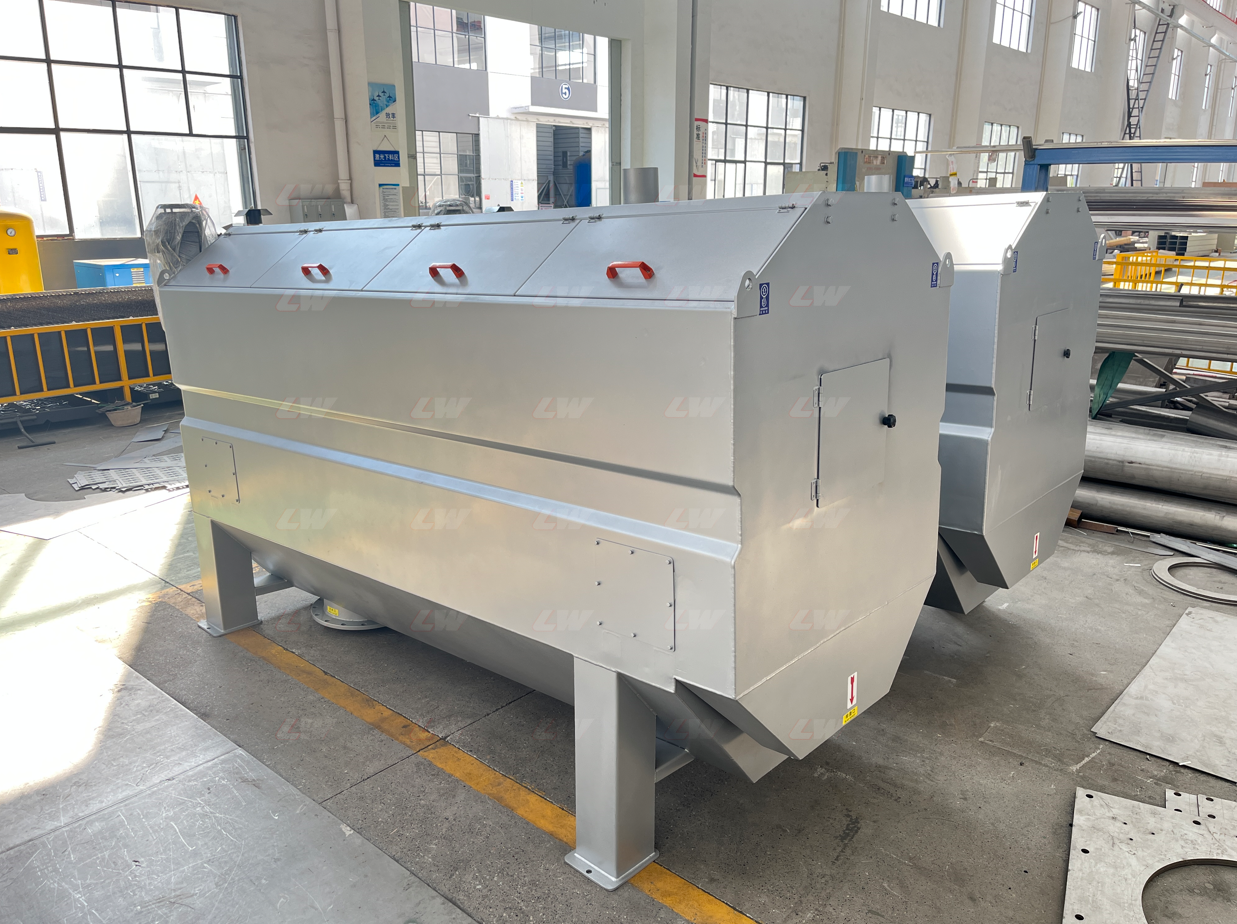
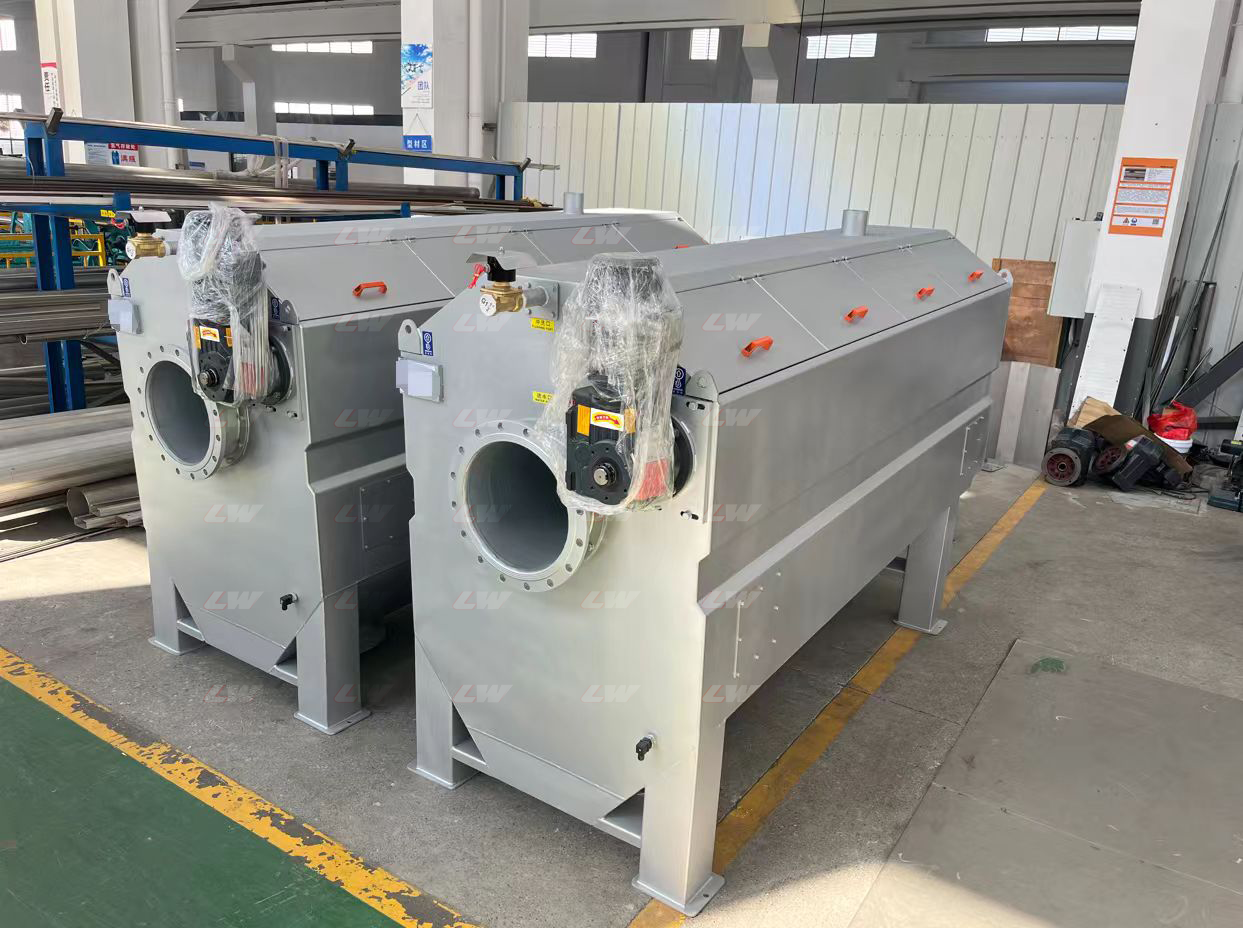
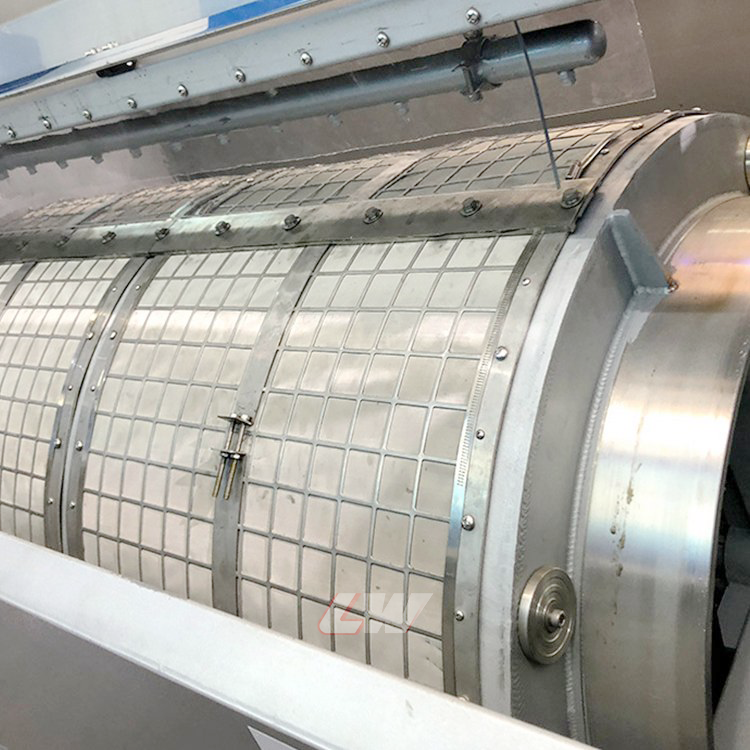
The unit uses an inside-in, outside-out flow path: wastewater enters through the drum’s center, solids are captured on the inner wall of the stainless steel screen, and clarified water exits from the outside. The drum rotates at a steady, slow speed while a high-pressure spray bar backwashes the screen from above at the same time — filtration and backwash run continuously, without interrupting the treatment process.

Several design choices target the specific weak points found in other equipment:

  • Screen material and modularity. The filter screen is built from 316L stainless steel, available in R100, R200, and R300 sizes with mesh openings from 10μm to 100μm depending on the required discharge quality. Instead of one continuous screen, each drum is assembled from 4, 8, or 12 individual segments — if one segment is damaged, it can be swapped out in about 30 minutes without dismantling the whole unit.
  • Housing options for different corrosion levels. The housing is available in 304 stainless steel for municipal or food-grade neutral wastewater, full 316 stainless steel for textile dyeing, chemical pickling, or high-salinity coastal applications, and a carbon steel epoxy-coated option for short-term or temporary sites where budget matters more than service life.
  • Self-cleaning under load spikes. The spray system uses a fan-shaped, evenly distributed nozzle layout that draws filtered water to backwash the screen from the inside. Even with influent SS spiking to 50mg/L, the screen continues to clear itself without clogging or producing turbid effluent.
  • Quiet, continuous-duty drive. The gearmotor is an imported brand paired with a reinforced stainless steel drive chain and submerged bearings with no exposed components, keeping operating noise under 40dB — suitable for unattended sites or facilities without night-shift staff.

Four Application Areas Where the R Series Fits Best

Unlike general-purpose filtration equipment that’s built for one type of wastewater, the R Series rotary drum filter is designed around a specific set of high-solids, high-fiber conditions. Four industries account for most of its installations:

  • Food & beverage, distillery pretreatment. In breweries, distilleries, and food processing plants, the drum filter captures spent grain particles and food fiber before they reach downstream biological treatment. Because the screen is stainless steel rather than fabric, it holds up under the organic fermentation environment without degrading, and in some setups the captured organic solids can be recovered rather than simply discarded — reducing the load on the biological treatment stage that follows.
  • Textile, synthetic fiber, and paper wastewater pretreatment. Cotton lint, pulp fiber, and other short fibers are a common cause of pump fouling and clogged downstream equipment in textile dyeing and papermaking operations. Placed ahead of dissolved air flotation or screw press units, the drum filter intercepts these fibers early, preventing them from wrapping around pump impellers or building up in equipment further down the line.
  • Aquaculture and surface water treatment. For recirculating aquaculture systems and river or lake water treatment, the filter removes algae, suspended sediment, and aquatic debris to help maintain water clarity. It’s also a practical alternative to traditional sedimentation basins in situations where site space is limited.
  • Industrial circulating cooling water and water reclamation. In industrial parks, the drum filter captures pipe scale, rust particles, and fine colloidal matter from circulating cooling water or reclaimed water streams — protecting heat exchangers and membrane components downstream, and reducing how often chemical dosing and equipment cleaning are needed.

Working as Part of a Treatment Train

Many engineering firms specify the R Series alongside a bar screen, fiber disc filter, and screw press as a complete pretreatment package. The drum filter’s role at the front of the line is to remove coarse fiber and solids first, which takes meaningful load off the finer filtration equipment downstream and improves the stability of the whole treatment process — something a single piece of equipment can’t achieve on its own.

Model

Nominal Flow

Mesh Opening

Screen Segments

Housing Options

LWRDF100

10 m³/h

10–100 μm

4

304 / 316 SS / Carbon Steel Epoxy

LWRDF R200

Mid-range

10–100 μm

8

304 / 316 SS / Carbon Steel Epoxy

LWRDF R300

up to 300 m³/h

10–100 μm

12

304 / 316 SS / Carbon Steel Epoxy

Selection Guidance: Matching the Right Configuration to Your Project

Choosing the right R Series configuration comes down to a few practical questions about your water quality, site conditions, and operating requirements.

  • High fiber or solids content in the influent. If the wastewater carries a significant amount of fiber, distillery residue, or fine plastic fragments, the R Series is generally a better fit than a fiber disc filter — cloth media in that environment tends to wrap, foul, and wear out faster, which raises long-term operating cost.
  • Corrosive or high-salinity conditions. For coastal sites, chemical pickling wastewater, or other acidic/alkaline environments, the full 316 stainless steel configuration is worth the upgrade over standard 304. In long-term exposure, 304 housing and screens are more likely to develop pitting or perforation over time.
  • Limited site space or retrofit projects. For older treatment stations being upgraded, or sites where civil works are difficult or costly, the skid-mounted, all-in-one configuration avoids the large-scale concrete construction that sand filtration or basin-based systems require.
  • Membrane systems downstream. If the treatment train includes MBR or ultrafiltration further downstream, installing an R Series unit ahead of the membrane stage helps intercept hard, fine particulates before they reach the membrane fibers — extending membrane service life and reducing the frequency of membrane cleaning or replacement.
  • Continuous, unattended operation. For sites that need to run 24 hours a day with minimal staff on-site, it’s worth specifying the full automatic backwash system with level-differential control, rather than relying on manual or timer-only backwash — this reduces how often an operator needs to be physically present.

    Not sure which configuration fits your water? Loway Equipment can run a free lab-scale trial on a water sample from your site — checking fiber, oil, and sediment content — to recommend the right mesh size and configuration before you commit to a quote.

Built and Tested In-House, Not Assembled from Outsourced Parts

A common issue with rotary drum filters on the market is that they’re assembled from outsourced screens and housings without full-system testing — which is where problems like solids leakage and drivetrain issues tend to show up after a few months in the field.

Loway Equipment handles the R Series from structural design through stainless steel screen fabrication to final assembly in-house. Every unit goes through a 72-hour water-load test before shipping, checking backwash pressure, screen sealing, and drive stability against spec — units that don’t pass aren’t shipped.

  • Standardized range, available as stock. The lineup runs from the small-flow R100 (10m³/h) up to the large-flow R300 (300m³/h) as standard, ready-to-ship configurations. For tight sites or old-channel retrofits, a shortened skid-mounted version can also be built to fit.
  • PLC control with multi-equipment integration. The electrical control system runs on a variable-frequency PLC, supporting both level-differential and timer-based backwash logic. It can also be linked with bar screens, DAF units, or screw presses from the same production line, and the control panel is available in both Chinese and English — relevant for both domestic projects and export orders.
  • Transparent pricing and support. Quotes are itemized with no hidden markups. Core components — drive motor, backwash pump, and electrical control — carry a one-year warranty, and replacement screens are supplied long-term at factory pricing rather than through a marked-up aftermarket channel. After-sales support is available through a nationwide service network.

Where the R Series Fits in Your Treatment Process

Purpose-built filtration equipment for high-fiber, high-suspended-solids wastewater is still relatively hard to find — most options on the market are designed around more general conditions. That’s the specific gap the R Series rotary drum filter is built to fill.

With a no-consumable stainless steel screen, continuous filtration and backwash, a compact footprint, and configurations suited to food & beverage, textile, aquaculture, and industrial water reuse applications, it works well both as filtration for a new treatment line and as a replacement for aging microscreen or fiber disc equipment that’s no longer keeping up.

Get a configuration recommendation. Share your daily flow rate, the type of solids or fiber in your wastewater, and your available site dimensions, and Loway Equipment’s technical team can put together a recommended configuration along with a detailed factory quote — free of charge.

Get a Configuration & Quote | Talk to Our Technical Team

Automatic washing filter press equipment for solid liquid separation Industry application Loway factory China

Ready to Optimize Your Filtration Process?
Contact our team of filtration specialists today to discuss how our filter press solutions can address your specific solid-liquid separation challenges. From process assessment to custom configurations, we’re here to help you achieve maximum efficiency and product quality.

Need filter press proposal

schedule a consultation with our filtration experts

Contact Information