Industry Applications · Food & Pharmaceutical
Two Filtration Duties in Every Food and Pharmaceutical Plant
One stream is the product — juice, oil, syrup, fermentation broth — and the machine behind it is judged on clarity and recovered yield. The other stream is the water leaving the plant, and that machine is judged on running continuously through greasy sludge. A food industry filter press and a sludge belt press usually end up in the same plant, doing different jobs.
The split
The product line and the water line
One is measured in clarity and recovered yield. The other is measured in tonnes hauled and hours of uninterrupted running. A food industry filter press picked for the first job is the wrong pick for the second, which is why the split comes before the equipment.
The product line
The stream is the product. Contact parts can be supplied in 304 or 316L stainless steel on request, and the cycle is tuned for clarity, wash and yield rather than raw throughput. Batch presses live here.
Juice · Edible oil · Sugar · Starch · Beer · Fermentation broth
The water line
The stream is on its way out. Food effluent runs greasy: a DAF unit strips fats, oils and grease into a float sludge, and the biological stage grows its own sludge behind it. Flocculated, continuous, large-volume. Belt presses live here.
DAF float · Biological sludge · Wash water
A pharmaceutical filter press and a sludge belt press can sit in the same plant, correctly equipped, without ever swapping jobs.
The product line · food
Four duties a food industry filter press covers
Each one presses for a different reason, and each is sized from a different variable. What they share is that the liquid or the cake is the product itself.
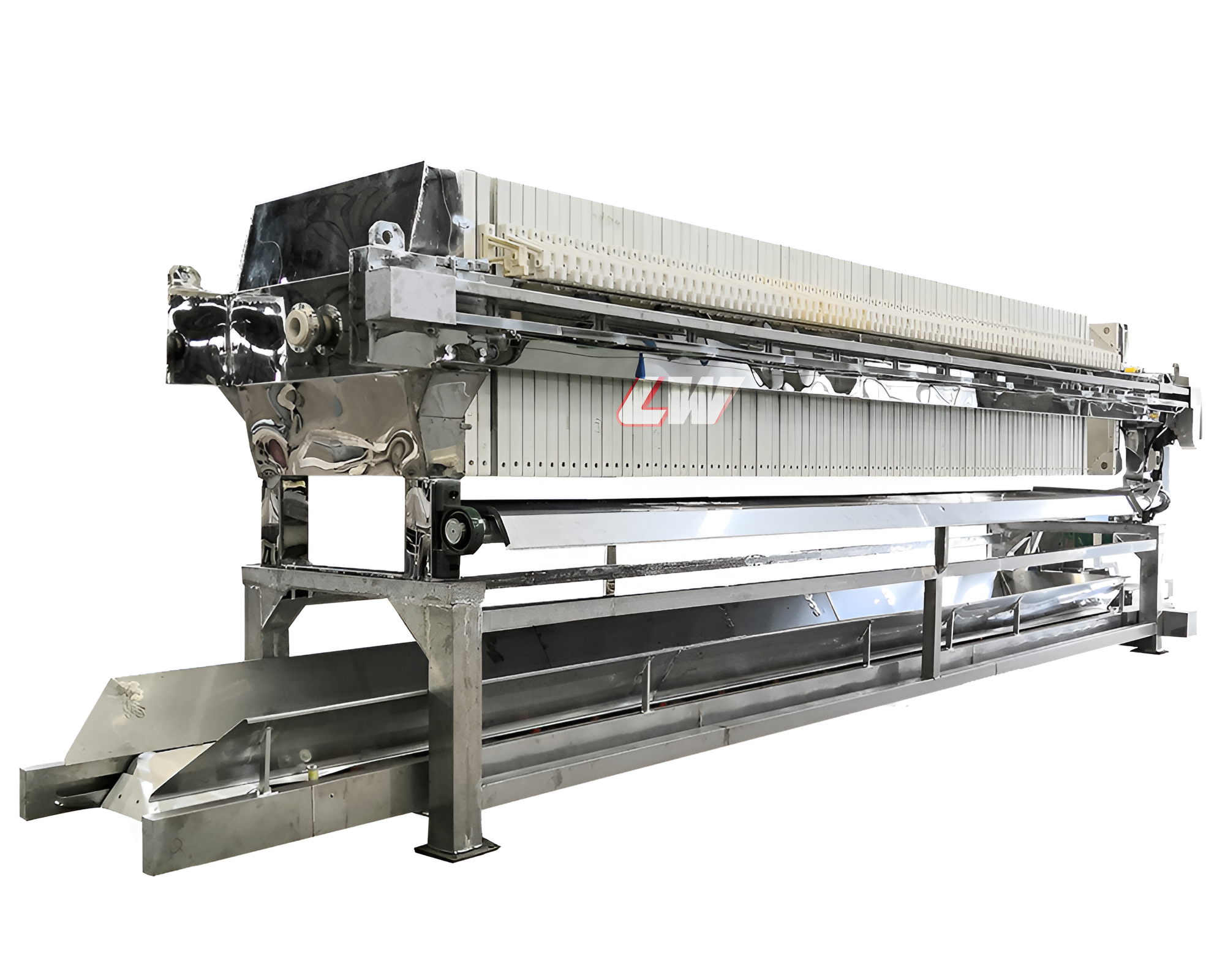
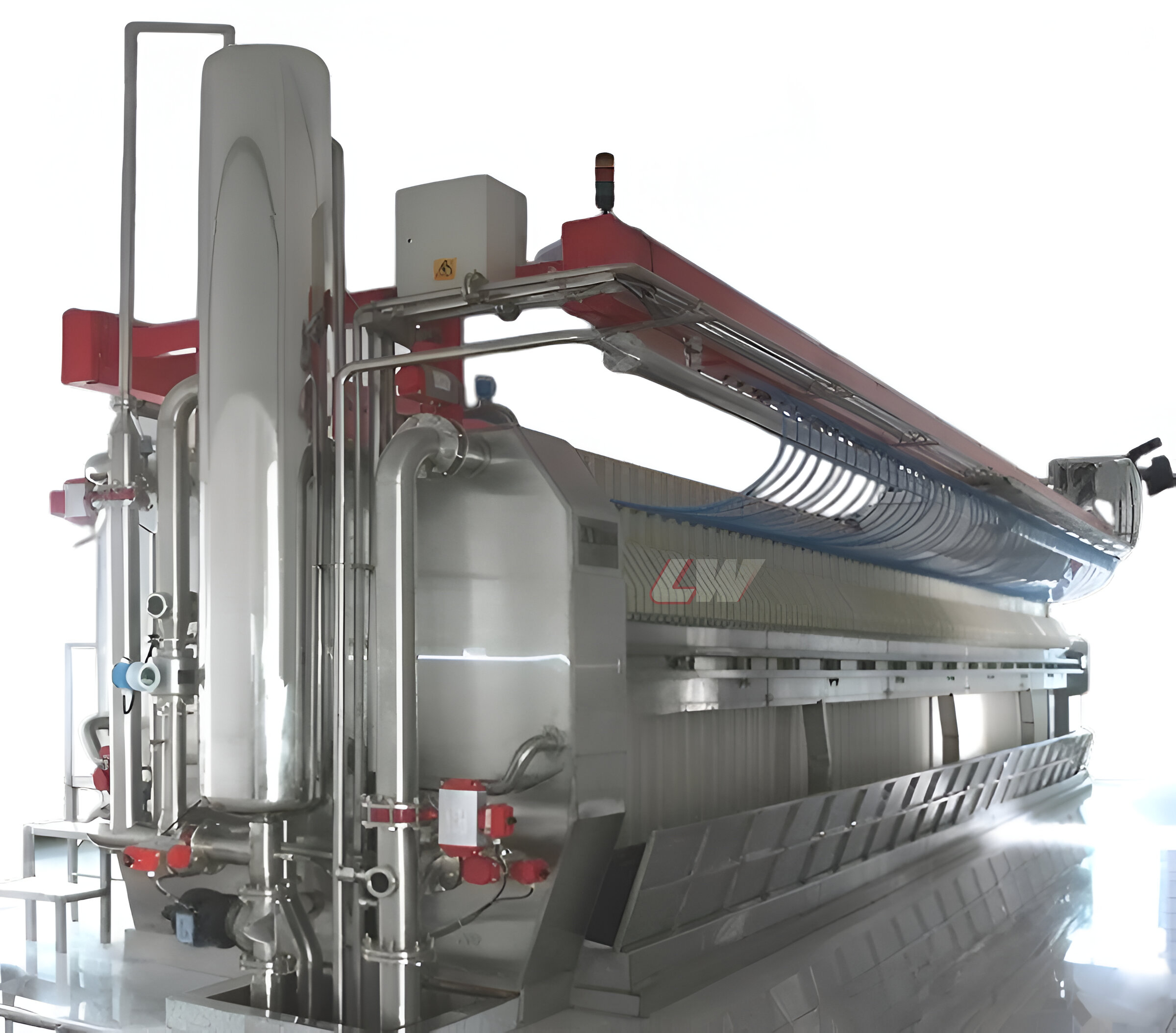
Fruit juice
Pulp and pectin make fresh juice cloudy. After enzyme treatment the juice runs through a chamber press with a diatomaceous earth precoat, and the filtrate goes straight to pasteurising and filling. Clarity is the specification.
Edible oil
Sunflower and similar oils carry waxes that cloud in the cold. Winterisation crystallises them out, and the press runs cold to hold the crystals back while the clear oil passes. The oil stays bright on the shelf.
Sugar and starch
Lime clarification in a sugar plant leaves a mud that still carries sugar, so the cake is washed before it leaves the press. Starch plants dewater their slurry into a cake heavy enough to handle. The wash recovers product either way.
Beer and distilling
Mash filtration separates sweet wort from spent grains, and presses dewater trub and surplus yeast. Spent grain leaves at 30 to 40% solids, heavy enough to haul straight to a feedlot.
The range behind these duties:Membrane filter pressRecessed chamber filter pressAutomated filter press
The product line · pharma
Three pharmaceutical filter press duties, specified on structure and material
We keep this to what a pharmaceutical filter press is built from: contact parts in 304 or 316L stainless steel on request, surfaces finished smooth so residue has nowhere to sit, and cloths that come out singly for cleaning between batches.
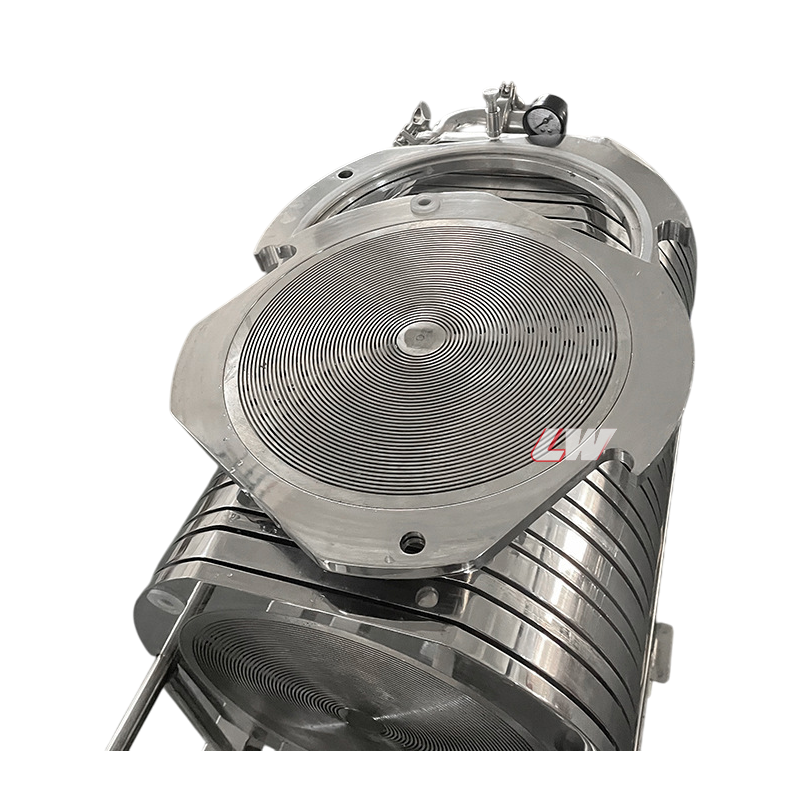
Fermentation broth
Antibiotic fermentations end as a broth of mycelium and mother liquor. A pharmaceutical filter press separates the two so both report to their next step: the solids discharge whole and the liquor runs clear enough to concentrate.
Herbal extraction
Herbal extraction leaves a fibrous residue behind. The press keeps the extract moving and the residue out, in a structure that opens up for cleaning between batches.
API crystals
Crystallised product has to leave its mother liquor. Membrane plates squeeze the liquor back out, and the cake discharges in one piece for drying.
Where the duty is fine clarification rather than dewatering, a pharmaceutical filter press is built as a plate-and-frame pack: filter paper or boards instead of cloth, out and back in without tools.Plate-and-frame filter press
By-products
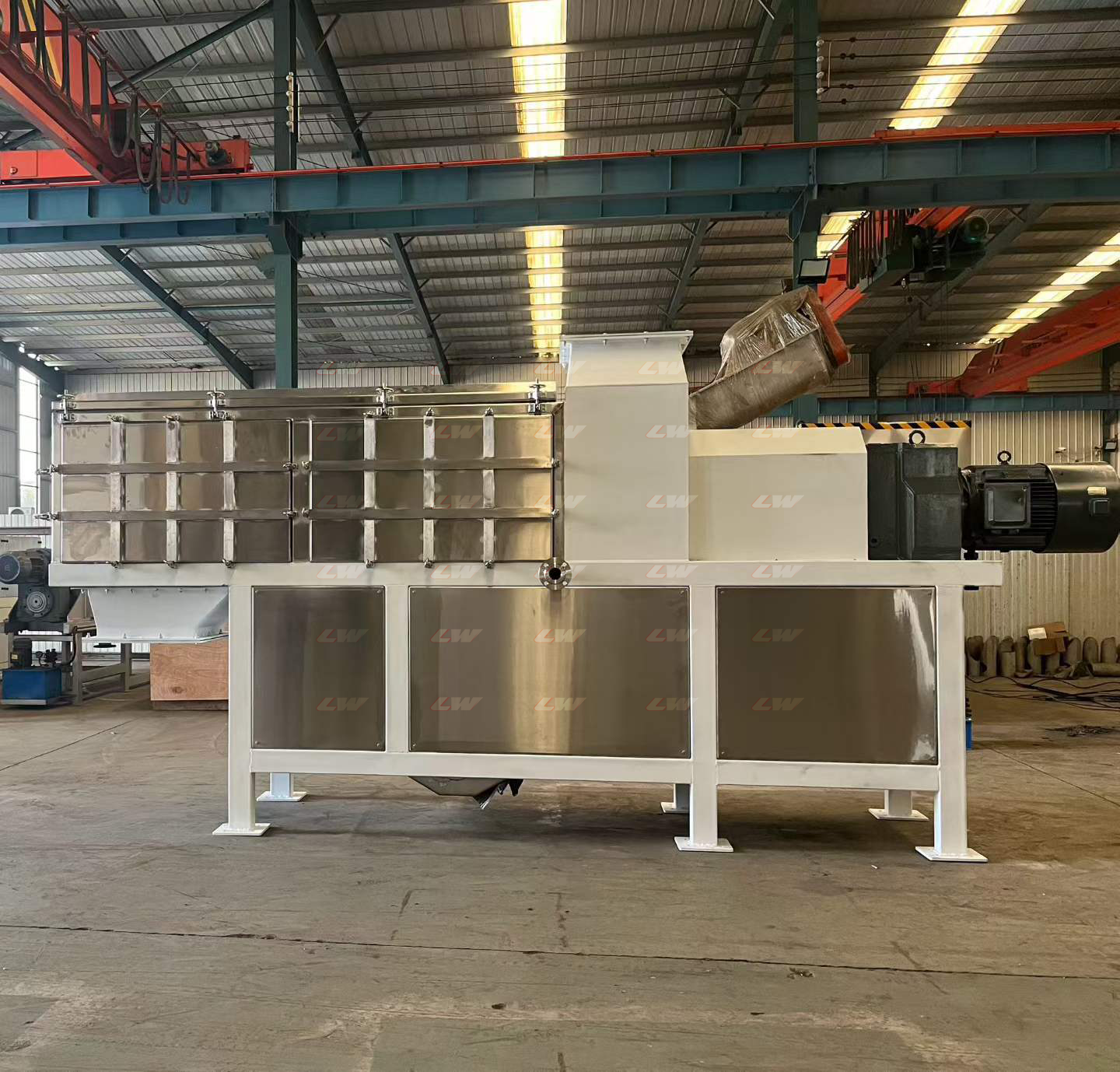
Continuous pressing for spent grain, pomace and residue: the multi-disc screw press
Not every stream suits a batch cycle. Fibrous by-products run continuously through a multi-disc screw press: no fill-and-open rhythm, just a steady feed in and a steady cake out. Most of these residues form their own filter mat and run without polymer; finer and more dilute streams may need a light dose.
What it takes
Wet, fibrous residue: spent grain and distillery grains, fruit pomace, herb and tea residue. Fed by pump or conveyor at whatever rate the line produces.
What it returns
A cake at 40 to 70% moisture, light enough to move and dry enough for feed, biomass or compost, and a liquid stream that reports to treatment.
Where it sits
Between the process and the by-product shed, or ahead of a dryer when the residue is dried for sale. Stainless contact parts on request, as on a food industry filter press.
A food industry filter press and a screw press often work the same site: the press on the batch product duty, the screw on the continuous by-product stream.
The water line
Greasy sludge is a belt press duty
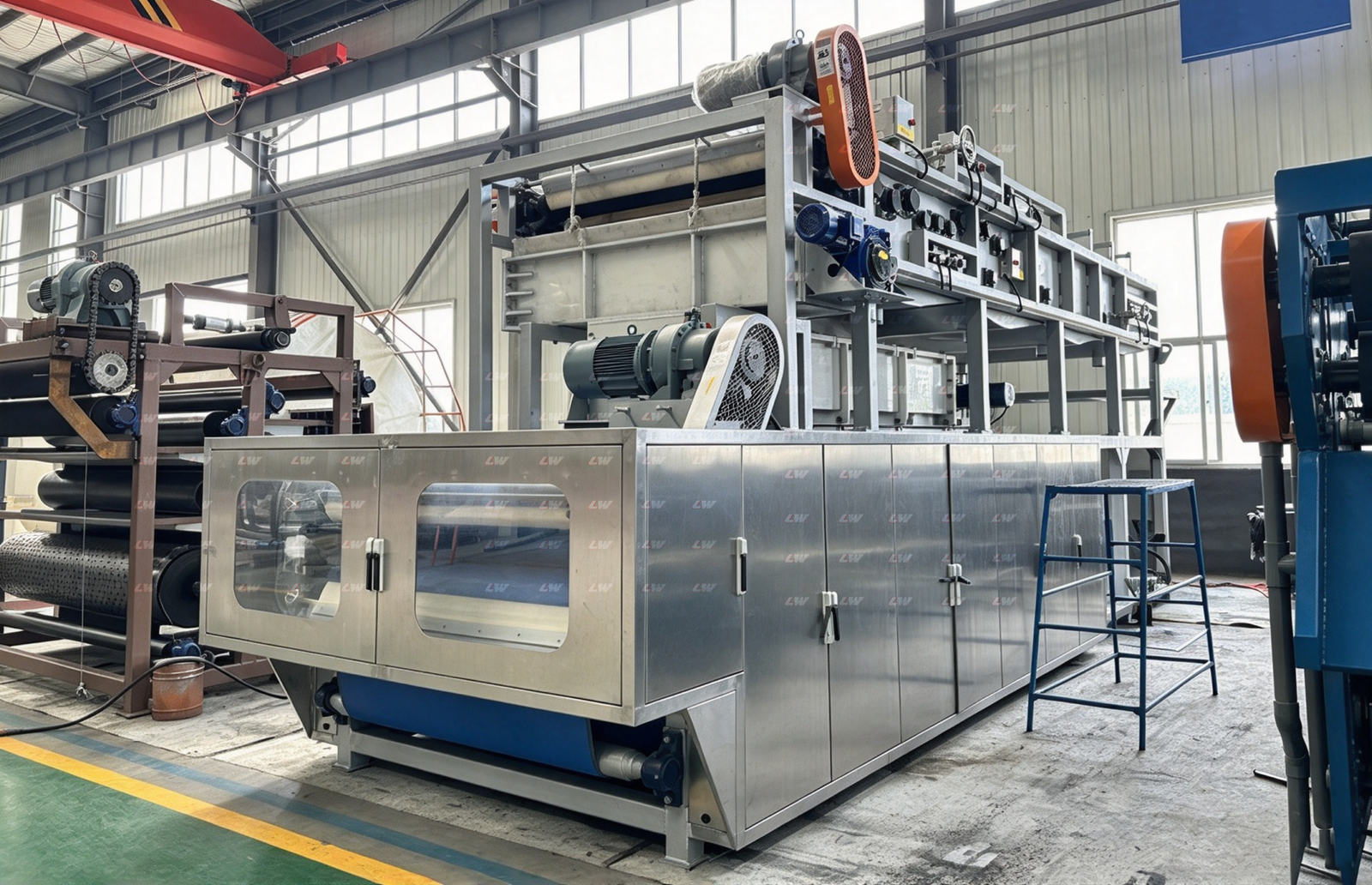
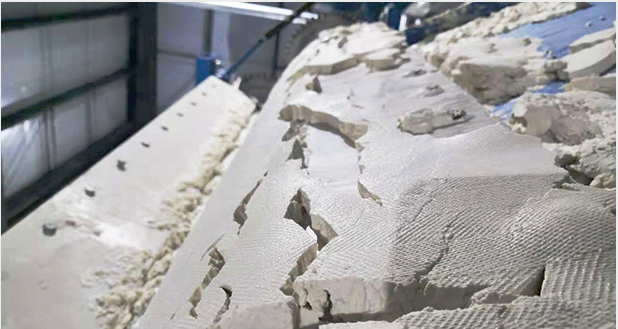
Food effluent is strong and fatty. The DAF float carries fats, oils and grease together with suspended solids, and the biological sludge behind it runs continuously at large volume. Both are flocculated before dewatering, and both belong on a belt filter press.
DAF float
Fats, oils and grease plus suspended solids, lifted as a float sludge. Flocculated ahead of the belt; the grease is exactly why it suits a continuous machine.
Biological sludge
Grown in the treatment stage behind the DAF, thin and continuous. A dilute feed, around 0.5 to 5% solids, is where the belt is at home.
The line between
Product streams stay off the belt. Juice, broth and oil are batch duties on a food industry filter press; the belt takes over where the water leaves the plant.
It is the same division a metallurgical plant runs: batch pressure filtration on the valuable stream, continuous dewatering on the way out.
Selection
Follow the material, not the catalogue
Read down the first column. The machine follows from three things: whether the stream is the product, whether the cake has to be washed, and whether the flow is batch or continuous.
Nine duties, four machine types, and the row order is the decision order on every food industry filter press enquiry.
Build & materials
What we specify, in plain terms
This section stays on structure and material: what a food industry filter press is made of and how it comes apart for cleaning. Compliance paperwork is a conversation for the enquiry, not a line on a web page.
Contact parts
Wetted parts can be supplied in 304 or 316L stainless steel. It is quoted against the liquor and the duty, not sold as a blanket upgrade.
Smooth structure
Frames and plate packs are specified with smooth, open surfaces, so cleaning reaches everything and residue has nowhere to sit.
Cloths and boards
Cloths come out singly for washing or changing between batches. A plate-and-frame pack holds filter paper or boards where the duty is fine clarification.
Spares at order
Cloths, boards and feed pump wear parts are listed with the order, so the first change is planned rather than improvised.
Delivery & support
What arrives with the machine
Four items agreed before the order decide how a food industry filter press behaves once it reaches your plant.
Layout drawings
General arrangement and interface drawings come first, so civil and piping work starts while the machine is still in our workshop.
Spares set
Cloths, boards and pump wear parts are listed at order, matched to the duty, so the first changeover is planned.
Commissioning
Our engineers fill the first batch, run the first wash and open the first cake with your operators. The crew that starts it with us runs it without us afterwards.
Cloth stock
Product duties blind cloths faster than sludge duties. A spare set on the shelf turns a lost batch into a short change.
FAQ
Questions from food and pharma projects
Why two kinds of filtration in one plant?
Because the two streams are judged differently. Product filtration is judged on clarity and recovered yield, and runs in batches. Effluent filtration is judged on tonnes hauled and hours of continuous running. A single machine type is a compromise at one of those jobs, so plants with a full circuit usually run both.
Can you supply stainless steel contact parts?
Yes. On both the food industry filter press and the pharmaceutical filter press ranges, wetted parts can be built in 304 or 316L stainless steel on request. It is quoted against the liquor and the duty, because temperature and chemistry decide how far the upgrade needs to go.
What can a pharmaceutical filter press handle?
Fermentation broth, herbal extraction residue and crystallised product are the three regular duties. What we can state on structure and material is on this page: stainless contact parts on request, smooth surfaces, cloths that change out singly, and plate-and-frame builds that hold filter paper or boards.
How dry does spent grain get?
On a multi-disc screw press the cake leaves at 40 to 70% moisture depending on the material, continuous, and most fibrous residues run without polymer. On a food industry filter press, spent grain reaches 30 to 40% solids. The choice follows the volume and what happens to the cake next.
Why is the belt press the one for food effluent?
Because the sludge is greasy, flocculated and continuous. A DAF float carries fats, oils and grease, and a belt runs through that all day on a dilute feed. Product streams stay off it, which keeps the two duties apart.
What do you need to quote one?
The stream, the solids in it, the temperature, and the target: clarity for a product duty or dryness for a residue. Say whether the contact parts should be stainless or polypropylene, and a food industry filter press can be quoted from there.
Send the stream and the target
For the product line, that is the stream, the solids in it and the clarity or dryness you need from the food industry filter press. For the water line, it is the flow and the grease load. Either one starts the sizing.