

<!doctype html>
PLATE & FRAME FILTER PRESS · FINE FILTRATION & POLISHING
Plate & Frame Filter Press for Fine Filtration and Polishing
Flat plates and hollow frames alternate in the pack, filter paper or fine pad sits on every plate face, and the press shuts the loop on the particles a chamber press lets through. Built for low-solids slurries where the filtrate clarity is the spec — edible oils, beverage clarification, electroplating rinse water, dye and intermediate solutions. Sized from your lab characterization, not a catalogue guess.
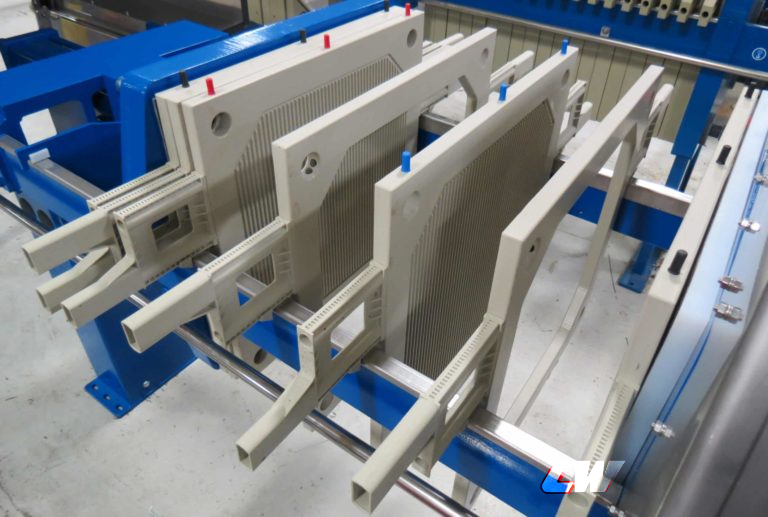
Where a Plate & Frame Press Fits in the Filter Press FamilyThree plate configurations, one factory, one engineering team
Loway builds recessed-chamber, membrane, and plate-and-frame presses in the same facility. Each suits a different particle-size window and dryness target. Use this map to confirm a plate-and-frame build is the right platform before you request a quote.
Chamber Filter Press
Recessed PP plates form sealed chambers. The standard build for mining tailings, municipal sludge, and chemical slurries when the cake is the product and the filtrate is a side stream. Simpler mechanism, lower capex.
Plate & Frame Press
Flat plates and hollow frames alternate in the pack; the filter medium is a flat sheet (cloth, paper, pad, or stack). Spec for low-solids feeds and high-clarity filtrate, not for maximum cake production. Smallest plate-to-plate cavities of the family.
Membrane Filter Press
Adds a flexible diaphragm behind the chamber face. A secondary squeeze step at 1.0–1.6 MPa trims another 10–15% moisture off an already-formed cake. Pick when disposal-volume — not filtrate quality — is the binding constraint.
Anatomy of a Plate & Frame PackPlate, frame, and filter medium — the three layers between feed and filtrate
Every cavity in a plate-and-frame press is the gap between a flat plate (or pad) and a hollow frame. The frame is the cake chamber. The plate is the drainage face. The medium between is where the actual separation happens. Six features to look at before sizing.
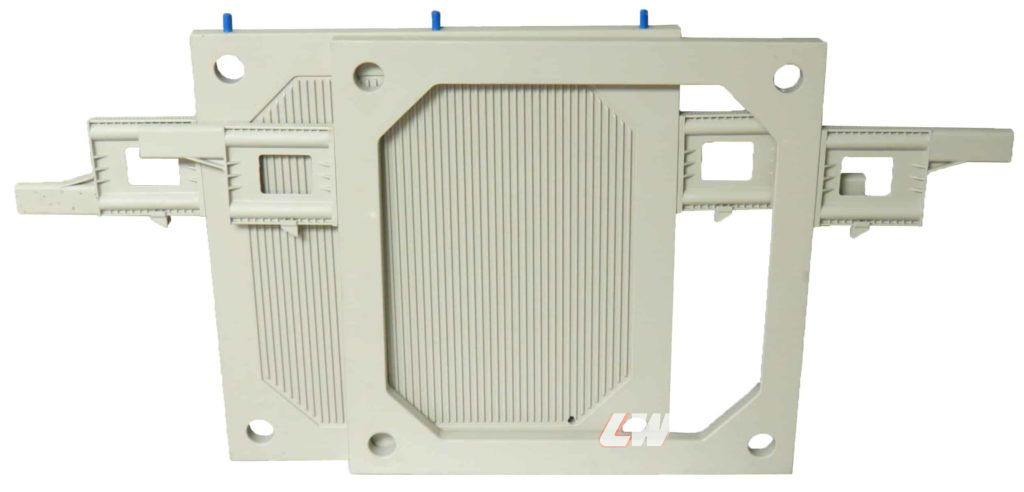
- Flat drainage plateVirgin PP, cast iron, or stainless steel. Grooved on the cloth face to channel filtrate to the corner drain — the pattern is straight ribs on the Loway standard plate.
- Hollow frameDefines the cake chamber. Frame depth — typically 20 mm, 25 mm, or 30 mm — sets the cake thickness. Cast in PP standard; SS304 / SS316L on request for edible and pharmaceutical duty.
- Filter medium on the plate faceOptional polypropylene cloth supports a finer layer on top: filter paper, membrane pad, nonwoven felt, or activated-carbon pad for colour stripping.
- Cloth & paper sandwichCloth below carries the paper for re-use across cycles; paper on top catches the finest particles and is the consumable, not the plate.
- Central feed boreSlurry enters through the bore in every plate and frame. The bore is sized larger than on a chamber press to keep low-solids feeds moving without plugging.
- Frame-to-frame sealA flat elastomer gasket between frame and plate carries the hydraulic closing load. EPDM standard; NBR, Viton, or PTFE-coated on request for solvent or hot duty.
How a Plate & Frame Filter Press WorksA four-step cycle, run with thin cake and a consumable medium
Steps one to three are the familiar filter-press cycle. The difference at step four is that the loose medium (paper, pad, or thin nonwoven) drops away with the cake. That is intentional: it lets the press pick up particles finer than any cloth-only build.
Close & seal the pack
The hydraulic cylinder drives the head plate against the stack. Every plate-to-frame face is loaded against a flat elastomer gasket, so the closing pressure is what keeps the cavities leak-tight during the cycle.
Fill & filter
The feed pump pushes slurry through the central bore; filtrate passes the paper, then the cloth, then drains out the corner port. Solids build as a thin cake inside every frame. The pack accepts low-solids feed (typically < 2% wt) where a chamber press would under-fill.
Wash (when required)
For soluble-removal duty (catalyst washing, sugar refining), wash liquid is pushed through the cake in a second pass. A frame-by-frame wash port on the 630 / 800 / 1000 mm series keeps wash volume per cavity balanced.
Open, drop paper, and discharge
The pack opens. Cake and the overlying paper (or pad) fall together onto the receiving tray — one motion per cavity, no scraping. Filter cloth stays in place; fresh paper is laid on the plate for the next cycle.
Plate Sizes and Filtration AreasStandard 500, 630, 800, 1000 and 1200 mm plate series — full tables below
All figures are typical values for a standard plate-and-frame build with hydraulic closing and cloth-on-paper sandwich. Smaller non-standard geometries and reinforced frames are available on request. Numbers below are based on our current production series; final sizing is confirmed by a bench test on your slurry.
| XA PFB18–70 / 800-U(BK) Plate & Frame Filter Press — Technical Parameters | ||||||||||
|---|---|---|---|---|---|---|---|---|---|---|
| Model | Filter area (m²) | No. of plates | No. of frames | Cake thickness (mm) | Frame volume (L) | Foundation length L (mm) | Total length L1 (mm) | Machine dimensions (mm) | Weight (t, ref.) | |
| Width | Height | |||||||||
| XA PFB18 / 800-U(BK) | 18 | 19 | 20 | 25 | 225 | 2680 | 2820 | 2050 | 1210 | ~3.0 |
| XA PFB24 / 800-U(BK) | 24 | 25 | 26 | 300 | 2980 | 3130 | ~3.9 | |||
| XA PFB30 / 800-U(BK) | 30 | 31 | 32 | 375 | 3280 | 3440 | ~4.7 | |||
| XA PFB36 / 800-U(BK) | 36 | 37 | 38 | 450 | 3580 | 3740 | ~5.5 | |||
| XA PFB42 / 800-U(BK) | 42 | 43 | 44 | 525 | 3880 | 4040 | ~6.3 | |||
| XA PFB50 / 800-U(BK) | 50 | 51 | 52 | 625 | 4280 | 4450 | ~7.3 | |||
| XA PFB60 / 800-U(BK) | 60 | 61 | 62 | 750 | 4780 | 4950 | ~8.5 | |||
| XA PFB70 / 800-U(BK) | 70 | 71 | 72 | 875 | 5280 | 5450 | ~9.7 | |||
| Plate 800 × 800 mm · frame 800 × 800 × 25 mm · feed bore Ø 80 mm · closing cylinder 1.6 MPa max. Cloth-on-paper sandwich; one paper sheet per cavity, replaced every batch. | ||||||||||
| XA PFB30–120 / 1000-U(BK) Plate & Frame Filter Press — Technical Parameters | ||||||||||
|---|---|---|---|---|---|---|---|---|---|---|
| Model | Filter area (m²) | No. of plates | No. of frames | Cake thickness (mm) | Frame volume (L) | Foundation length L (mm) | Total length L1 (mm) | Machine dimensions (mm) | Weight (t, ref.) | |
| Width | Height | |||||||||
| XA PFB30 / 1000-U(BK) | 30 | 31 | 32 | 25 | 375 | 3050 | 4660 | 2380 | 1380 | ~5.4 |
| XA PFB40 / 1000-U(BK) | 40 | 41 | 42 | 500 | 3500 | 5120 | ~6.9 | |||
| XA PFB50 / 1000-U(BK) | 50 | 51 | 52 | 625 | 3950 | 5580 | ~8.4 | |||
| XA PFB60 / 1000-U(BK) | 60 | 61 | 62 | 750 | 4400 | 6040 | ~9.9 | |||
| XA PFB72 / 1000-U(BK) | 72 | 73 | 74 | 900 | 4900 | 6550 | ~11.6 | |||
| XA PFB84 / 1000-U(BK) | 84 | 85 | 86 | 1050 | 5400 | 7060 | ~13.3 | |||
| XA PFB100 / 1000-U(BK) | 100 | 101 | 102 | 1250 | 6100 | 7770 | ~15.6 | |||
| XA PFB120 / 1000-U(BK) | 120 | 121 | 122 | 1500 | 7000 | 8680 | ~18.5 | |||
| Plate 1000 × 1000 mm · frame 1000 × 1000 × 25 mm · feed bore Ø 100 mm · per-frame wash port standard on PFB72 and larger. Cloth + filter-paper sandwich is standard; activated-carbon pad optional. | ||||||||||
All figures are typical for standard builds with hydraulic closing, cloth-and-paper sandwich, and manual paper change. Final numbers depend on frame count, medium selection, and slurry behaviour. Sizing is confirmed against a bench test on your sample at the Loway lab.
Smaller series: 500 and 630 mm plate sizes (pilot, lab, and small-batch duty)
| XA PFB3–12 / 500-U(BK) Plate & Frame Filter Press — Technical Parameters | ||||||||||
|---|---|---|---|---|---|---|---|---|---|---|
| Model | Filter area (m²) | No. of plates | No. of frames | Cake thickness (mm) | Frame volume (L) | Foundation L (mm) | Length | Width | Height | |
| XA PFB3 / 500-U(BK) | 3 | 11 | 12 | 20 | 30 | 1100 | 1335 | 705 | 835 | |
| XA PFB4 / 500-U(BK) | 4 | 15 | 16 | 40 | 1250 | 1485 | ||||
| XA PFB6 / 500-U(BK) | 6 | 21 | 22 | 60 | 1500 | 1735 | ||||
| XA PFB8 / 500-U(BK) | 8 | 27 | 28 | 80 | 1750 | 1985 | ||||
| XA PFB10 / 500-U(BK) | 10 | 33 | 34 | 100 | 2000 | 2235 | ||||
| XA PFB12 / 500-U(BK) | 12 | 39 | 40 | 120 | 2250 | 2485 | ||||
| Plate 500 × 500 mm · frame 500 × 500 × 20 mm · working stroke 360 mm. Common on edible oil and beverage clarification lines; sanitary cloth + filter-paper sandwich, all contact parts SS304 / SS316L on request. | ||||||||||
| XA PFB8–30 / 630-U(BK) Plate & Frame Filter Press — Technical Parameters | ||||||||||
|---|---|---|---|---|---|---|---|---|---|---|
| Model | Filter area (m²) | No. of plates | No. of frames | Cake thickness (mm) | Frame volume (L) | Foundation L (mm) | Total length | Width | Height | |
| XA PFB8 / 630-U(BK) | 8 | 19 | 20 | 25 | 100 | 2200 | 2580 | 900 | 1000 | |
| XA PFB12 / 630-U(BK) | 12 | 29 | 30 | 150 | 2700 | 3080 | ||||
| XA PFB16 / 630-U(BK) | 16 | 39 | 40 | 200 | 3200 | 3580 | ||||
| XA PFB20 / 630-U(BK) | 20 | 49 | 50 | 250 | 3700 | 4080 | ||||
| XA PFB24 / 630-U(BK) | 24 | 59 | 60 | 300 | 4200 | 4580 | ||||
| XA PFB30 / 630-U(BK) | 30 | 73 | 74 | 375 | 4900 | 5280 | ||||
| Plate 630 × 630 mm · frame 630 × 630 × 25 mm · working stroke 360 mm. Common in pharmaceutical intermediates, dye solutions, and small chemical plants where filtrate is the spec — not the cake. | ||||||||||
| XA PFB60–200 / 1200-U(BK) Plate & Frame Filter Press — Technical Parameters | ||||||||||
|---|---|---|---|---|---|---|---|---|---|---|
| Model | Filter area (m²) | No. of plates | No. of frames | Cake thickness (mm) | Frame volume (L) | Foundation L (mm) | Total length | Width | Height | |
| XA PFB60 / 1200-U(BK) | 60 | 41 | 42 | 30 | 900 | 4200 | 5780 | 2790 | 1620 | |
| XA PFB84 / 1200-U(BK) | 84 | 57 | 58 | 1260 | 5000 | 6620 | ||||
| XA PFB110 / 1200-U(BK) | 110 | 75 | 76 | 1650 | 5900 | 7560 | ||||
| XA PFB140 / 1200-U(BK) | 140 | 95 | 96 | 2100 | 6900 | 8600 | ||||
| XA PFB170 / 1200-U(BK) | 170 | 115 | 116 | 2550 | 7900 | 9640 | ||||
| XA PFB200 / 1200-U(BK) | 200 | 135 | 136 | 3000 | 8900 | 10680 | ||||
| Plate 1200 × 1200 mm · frame 1200 × 1200 × 30 mm · working stroke 480 mm. Two-stage build available on PFB170 and PFB200 for plants with length-restricted rooms. | ||||||||||
Frame, Plates, Frames — What Loway BuildsIn-house casting and machining, qualified medium supply
The press frame, the flat plates, the hollow frames, and the hydraulic closing system are designed and built in the Loway facility. Filter papers, pads, and cloths are matched to your slurry through qualified OEM mills — the same sources we ship for other Loway builds.
Frame & hydraulic closing
The main beam is fabricated from Q345B carbon steel with submerged-arc welding. The hydraulic closing cylinder runs the pack to a regulated 1.0–1.6 MPa, which is what keeps the paper, cloth, and frame gaskets leak-tight at full working pressure.
- Main beam Q345B carbon steel, submerged-arc welded
- Sandblasted to Sa 2.5, three coats marine epoxy
- Designed with a 2.0× safety factor on closing force
- Hydraulic closing cylinder, regulated 1.0–1.6 MPa
- Overpressure protection and travel limits as standard
- Stainless main beam on request for sanitary lines
- Swing-open design on the 500 and 630 series for paper change at bench height
Plates, frames & filter media
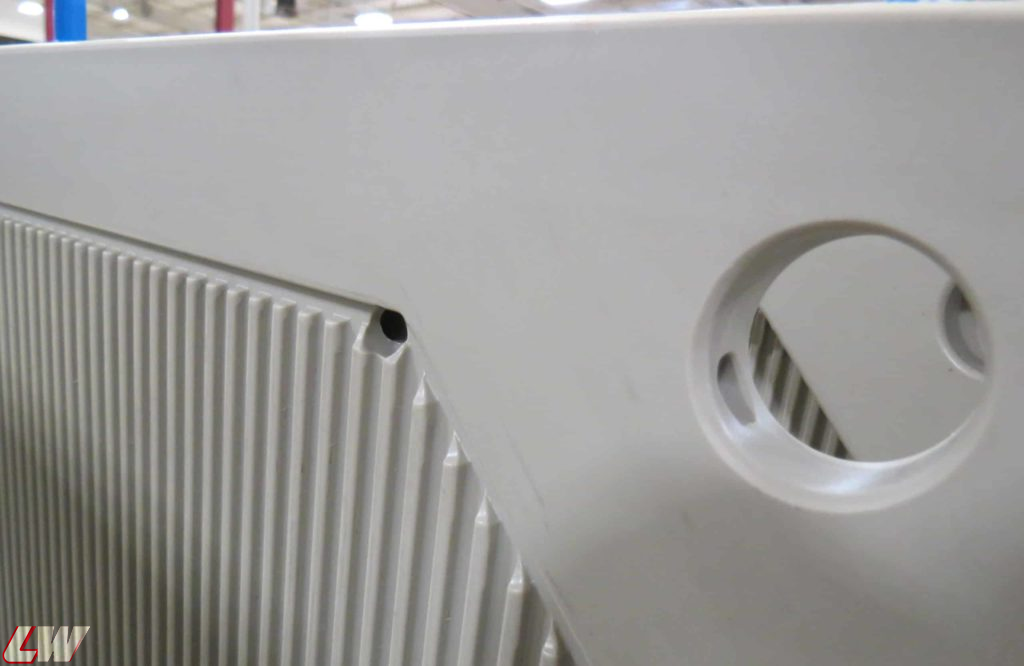
Plates and frames cast in PP standard; SS304, SS316L, cast iron, or rubber-lined frame options on request. The filter medium is a flat sheet laid on every plate: standard monolayer polypropylene cloth, plus filter paper, nonwoven felt, membrane pad, or activated-carbon pad as the spec demands.
- PP plate and frame, virgin resin in contact surfaces
- SS304 / SS316L frame on request for edible, beverage, pharmaceutical duty
- Cast iron and rubber-lined frames for abrasive slurries
- Straight-rib drainage pattern, 3 mm rib height, 12 mm pitch
- CNC-milled sealing face, flatness ≤ 0.1 mm
- Cloth materials: polyester, polypropylene, nylon; paper grades: cellulose, glass, qualitative
- Custom medium stacks (cloth + paper + pad) on request
Filter Medium OptionsMix and match cloth, paper, pad, and pre-coat to match the spec
The medium on the plate face is where plate-and-frame filters earn their name. Six configurations cover most industrial clarification duties; sample-driven selection picks the right one for your slurry. Talk to engineering if your duty does not fit one of these six.
Woven PP / polyester cloth
Single-layer multifilament cloth on the plate face. Re-use for many cycles; replacement when blinding drops flux. Workhorse medium for clarification where capture down to ~10 µm is enough.
Cloth-supported filter paper
Filter paper laid over cloth. The paper is the consumable; cloth carries it cycle after cycle. Drop in capture down to ~2 µm without giving up cloth life. The plate-and-frame standard for edible oil refining.
Membrane pad on cloth
Polyethersulfone or PVDF membrane pad replaces paper for fine chemistry. Absolute pore size from 0.1 to 5 µm. The membrane is the consumable; pad is cut to frame size and replaced by batch.
Activated-carbon overlay
Carbon-impregnated nonwoven pad over the cloth. Combines mechanical capture with adsorption for colour stripping and trace organics. One-shot consumable, replaced each batch.
Multi-layer stack
Papers and pads stacked to filter from coarse to fine: a coarse paper on the bottom to protect the cloth, a fine paper in the middle for particle capture, a membrane pad on top for absolute cutoff. Captures multiple contaminant classes in one cycle.
Body-feed pre-coat
Diatomaceous earth or cellulose powder dosed into the feed stream forms a renewable filter cake on the first run. The pre-coat is the medium; the cake becomes the filter. Use when the slurry would blind a plain medium within a few cycles.
Selection GuideThree questions to size the right plate-and-frame build
Use these three questions to bracket your build. The exact plate size and medium stack is confirmed after a bench test on your slurry at the Loway lab — but the answers below point our engineers to the right starting series.
What is in the slurry, and what does the filtrate need to look like?
Feed solids concentration, particle size distribution, viscosity, pH, temperature, and target filtrate clarity (NTU or TSS). These set whether a plate-and-frame build is the right call at all, and which medium stack on the plate face will hit the spec.
Send a 3–5 L slurry sample and a clarified-filtrate spec → Lab page
How many cubic metres per day, and is the filtrate or the cake the spec?
Plate-and-frame presses run on low-solids feeds (typically < 2% wt) where filtrate clarity — not cake production — is the binding constraint. If your slurry is > 5% wt, the cavity fills too quickly and a chamber press is the better-fitting platform.
For sizing, share daily m³, feed solids %, target NTU, and shift pattern
Which filter medium, and how often will it change?
The medium on the plate face is a consumable (paper, pad, or membrane), so the operating cost is paper or pad, not cloth. Filter paper, nonwoven pad, membrane pad, and activated-carbon pad are all factory-stock; custom medium stacks on request.
Paper cost per batch is the recurring line item; cloth is a multi-cycle consumable
ApplicationsFiltration duties where plate-and-frame is the standard build
Plate-and-frame presses are the workhorse of liquid-polishing duties. Where the spec is the filtrate — not the cake — and where the slurry carries too little solid for a chamber press, a plate-and-frame build with the right medium stack is the right call.
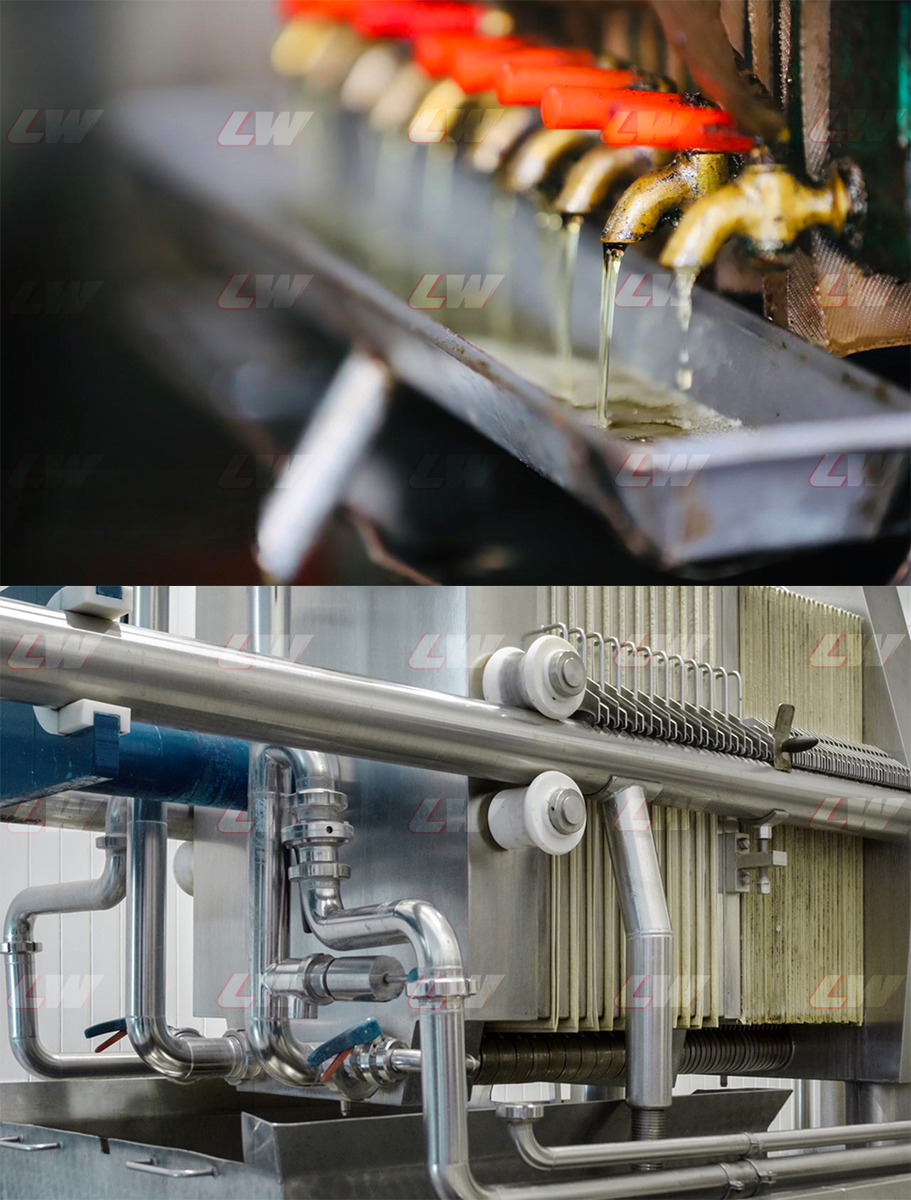
Crude oil & wax clarification
Filter paper over cloth catches waxes, residual gums, and trace solids after degumming and neutralization. Cake falls with the paper; cloth is re-used for many cycles. SS316L contact parts standard.
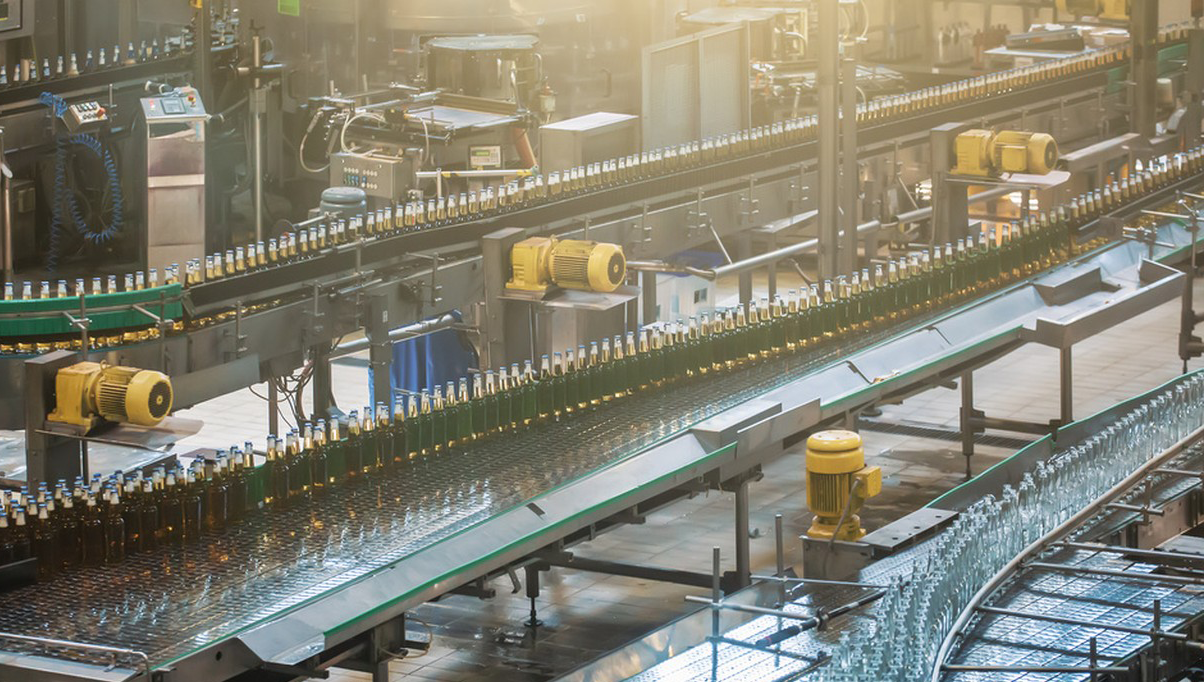
Fruit juice, wine, and fermentation broth
Body-feed pre-coat on the first cycle; cellulose paper + DE on subsequent cycles. Captures pectin, yeast, and protein haze without stripping the colour or flavour. Sanitary surface finish on every contact part.
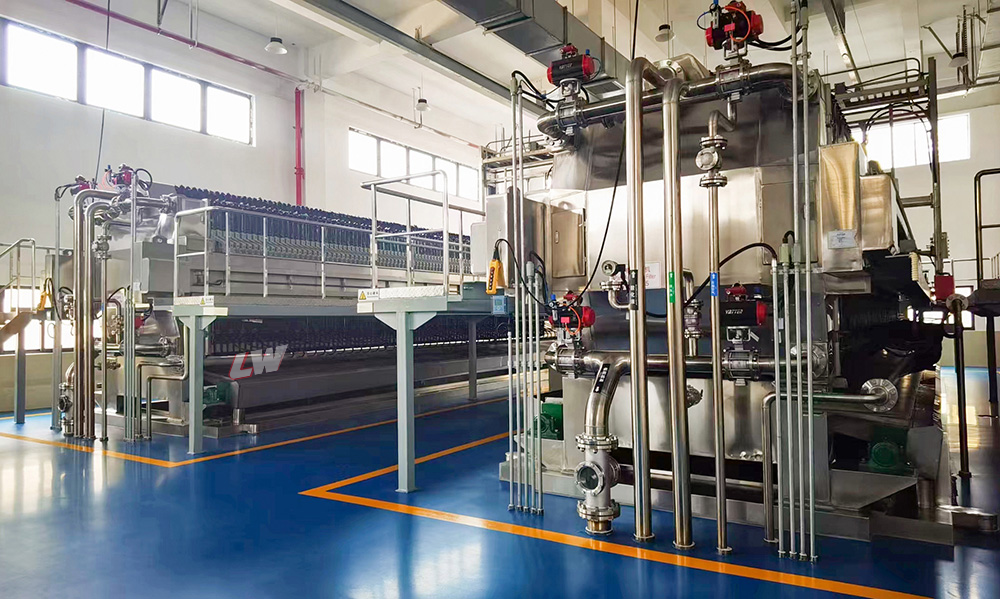
Pesticide, dye, and pharmaceutical intermediate
Multi-layer paper + membrane stack catches trace catalyst residue in pesticide intermediates, dyed intermediates, and APIs. Wash-pass port on 630 / 800 / 1000 mm series for soluble-removal duty.
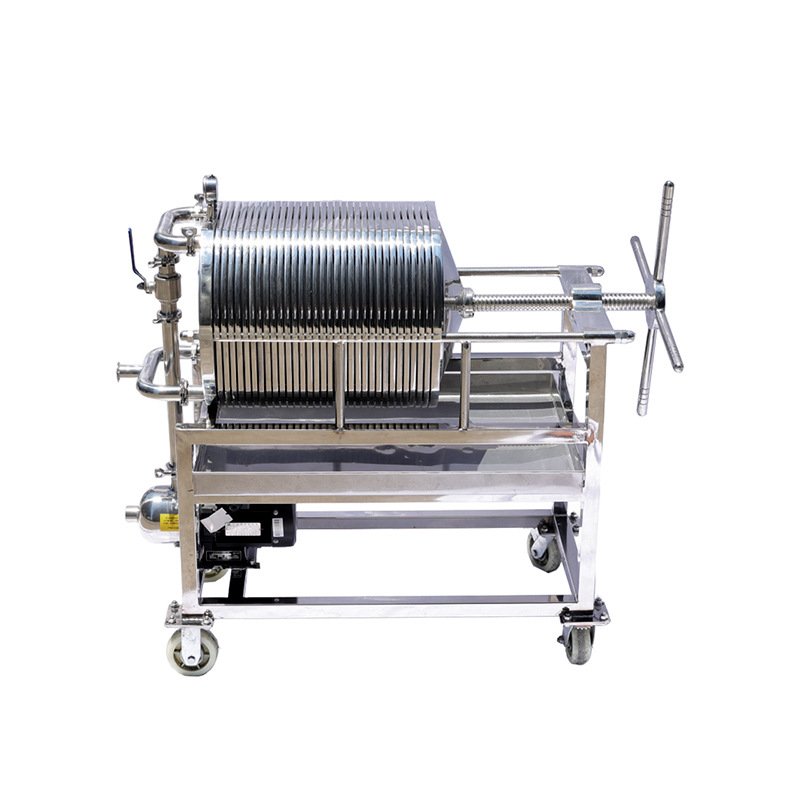
Rinse-water recovery and dye solution
Cloth-only on the plate face for low-solids rinse water and dye solutions. Recovers water for re-use in the plating bath; captures dye solids for disposal. PP standard, SS316L on request for acid rinse duty.
Frequently Asked Questions
The questions buyers ask most often about plate-and-frame presses. If yours is not below, our engineering team replies within one working day.
Q1. How is a plate-and-frame press different from a chamber press?
A chamber press builds the cavity from two recessed plates pressing against each other; the cake is the product. A plate-and-frame press builds the cavity from a flat plate (or pad) on one side and a hollow frame on the other; the cake and the medium drop together at discharge.
Plate-and-frame is the right choice when the binding constraint is filtrate clarity on a low-solids feed, or when the duty needs a consumable medium (filter paper, membrane pad, activated carbon) on the plate face. Chamber is the right choice when the binding constraint is throughput on a high-solids feed — view the chamber press page.
Q2. How often do I change the filter paper?
Every cycle. The plate-and-frame build expects a fresh sheet of paper (or pad) on every plate for every batch. The cloth below the paper does not change every cycle — it is a multi-cycle consumable that carries the paper.
Paper change on a 60-frame press takes one operator about 3–5 minutes once the pack is open. Pre-cut paper to plate size is available from the Loway accessories page; activated-carbon and membrane pads are cut to order.
Q3. Is the cake from a plate-and-frame press drier than a chamber press?
Yes, often by 5–10 percentage points at the same closing pressure. The plate-and-frame cavity is thinner (typically 20–30 mm vs 25–30 mm on a chamber), the medium on the plate face is a finer pore, and the feed-side flow is lower resistance. Drier cake means lower disposal tonnage.
Cake quantity per cycle is smaller than a chamber press on the same frame count, because the cavity is smaller. Pick plate-and-frame for filtrate quality; pick chamber for cake quantity. Pick membrane when both need to be at their best — view the membrane press page.
Q4. How many plates and frames do I need?
Frame count sets the cake volume per cycle. Plate count is frame count + 1 (one plate at each end of the pack). The frame count that fits your duty is set by daily m³ × feed solids % ÷ frame volume ÷ cycles per day.
Take a 60 m³/day feed at 1.5% solids, 25 mm frame at 750 L cake volume per frame. 60 000 × 0.015 ÷ 750 = 1.2 frames per cycle for clean removal, rounded up to 2; at 3 cycles per day the press fits with a comfortable margin. Confirm against a bench test on your slurry.
Q5. SS304 or SS316L — which do I need?
Both are available on the Loway plate-and-frame line. SS304 covers most food, beverage, and standard chemical duties (pH 4–9, < 80 °C). SS316L lowers carbon and adds molybdenum — needed for chloride-bearing service, hot acid, or pharmaceutical-grade polishing.
Tell our engineering team the pH, chloride level, and operating temperature and we will spec one of the two. Switch to SS316L whenever the spec sheet calls for it; the capex difference is small compared with the cost of a chloride-stress-corrosion rebuild.
Q6. Can I mix plate and frame counts after the press is built?
Yes, in batches. The Loway plate-and-frame pack is built so additional frames can be inserted or removed on site — the foundation length changes with frame count, but the head plate, hydraulic pack, and control cabinet stay in place.
Use this when you are scaling from a pilot campaign to a production line, or when the feed solids concentration changes through the year. We supply bare frames to match the existing series so the press stays as one platform.
Get a Sized Plate & Frame Press Quotation
Send your slurry characteristics, target filtrate spec, and shift pattern. Our engineering team will propose a plate size, frame count, and medium stack, and quote the complete line including the feed pump, paper supply, and receiving tray if needed.
Related PlatformsOther filter press platforms and dewatering lines for adjacent duties
The plate-and-frame press is one of the filter press platforms Loway builds. If your duty points to a different platform, these are the natural next reads.
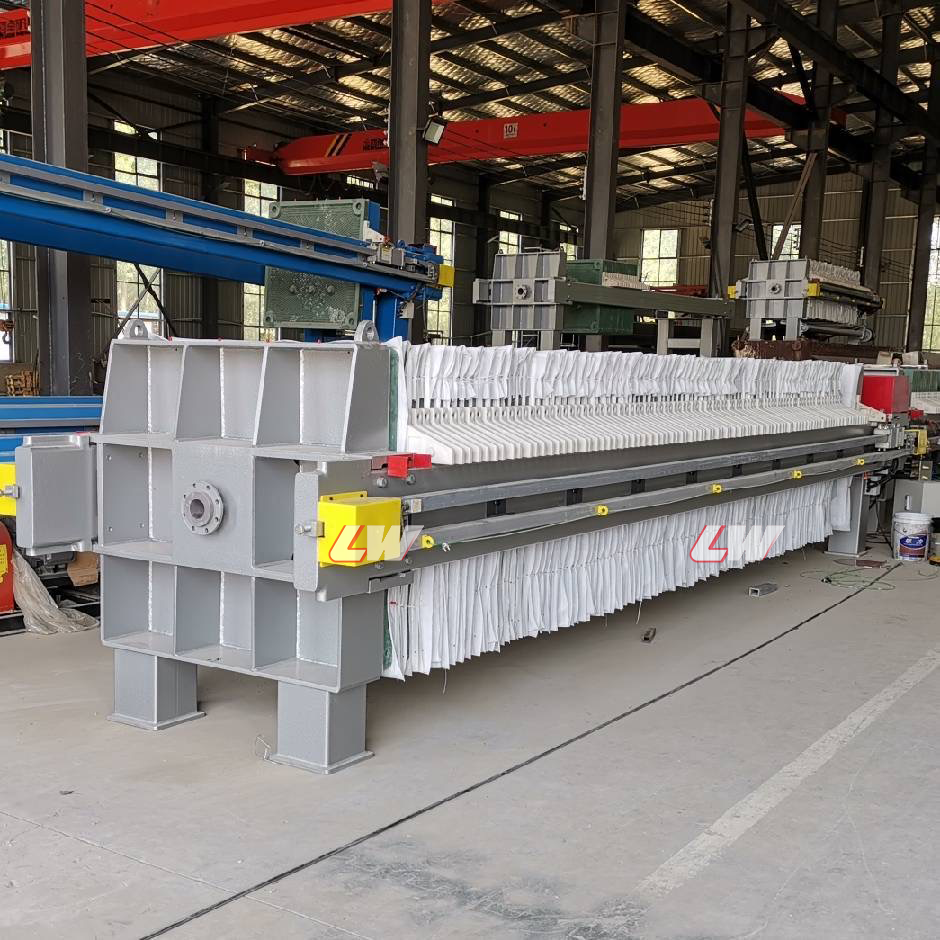
Chamber Filter Press
Recessed-plate dewatering on a cloth — the workhorse for mining tailings and chemical slurries.
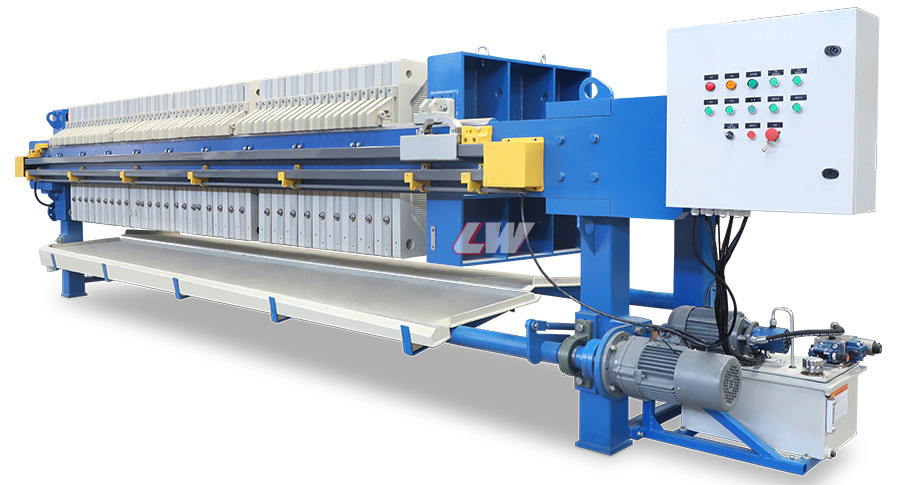
Membrane Filter Press
Secondary squeeze for the driest cake in the filter press family.

Quick Opening Filter Press
Fast-release plate shifter for labs, small batches, and frequent grade changes.
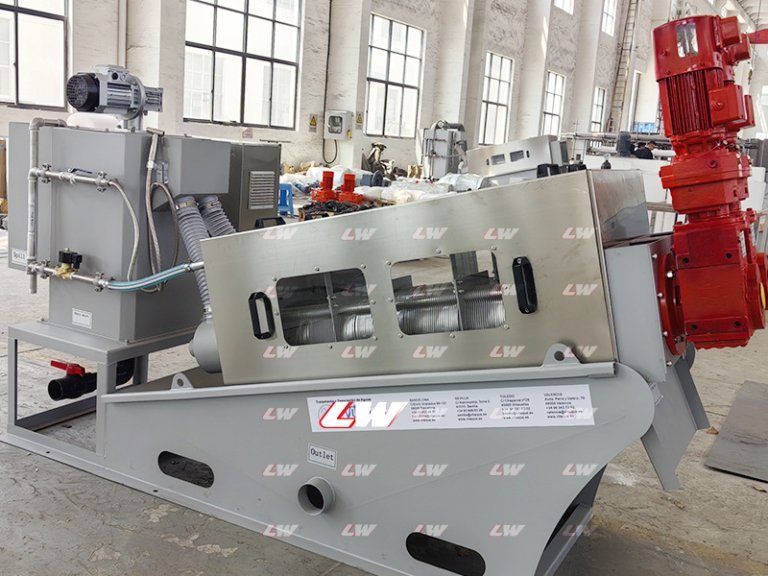
Dewatering Screw Press
Continuous mechanical dewatering for high-solids sludge; complementary to a plate-and-frame line.