LW Series Belt Filter Press — Continuous Sludge Dewatering Machine
An LW belt filter press dewaters sludge in one continuous pass: conditioned feed is carried between two tensioned belts through a gravity drainage section and then a roller pressure section, and leaves as stackable cake. There is no batch cycle to plan around and no filter cloth to change between loads. The range runs from 500 mm to 3000 mm of belt width at 12 to 100 m³/h, so the same platform covers a package plant and a large municipal works. Every machine is assembled and acceptance-tested in one factory.
What an LW Series Belt Filter Press Is
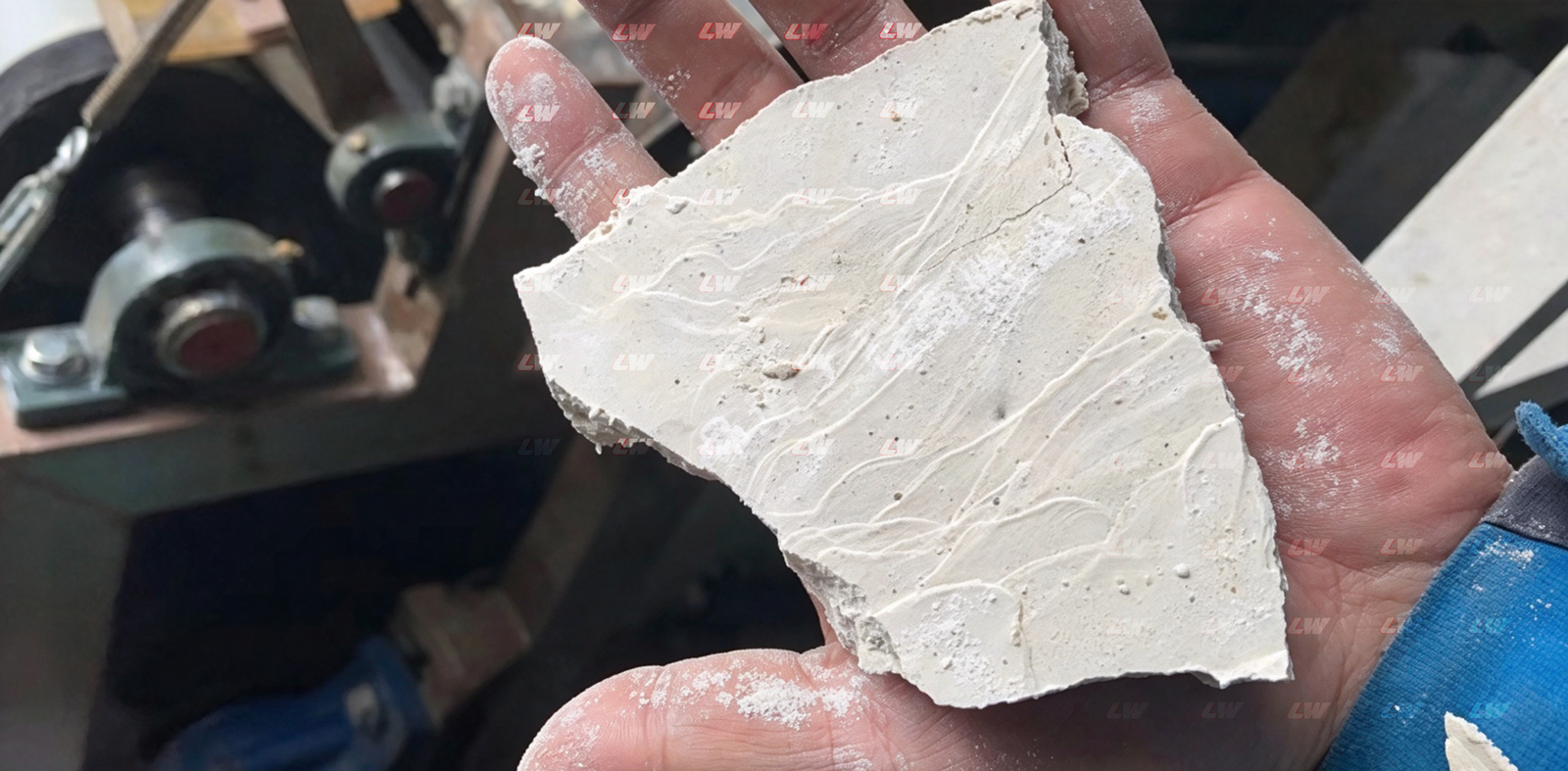
The LW series is our standard machine: a continuous press that takes conditioned sludge at 1–3% dry solids and discharges cake at 18–25% dry solids without stopping. Six models span 500 mm to 3000 mm of belt width, so one platform covers a package plant and a municipal works.
Continuous, not batch
A chamber filter press works in cycles: fill, press, open, discharge, and the plant schedules around it. The LW does the same job in one pass. Sludge is conditioned, spread across a moving belt, drained under gravity, then carried between the two belts through a roller train where pressure rises as the cake gains strength. Cake leaves the end of the belt every minute of the run. There is no cycle to plan around and no cloth change between loads, which is why plants with a sludge stream that never stops specify a belt machine.
Where it sits in the plant
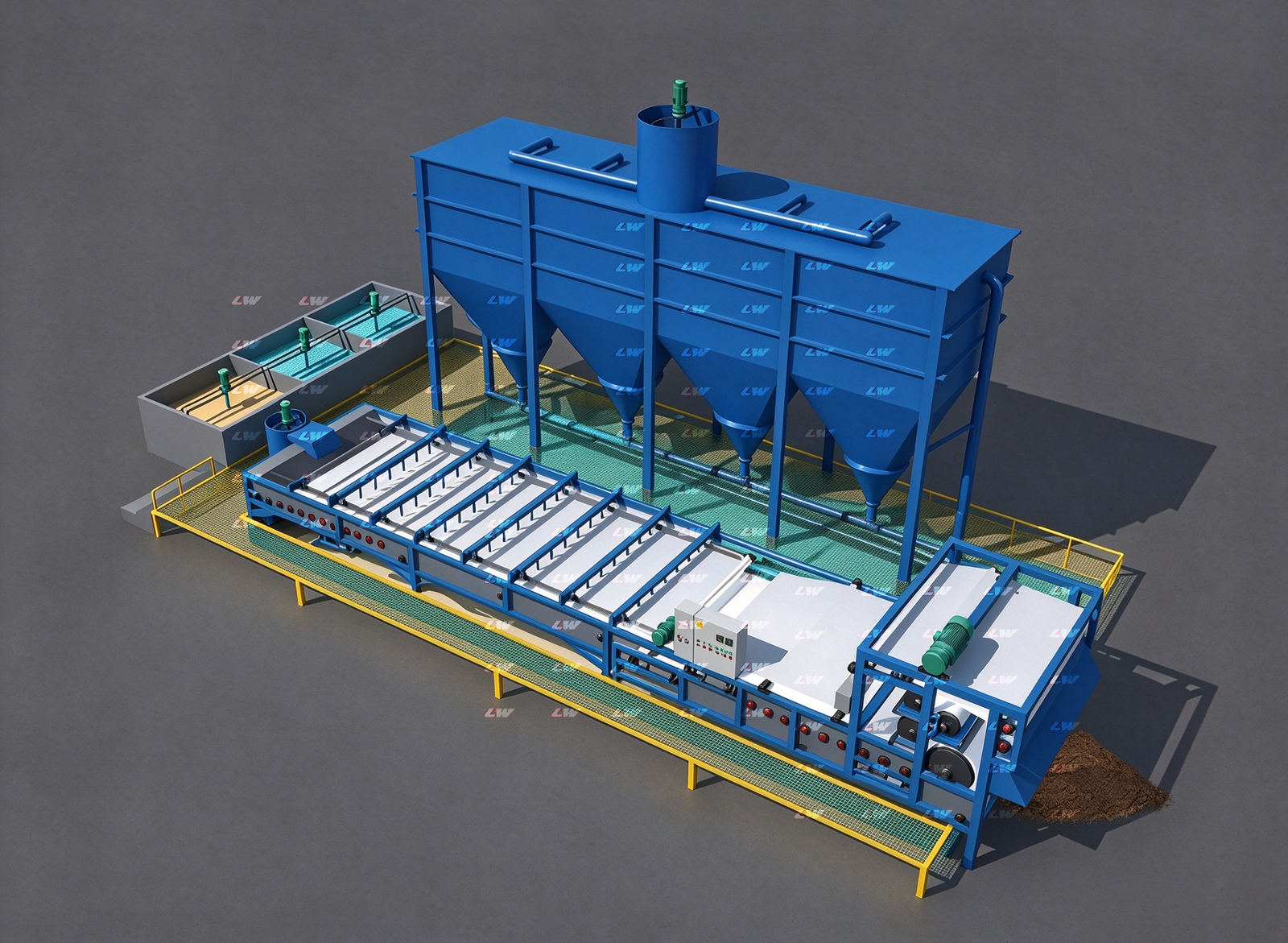
The press takes feed from a pump and hands cake to a conveyor. Ahead of it sit the polymer make-up unit and the feed pump; behind it, the filtrate return and the cake handling. Feed below 1% dry solids is thickened first, which cuts polymer dose and lets a narrower machine handle the same flow.
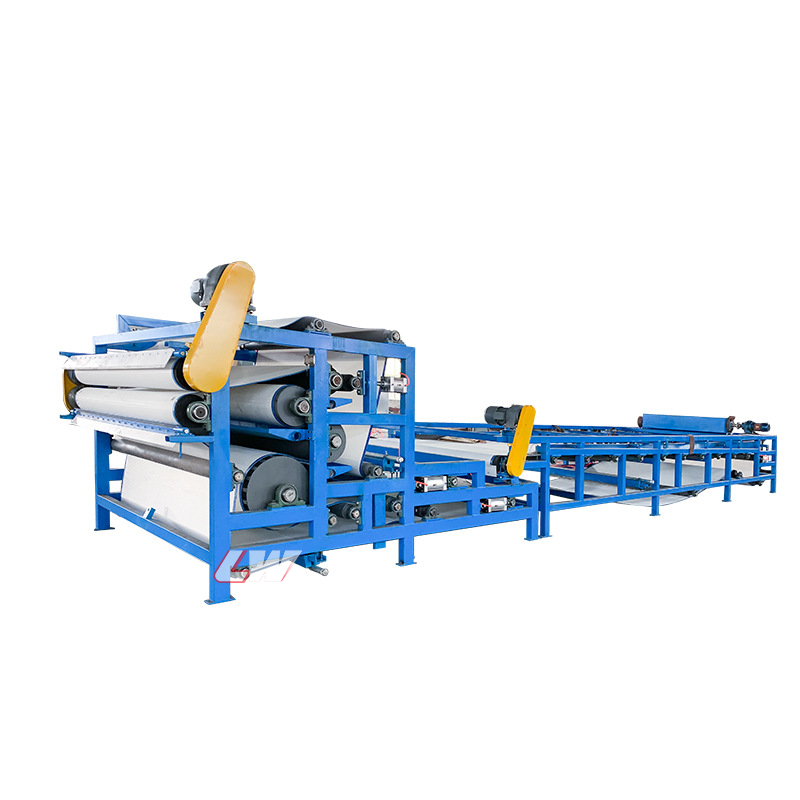
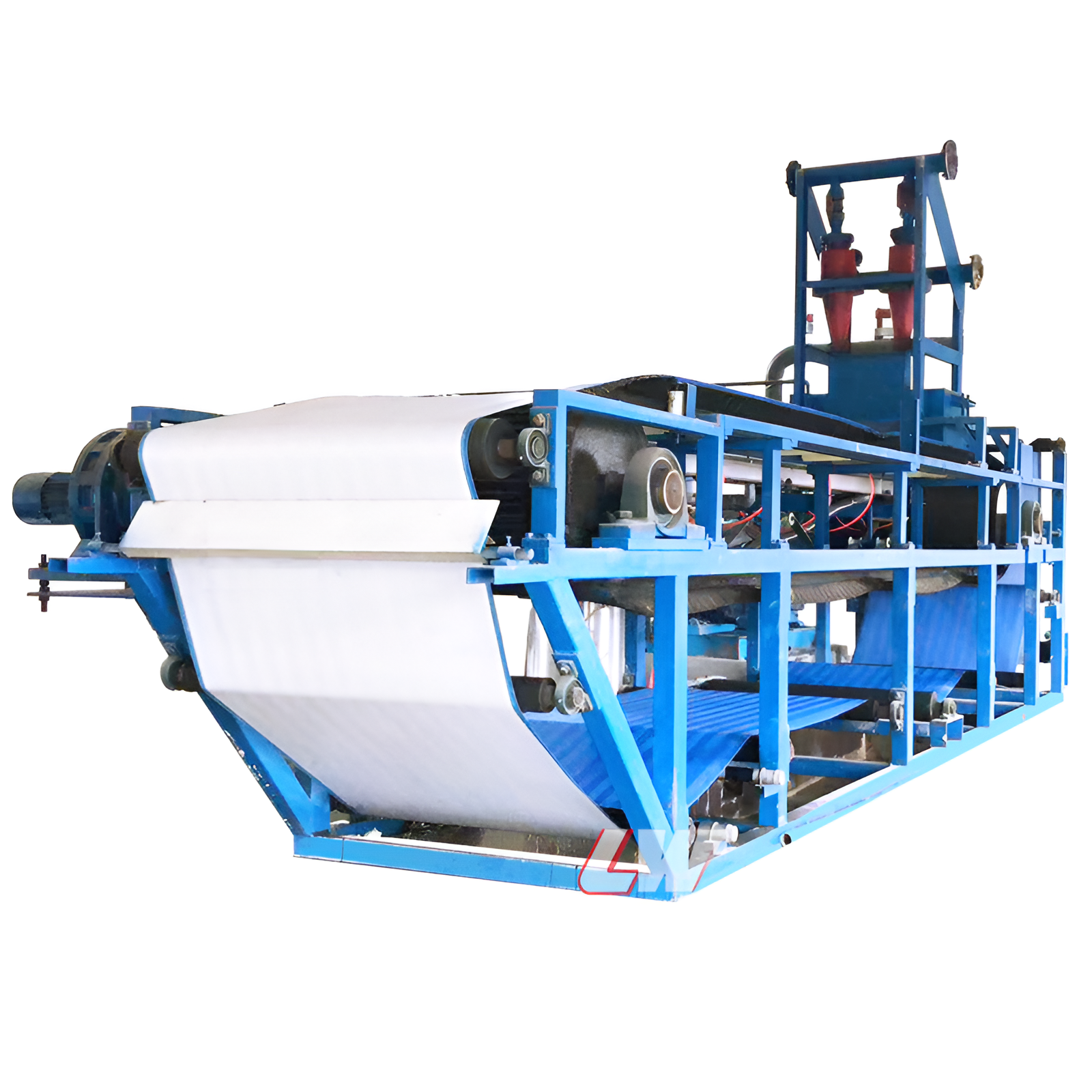
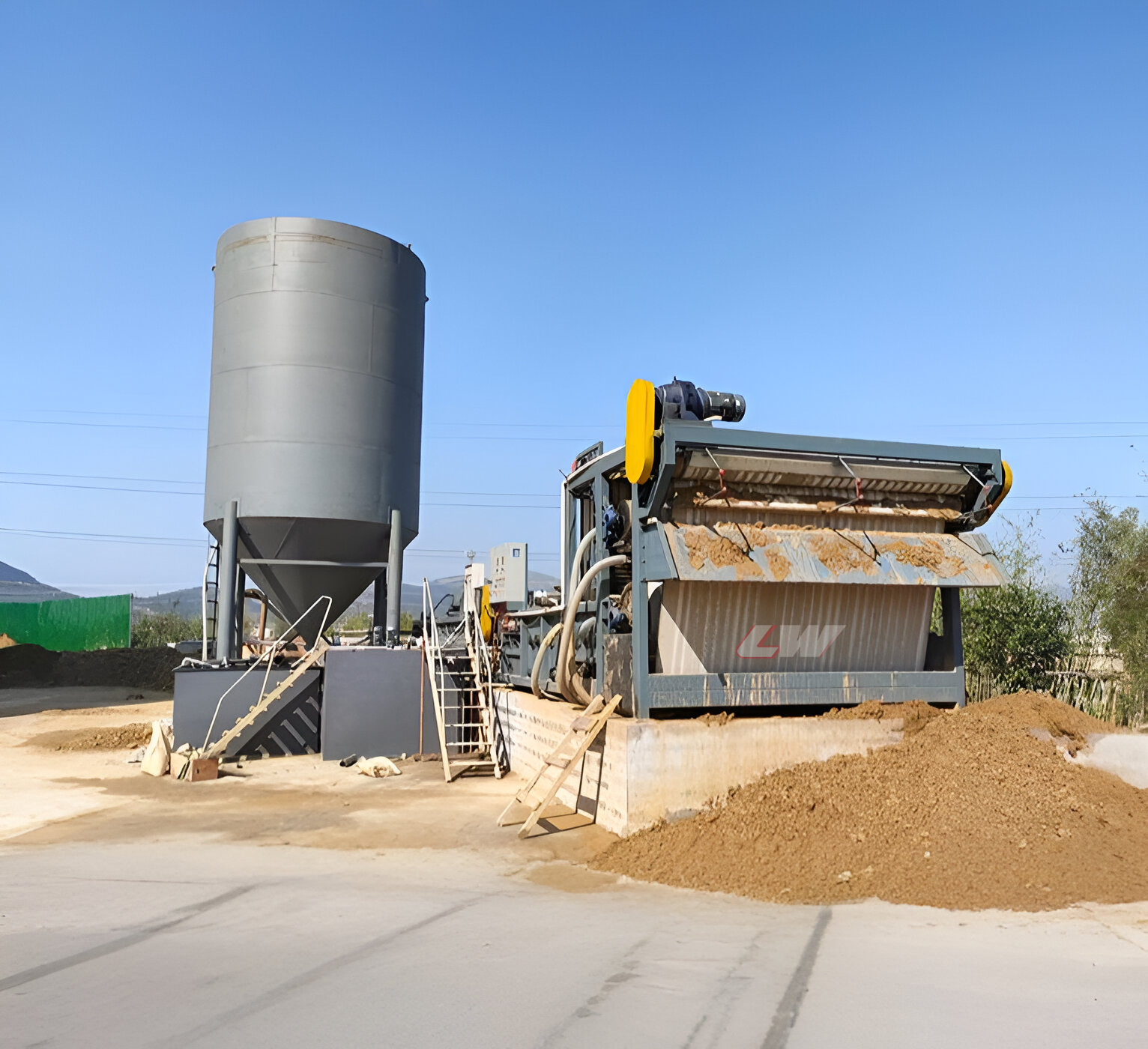
LW series standard machine: gravity drainage section followed by the roller pressure section.
LW Standard Belt Filter Press Specifications
The standard belt press handles municipal and industrial sludge with gravity drainage followed by low and medium-pressure rollers. The LW-500 to LW-3000 range covers plants from small package units to large municipal stations. Model numbers give the belt width in millimetres: LW-1000 is a 1000 mm belt. A suffix marks the build — no suffix is the standard press, H is high-pressure, V is vacuum, T carries the thickening section on the same frame, G is the gravity thickener that sits ahead of a press.
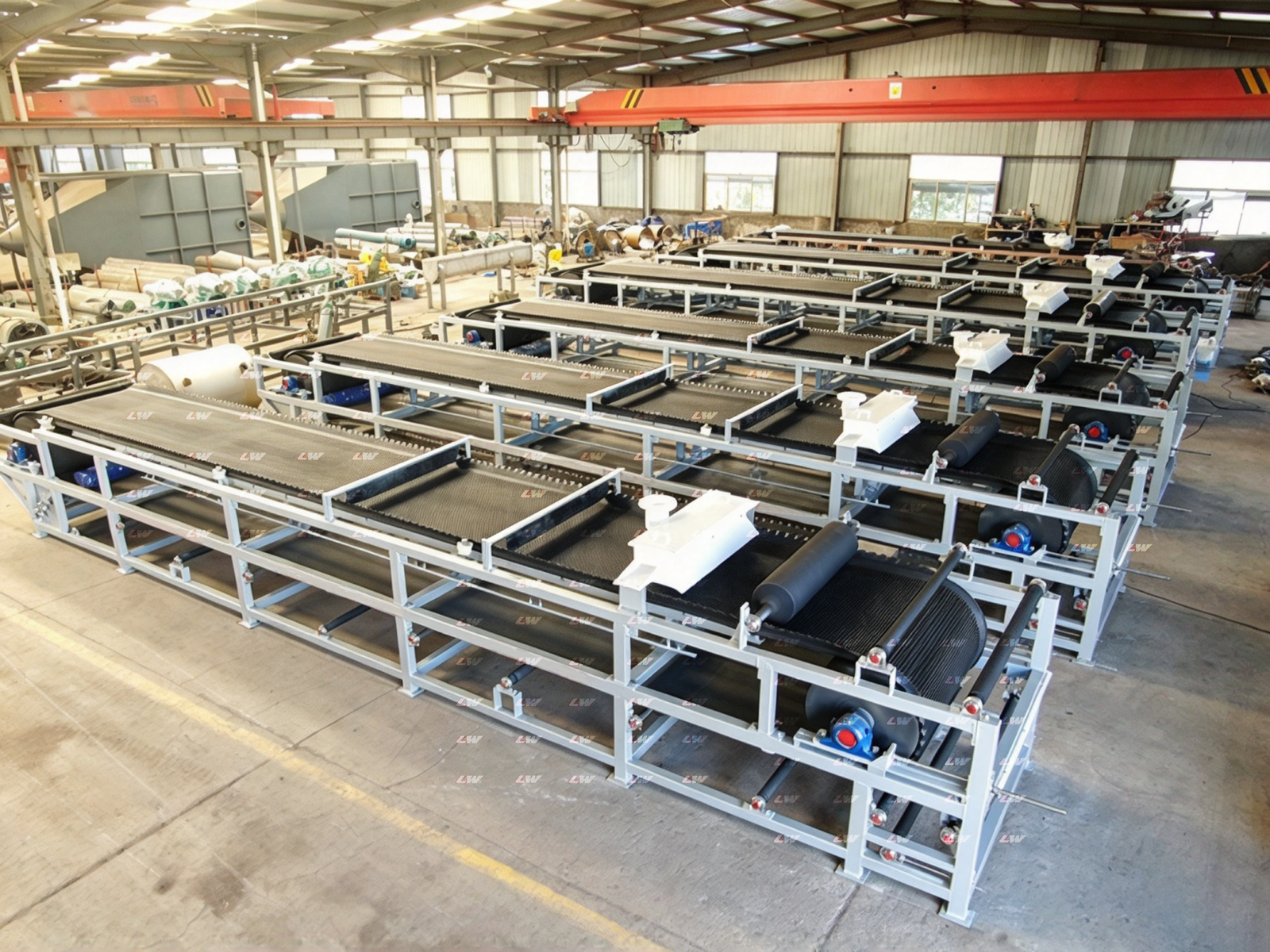
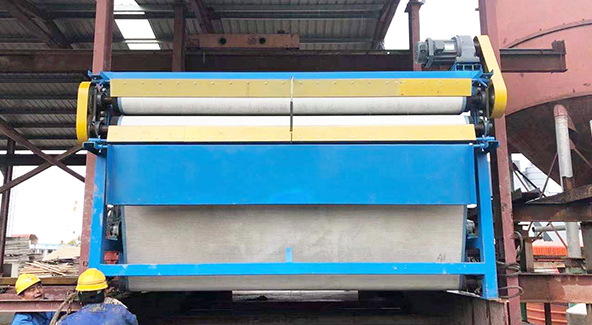
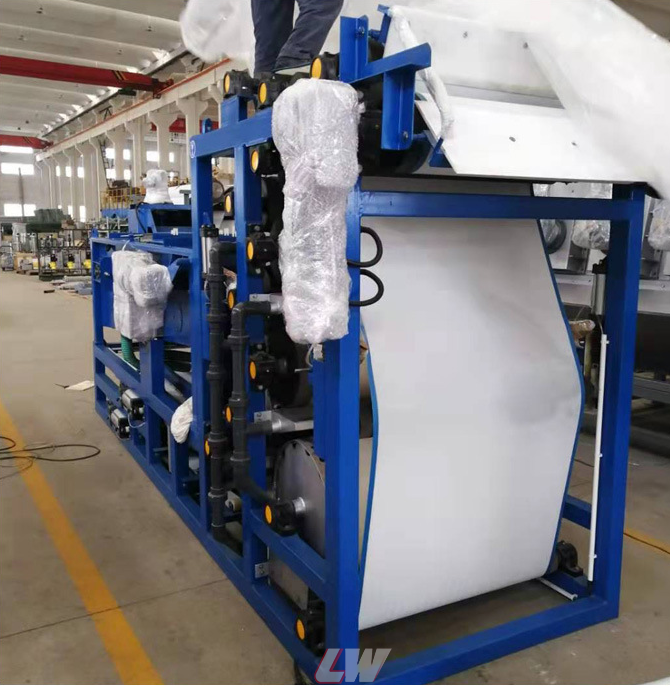
LW standard belt press in final assembly before factory acceptance testing.
| Model | Belt width | Capacity | Drive power (main + auxiliary) | Belt speed | Dimensions | Weight |
|---|---|---|---|---|---|---|
| LW-500 | 500 mm | 12–30 m³/h | 1.5 + 0.75 kW | 1–12 m/min | 6.6 × 1.3 × 2.5 m | 4000 kg |
| LW-1000 | 1000 mm | 25–40 m³/h | 2.2 + 0.75 kW | 1–12 m/min | 6.6 × 1.8 × 2.5 m | 5000 kg |
| LW-1500 | 1500 mm | 36–50 m³/h | 3 + 0.75 kW | 1–12 m/min | 6.6 × 2.3 × 2.5 m | 6000 kg |
| LW-2000 | 2000 mm | 50–60 m³/h | 4 + 1.1 kW | 1–12 m/min | 6.6 × 2.8 × 2.5 m | 7000 kg |
| LW-2500 | 2500 mm | 60–80 m³/h | 5.5 + 1.5 kW | 1–12 m/min | 6.6 × 3.3 × 2.5 m | 8000 kg |
| LW-3000 | 3000 mm | 80–100 m³/h | 5.5 + 1.5 kW | 1–12 m/min | 6.6 × 3.8 × 2.5 m | 10000 kg |
- Supplied with the machine — two filter belts, roller train with bearings, belt tension and tracking system, drive with variable-frequency control, hydraulic power pack, wash-water manifold with nozzles, feed box and distribution, scraper discharge, control panel with recipe storage.
- Specified separately — polymer make-up and dosing unit, feed pump, cake conveyor, enclosed hood with odour extraction, wash-water filtration loop.
- Confirmed with the order — materials of construction, belt weave and permeability, frame and drainage length, final dimensions.
Capacity is hydraulic throughput at typical municipal sludge solids; cake output depends on the sludge. Drive power is the main belt drive plus the auxiliary drive on the conditioning and dosing equipment. Total installed power is not fixed by belt width: the polymer unit, feed pump and wash-water pump are sized to your feed moisture, target cake dryness, throughput and site layout, so the full figure comes with the proposal.
Belt Filter Press Machines from the Factory Floor
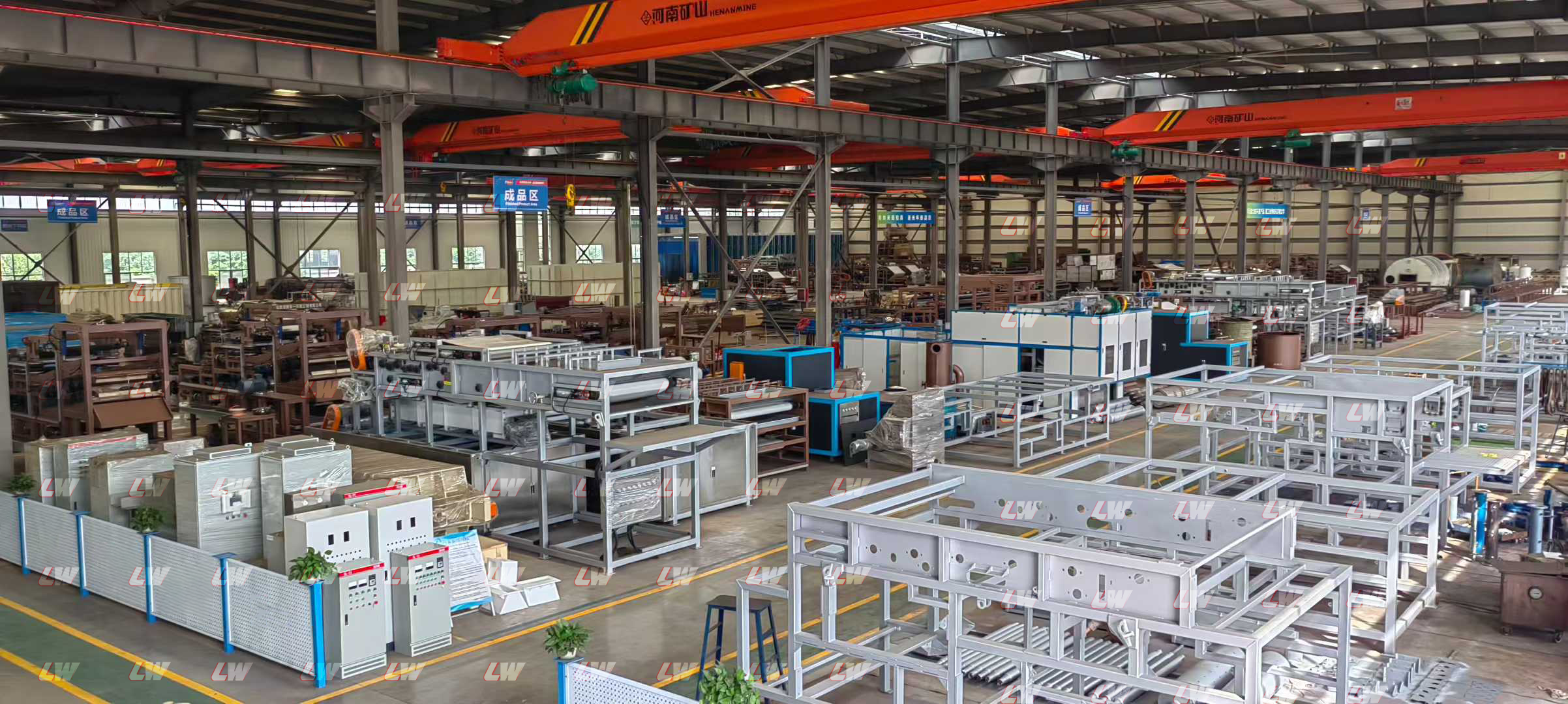
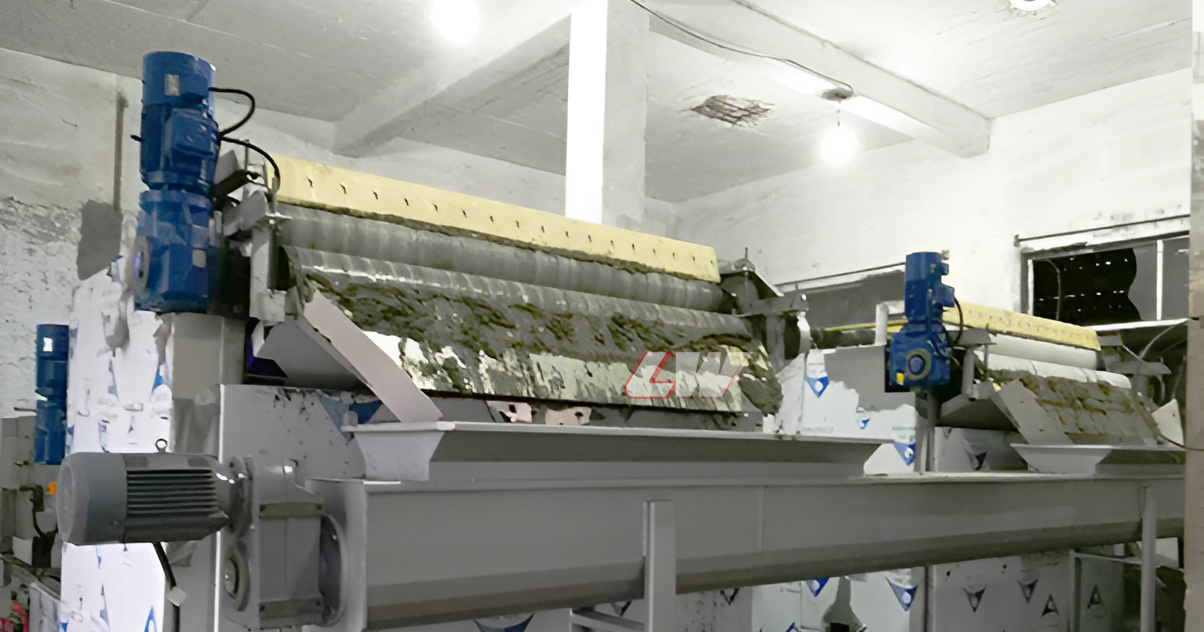
LW belt filter press machines at the end of final assembly, before they are packed and shipped. Frames, roller trains and belts are built in the same workshop; the acceptance test is described further down the page.
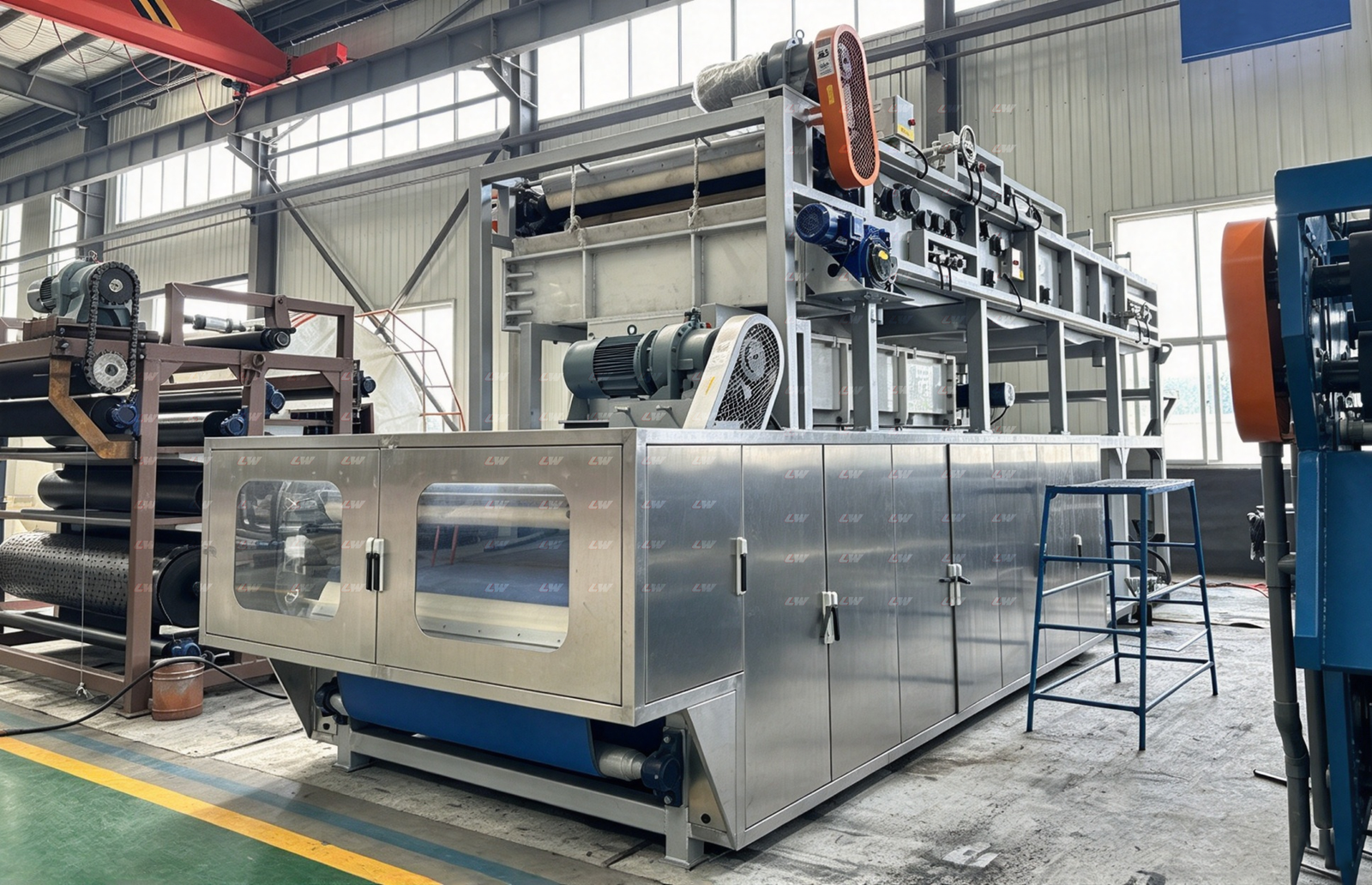
All machines share the same belt platform. What changes is the roller count, the hydraulic set point and the belt specification.
How Belt Press Dewatering Works
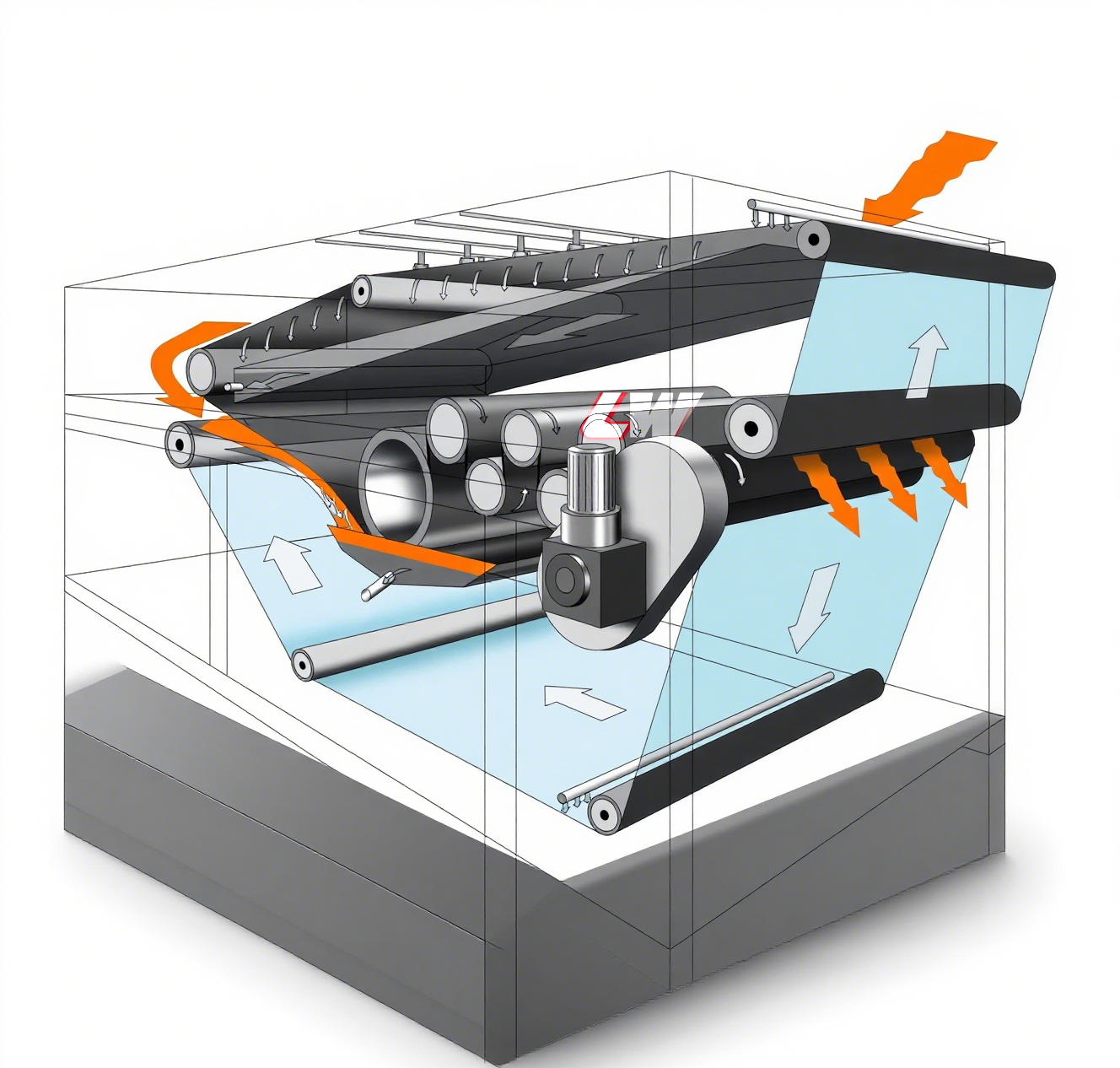
Conditioned sludge travels between two tensioned belts through six zones. Each zone removes water by a different mechanism, and the mechanism changes as the cake dries: free water drains under gravity first, then mechanical pressure takes over, then shear opens the channels that stay closed under pressure alone. That progression is why continuous belt filter press dewatering reaches 18–25% dry solids without a batch cycle.
- Conditioning — polymer is mixed into the feed so solids release water instead of smearing through the belt.
- Gravity drainage — free water drains through the moving belt. The largest share of the water leaves here, at no energy cost.
- Wedge zone — the belts converge and the sludge layer is squeezed gently, so it is gripped rather than extruded sideways.
- Low and medium pressure — rollers of decreasing diameter apply a rising pressure profile.
- High-pressure shear — small rollers plus a belt speed differential break the floc open and release the water held inside it.
- Discharge and belt washing — cake is scraped off and the belt is cleaned before it picks up the next load.
Filtrate returns to the head of the plant. Cake discharges at the end of the belt onto a conveyor or into a skip.
Zone 01 · Feed preparation
Conditioning and flocculation
Sludge particles carry a negative surface charge and stay in suspension as a stable colloid, with water held inside and around each particle. A cationic polymer neutralises that charge and bridges the particles into dense flocs, which is what releases free water. Dose is the single largest lever on cake dryness: under-dosing leaves fines that blind the belt and cloud the filtrate, while over-dosing wraps water inside a slime floc and makes the cake wetter while adding cost. Mixing energy matters too, because a floc sheared after it has formed does not reform. Grade and dose come from a jar test on your sludge.
Zone 02 · Free water removal
Gravity drainage
Flocculated sludge is spread across the belt and free water drains through it under gravity alone. It costs nothing to remove water here, and the largest share of it leaves in this zone. What governs the result is drainage length, which sets residence time, plus the belt's air permeability and how evenly the sludge is spread. Ploughs ride on the layer and turn it over, opening fresh channels so water from inside the layer reaches the belt instead of pooling on top. A gravity section too short for the flow is the most common reason a press underperforms: sludge arrives at the wedge zone still fluid, and the pressure section does not make up the difference.
Zone 03 · Cake formation
Wedge zone
The two belts converge and the sludge is squeezed from both sides at a shallow angle. The purpose is not maximum pressure yet but conversion: a fluid layer has to become a coherent cake that can be gripped without being pushed out at the edges. Wedge angle is the design variable, and getting it wrong shows up immediately as sludge extruding sideways. This is also the zone that reveals whether the gravity section was sized correctly, and where most reports of a press throwing sludge are traced back to.
Zone 04 · Capillary water
Low and medium pressure
The cake is now carried between the belts around a series of rollers. A tensioned belt running over a roller generates radial pressure, and that pressure rises as roller diameter falls, which is why diameter decreases along the train. Because the cake gains strength as it dries, it can accept more pressure at each stage than at the one before. This section removes the capillary water held between particles.
Zone 05 · Bound water
High-pressure shear
The final section uses the smallest rollers and the highest tension. Pressure alone stops working here: the water left is held inside the floc structure, and squeezing a closed floc only compresses it. Shear does the work, because the two belts travel at slightly different speeds or over offset paths, and the resulting shear stress tears the floc open and exposes trapped water to the belt. That shear-plus-pressure combination is what separates a belt filter press from a plain roller press, and it is the difference between a stackable cake and a paste. High-pressure machines add rollers and raise the tension set point here.
Zone 06 · Cake release
Discharge and belt washing
Cake is removed by a scraper at the end of the belt, and how completely it releases determines what the belt carries into the next cycle. The belt is then washed on the return run by nozzles. Washing is not housekeeping: a belt whose pores have blinded with fines stops draining, and blinding is the usual cause of a press that slowly loses output over months rather than failing outright. Wash water is the largest utility consumer on the machine, which is why closed-loop filtration of it is a frequent specification.
Core Engineering and Belt Press Components
All six LW models share one frame and belt platform. What changes with belt width is the roller count, the drainage length and the belt specification.
Filter belt
Two endless belts carry and press the cake. They are woven polyester monofilament, chosen for dimensional stability under tension and for resistance to the pH range of municipal and industrial sludge. The specification that decides performance is air permeability: an open weave drains quickly but passes fines into the filtrate, a tight weave holds fines but blinds sooner and throttles drainage. The belt for a given sludge is selected on that trade-off rather than defaulted. Tensile rating and seam construction are matched to the tension the pressure section runs at, and tension itself is set per sludge type.
Roller train
Roller diameter decreases along the pressure section so that belt tension converts into a rising pressure profile: the cake meets light pressure while it is still weak and progressively more as it gains strength. Roller count and the way the train is arranged set how much shear the cake is exposed to, which is the main structural difference between a standard machine and a high-pressure one. Faces are coated, and often grooved, to grip the belt without slipping and to give expressed water a path away from the cake.
Tension and tracking
Tension is what generates dewatering pressure, so it is held constant by a pneumatic or hydraulic system rather than set once by hand. Tracking keeps the belt centred: a sensor reads the belt edge and a correcting roller steers it back. Tracking reliability matters more than it appears to. A belt that walks off its path is the most common cause of an unplanned stop, and one damaged at the edge is a replacement rather than a repair.
Drive
A variable-frequency drive sets belt speed, which is the operator's day-to-day control: slower for a difficult sludge that needs residence time, faster when the feed is easy. The upper and lower belts are driven so that a speed differential, and therefore shear, can be set where the process needs it.
Hydraulics
One power pack serves tension, tracking and the pressure set point. Set points are adjusted from the panel and stored with the recipe, so changing sludge type becomes a selection rather than a re-commissioning.
Wash water circuit
Nozzles clean the belt on every return pass. Pressure and coverage are what keep the pores open, and a blocked nozzle shows up first as a wet streak across the cake and later as lost throughput. Because wash water is the largest utility draw on the machine, filtration and recirculation of it is commonly specified, and strainers are sized for the water actually available on site rather than for an ideal supply.
Feed and distribution
How sludge is spread onto the belt governs everything downstream. The feed box and its distribution arrange an even layer across the full width at a controlled depth. An uneven layer means part of the belt is overloaded while the rest runs below capacity, and that shows up as a cake wet on one side. This is the least conspicuous item on the machine and one of the most consequential.
Frame and wetted parts
Carbon steel with epoxy coating is the standard build. Stainless contact parts, 304 or 316 depending on chloride content, are specified where the sludge, the wash water or the cleaning regime is corrosive. Food, pharmaceutical and coastal installations typically specify stainless through the drainage and pressure zones. Enclosure options, from open frame to fully enclosed with odour extraction, are specified to the site rather than to the machine size.
Control panel
A PLC with recipe storage covers several sludge types, with interlocks on tracking, torque and emergency stop, and feedback on belt speed and torque. Panels expose flow, dose, speed and torque over the plant network, so a dryness complaint becomes a data review rather than a site visit.
Rings, rollers and frames are machined and assembled in one plant — the reason buyers shortlisting a belt press filter manufacturer usually ask to see the floor. See the factory and the quality control steps.
Performance Range and Operating Envelope
These are the figures our engineers work from when sizing an industrial belt filter press machine. They are design ranges, not guarantees: the number that matters for your plant comes out of a sludge test.
Feed side
- Feed concentration0.5–5% dry solids
- Design point, municipal1–3% dry solids
- Throughput per metre of beltFalls as belt width rises — see the model table
- Belt speed1–12 m/min
Output side
- Cake, municipal activated sludge18–25% dry solids
- Cake, high-pressure machine≥40% dry solids
- Polymer doseSet by sludge type, confirmed by jar test
- DutyContinuous, 24/7
What sets cake dryness
Conditioning comes first: no amount of roller pressure recovers a sludge that was never flocculated correctly. Then residence time, which is belt speed against drainage length, then the pressure profile in the roller train, then the belt itself. Operators usually reach for belt speed first, but on a machine that was sized correctly the dose and the belt are the two items worth checking before speed.
What the machine consumes
Polymer is the largest operating cost and it moves with sludge type and dose rather than with machine size. Wash water is the largest utility draw, and filtering and recirculating it is the usual first saving. Electrical load is modest next to those two, because gravity drainage removes the bulk of the water without any energy input at all.
When a press misses its figure
It is almost always one of four causes: the gravity section is too short for the actual flow, the dose is wrong for the sludge as it is today rather than as it was at commissioning, the belt has blinded, or feed concentration has drifted outside the design range. All four are diagnosable from flow, dose, speed and torque logged together, which is why we specify that instrumentation as standard on a belt filter press machine.
Cake dryness depends on sludge origin, conditioning and belt speed. We quote a figure after a sludge test, not before.
How a Belt Filter Press Is Configured for Your Sludge
Two belt filter press machines of the same belt width can leave the factory as quite different machines. These are the six choices that decide what you actually receive, and they are the ones worth settling before the enquiry goes out.
Materials of construction
Default: carbon steel, epoxy coatedCarbon steel with epoxy coating suits most municipal duty. Where chlorides, low pH or a caustic cleaning regime are present, contact parts move to 304 or 316 stainless, and the choice between them is driven by chloride content rather than by budget alone. Food and pharmaceutical plants typically specify stainless through the drainage and pressure zones.
Enclosure and odour control
Default: open frameAn open frame is the standard build and the easiest to service. Where the machine sits indoors or near a site boundary, a half or full enclosure with odour extraction is specified. Enclosure changes access for belt changes and wash-down, so it is decided with the layout rather than added afterwards.
Level of automation
Default: PLC + HMI with recipesAt its simplest the panel runs belt speed, tension and dose from the HMI with recipes stored per sludge type. Where one operator covers several plants, remote monitoring and alarm forwarding are added. The instrumentation package, with flow, dose, speed and torque logged together, is what turns a dryness complaint into a diagnosis, and it is far cheaper to include at build than to retrofit.
Scope of supply
Default: press, dosing unit, panelThe press can ship alone, with the polymer make-up and dosing unit, or as a complete line including feed pump, conveyor and control. Specifying the press alone and sourcing dosing separately is where mismatched capacity usually originates, because the dosing unit is sized to the sludge rather than to the press.
Belt specification
Default: selected per sludge testBelt weave and permeability are selected to the sludge rather than carried across from the last project. Fine or low-concentration feeds need a tighter weave and accept the slower drainage that comes with it; fibrous or granular sludges drain through an open weave and gain throughput from it. We confirm the specification against a sludge test rather than by analogy.
Site constraints
Default: fixed frame or skidSkid-mounted and containerised builds compress installation time where the shutdown window is short. Frame length, drainage length and access for belt changes are laid out to the room available, which is why final dimensions on integrated machines are confirmed with the order rather than read off a standard sheet.
Send feed concentration, flow and where the cake goes, and the configuration comes back as a specified machine rather than a range. Start with a sludge test if the figures are not already on hand.
Where These Machines Run
The same continuous belt sludge dewatering machine shows up in four very different plants. What changes is the belt specification, the conditioning and the wash water circuit.

Municipal wastewater
Waste-activated sludge, digested biosolids and septage. A sludge belt filter press on activated sludge typically runs 18–25% dry solids, and a wastewater belt filter press on digested biosolids runs higher.
Industrial process water
Chemical precipitation sludge, biological treatment sludge and oily streams from metal working and food processing.

Pulp and paper
De-inking sludge, primary clarifier sludge and biological sludge from the mill treatment plant. Fibre recovery keeps raw material in the mill.

Mining and chemical
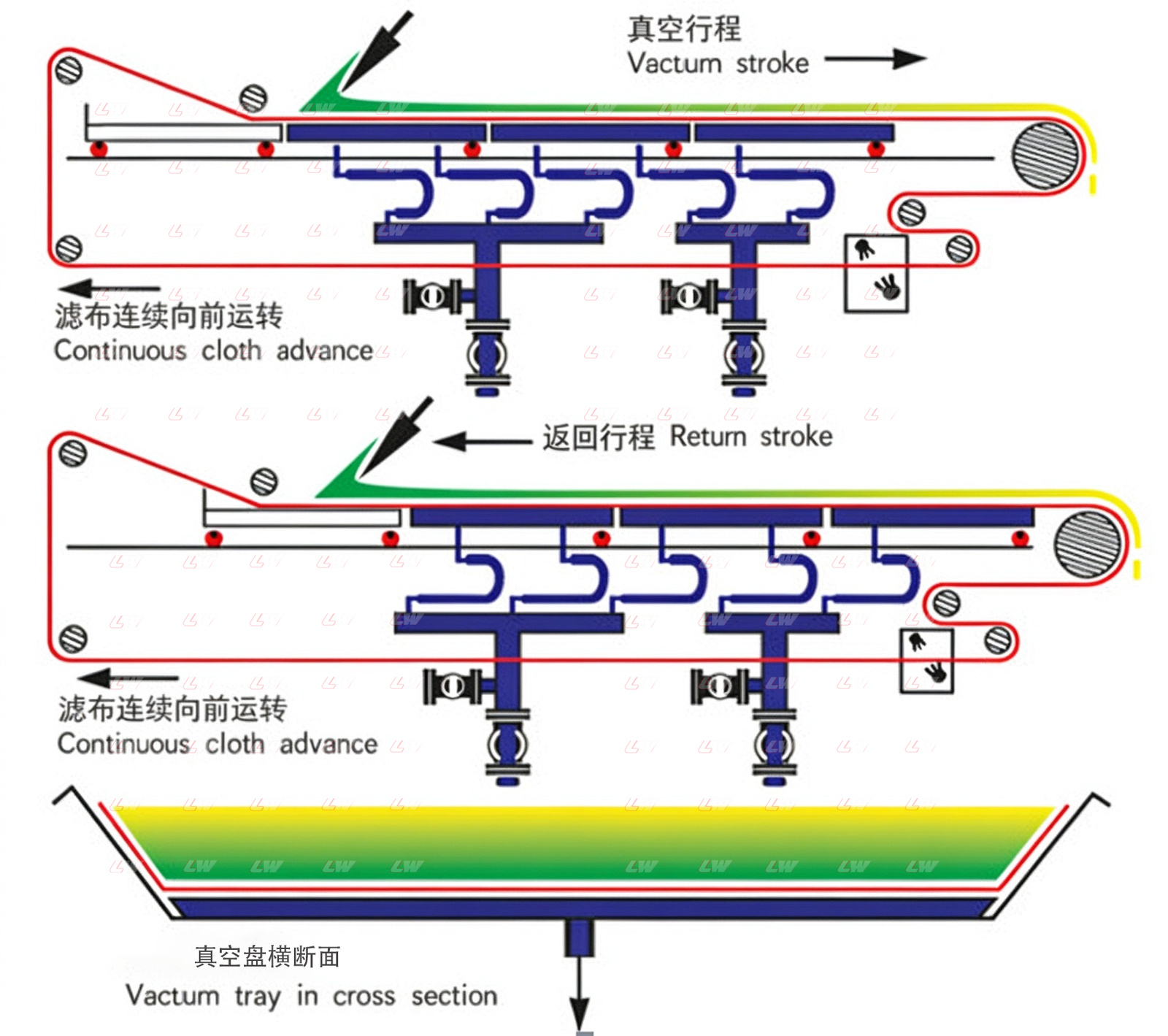
Tailings, coal slurry and mineral concentrates. Where the particles are fine or the feed is dilute, the vacuum belt press is the machine specified.
What a Belt Press Line Needs Around It
The press is one item on the equipment list. Five others decide whether it reaches its design throughput, and they are the items most often under-specified on a first enquiry.
Polymer make-up and dosing
Conditioning decides cake dryness more than any roller does. The make-up unit has to deliver fresh, fully inverted polymer at a dose that follows the feed, not a fixed set point.
Feed pump
A progressive cavity pump with variable speed, sized for the design flow at the actual head. Oversizing the pump is a common cause of sludge breaking out at the wedge zone.
Wash water circuit
Nozzles need clean water at a stable pressure. Closed-loop filtration on the wash water cuts consumption and keeps nozzles from blocking, which is the usual source of belt drift.
Filtrate return
Filtrate carries fines and polymer back to the head of the plant. Where it returns matters: sending it to the wrong point loads the clarifier with what the press just removed.
Cake handling
Continuous machines produce cake continuously. A conveyor or skip sized for peak output, not average, keeps the press from being stopped by the queue behind it.
Instrumentation
Flow, polymer dose, belt speed and torque logged together turn a dryness complaint into a diagnosis. Our panels expose these over the plant network.
We supply the press with the dosing unit and the control panel, or the whole line as a complete dewatering system.
Built and Tested in One Factory
Plants working to a fixed roll-out schedule often select Loway as their belt filter press manufacturer because frame fabrication, roller machining, assembly and the acceptance test all stay under one roof. One roof also means one counterparty for spares and warranty, which is why several of them keep the same belt filter press supplier across repeat projects.
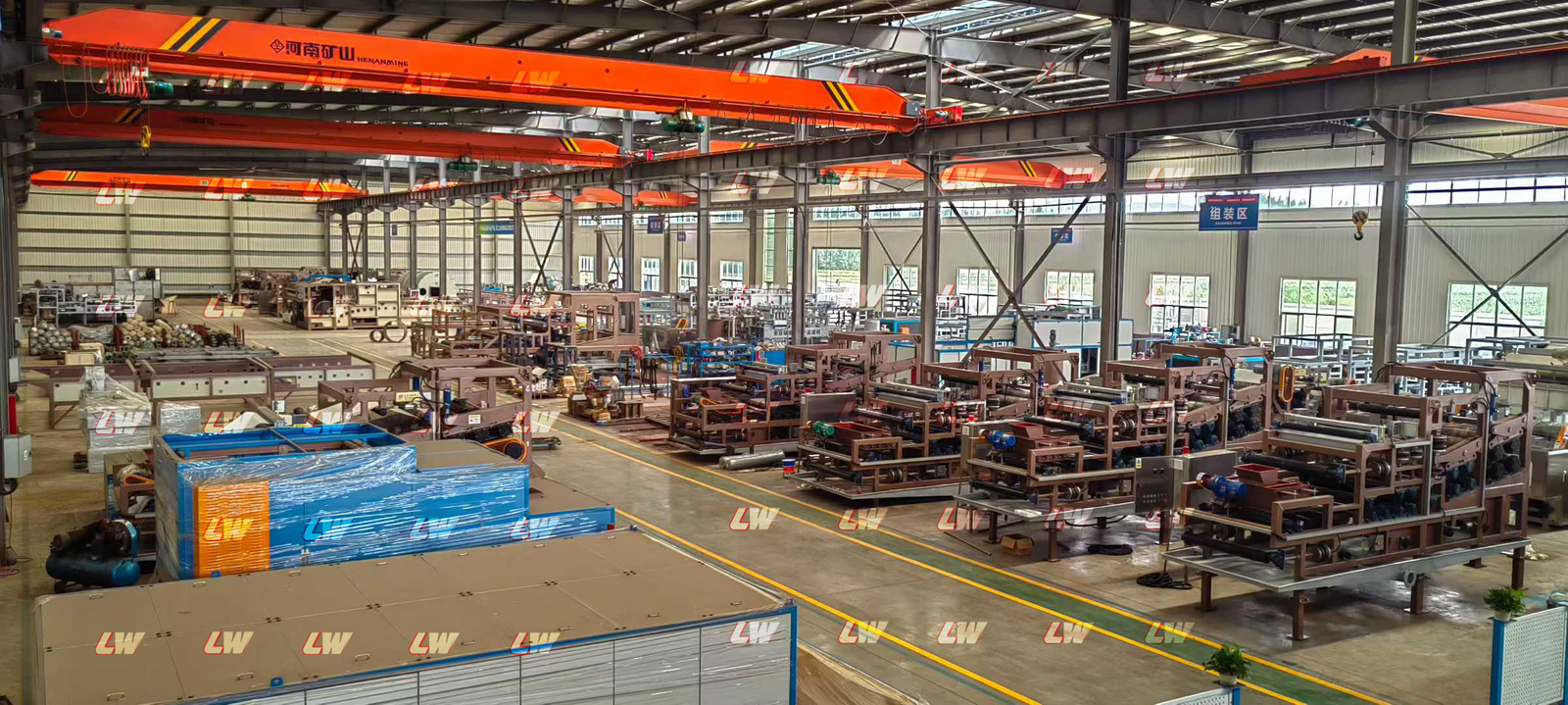
Multiple belt presses in assembly on the factory floor before acceptance testing.
Frame and rollers
Frames are cut and welded in-house; rollers are machined and balanced before assembly, so belt tracking holds from the first run.
Assembly and wiring
Each machine is assembled complete with hydraulics, wash water and panel before it leaves the bay. Belt tracking and pressure are set on the floor, not on site.
Acceptance test
The unit runs before shipment: belt tracking, pressure ramp, wash circuit and panel I/O. Test records go with the machine.
Meet the engineering team and the inspection steps behind every shipment. Every press leaves the factory with a 2-year warranty.
Where the LW Series Hands Over to Another Machine
The standard press covers most municipal and industrial sludge. Four situations call for a different build, and each one has its own page.
High-pressure press
Extra rollers and a higher tension set point take cake to ≥40% dry solids. Specified when cake feeds a dryer or incinerator and every point of dryness is measured against the fuel bill.
High-pressure belt filter pressVacuum press
Negative pressure under the belt, with counter-current cake washing. Specified for fine particles and low-concentration feeds: mining tailings, mineral concentrates, FGD gypsum.
Vacuum belt filter pressThickener and press on one frame
The gravity drainage section is lengthened so sludge enters at 1% and leaves as cake without a separate thickener, an intermediate pump or the floor space between them.
Integrated machineGravity belt thickener
Drains free water ahead of the press, taking feed from 0.5–1% to 3–6% dry solids. Cuts polymer dose and lets a narrower press handle the same flow.
Thickening optionsFrequently Asked Questions
The questions that come up before an enquiry, answered by the engineers who size the machines.
Q1. What is the typical capacity of a belt filter press machine?
Capacity is set by belt width and sludge characteristics. Our machines run from 500 mm to 3000 mm belt width, which covers roughly 10 to 100 m³/h of hydraulic feed at 97–99% moisture. Cake output in tonnes per hour depends on the solids you are capturing, so we size from a sludge test rather than from flow alone.
Q2. How does it fit into a wastewater treatment plant?
It sits after the thickener or the aeration basin and before disposal. Conditioned sludge is pumped onto the belt, water drains under gravity and then under rollers, and cake discharges continuously. Filtrate returns to the head of the plant, so the machine is a closed loop rather than a disposal step.
Q3. What maintenance does the machine require?
Daily work is a belt tracking check and a visual wash-nozzle check. Scheduled work covers roller bearings, hydraulic oil, belt condition and wash water filtration. Belts are the wearing item; service life depends on sludge abrasiveness and how well the wash circuit is kept up.
Q4. What are the common troubleshooting issues?
Three issues account for most calls: poor cake dryness, which usually traces back to polymer dose or belt speed; sludge squeezing out at the edges, which points to feed rate above the wedge zone capacity; and belt drift, which is tracking or a wash nozzle blocked.
Q5. Can the machine handle varying feed conditions?
Within its hydraulic range, yes — belt speed and polymer dose are adjusted from the panel and recipes are stored per sludge type. Feed that swings outside the design range is better handled by thickening ahead of the press, which is what the LW-T integrated machine does on one frame.
Q6. What cake dryness can it achieve?
The standard machine reaches 18–25% dry solids on municipal sludge. The high-pressure machine reaches 40% and above, and the high-pressure machine with the thickening section on the same frame reaches 30% and above. Both figures are typical ranges from factory acceptance runs; the figure for your sludge comes from a sludge test, and we quote it that way.
Q7. Can an automatic belt filter press run unattended?
Yes. The panel stores recipes for several sludge types and holds belt speed, polymer dose and pressure set points. Torque and belt tracking feedback are logged, and the machine integrates with plant SCADA for remote start and alarm.
Q8. When does the integrated thickener and press make sense?
When floor space or installation time is the constraint, or when you would rather buy one machine than two. The LW-T does gravity drainage and roller pressing on one frame, so feed at 1% leaves as cake without an intermediate pump. Where feed swings widely, a separate thickener still gives more buffer.
Q9. How do I choose between a belt filter press and a screw press?
Belt machines win on throughput and on cake dryness at large flows. Screw presses win where the plant is small, enclosed and needs to run unattended with no wash water. The technology selection guide walks through the decision, or send us your sludge data and we will run both.
Q10. What does a belt filter press cost?
There is no standard price for a belt width, because the machine is sized to your sludge rather than taken off a shelf. Belt width, frame and wetted-part material, the level of automation, and the equipment around the press — polymer dosing, feed pump, wash-water filtration, cake conveyor — move the total more than the press itself. To quote, we need four things: your feed moisture or dry solids, the flow you have to handle, the cake dryness you are aiming for, and the space you have. Send those and the proposal comes back with a sized machine, the installed power and a price. Request a technical proposal.
Sizing a machine? Start with a sludge test or send the data you already have.
Get a Machine Sizing for Your Sludge
Send feed concentration, flow and where the cake goes. We come back with the machine type, the belt width and the expected cake dryness — or with the questions that need answering first.
Related Dewatering Equipment
Where a belt press is not the answer, one of these usually is.
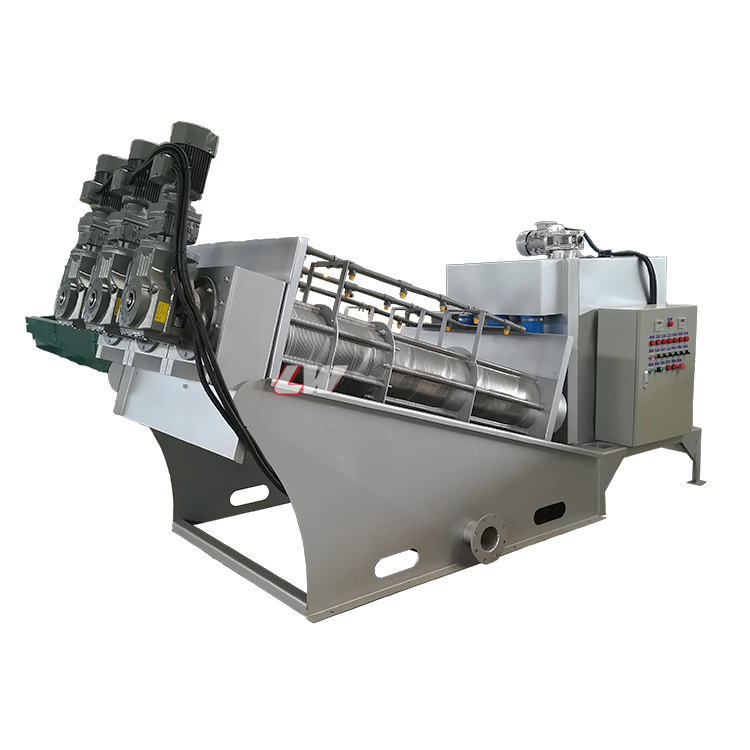
Screw Press
Enclosed, low-speed, no wash water. Fits smaller plants and oily sludge.
View screw press
Membrane Filter Press
Batch cycle, highest cake dryness of the range.
View membrane press
Mobile Filter Press
A press on a skid that moves between sites or covers a shutdown.
View mobile press
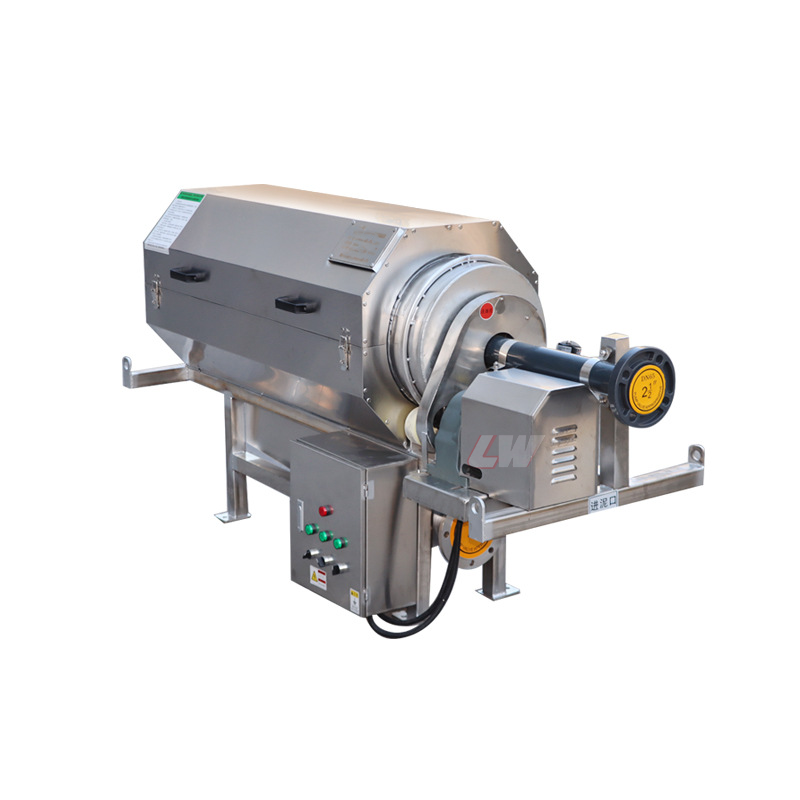
Rotary Drum Filter
Continuous vacuum filtration for fine solids and washing duties.
View rotary drum filterComparing technologies? Start with sludge dewatering equipment or the technology selection guide.