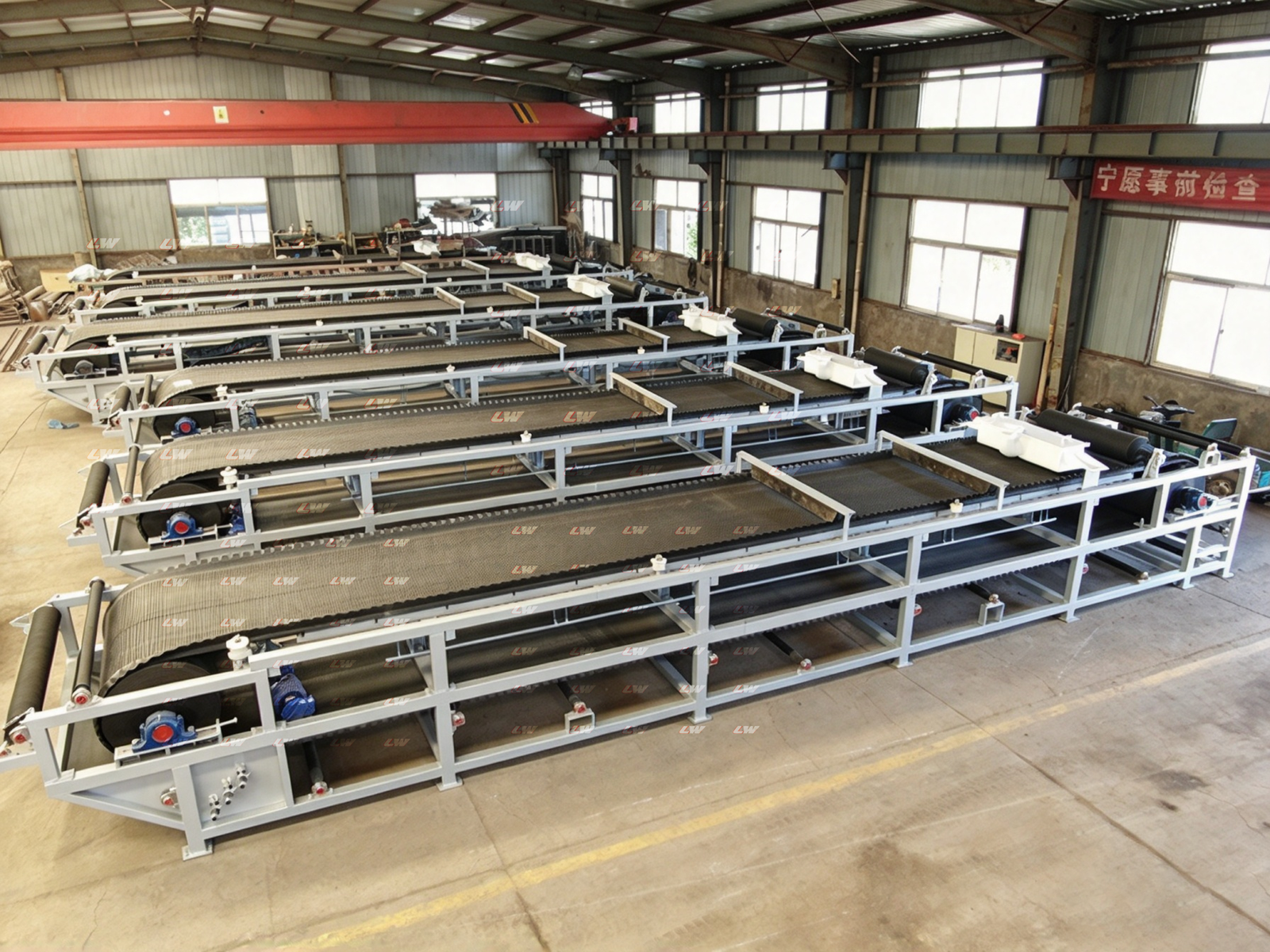
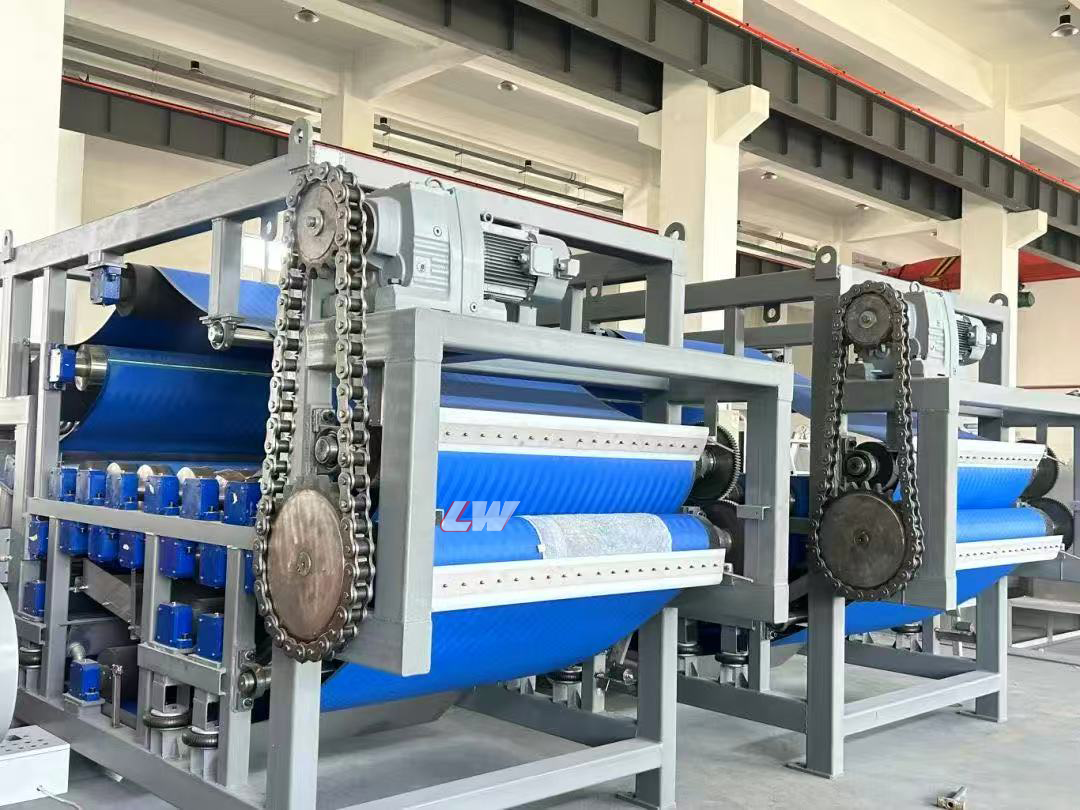
Vacuum Belt Filter Press — Continuous Filtration, Washed Cake, Clear Filtrate
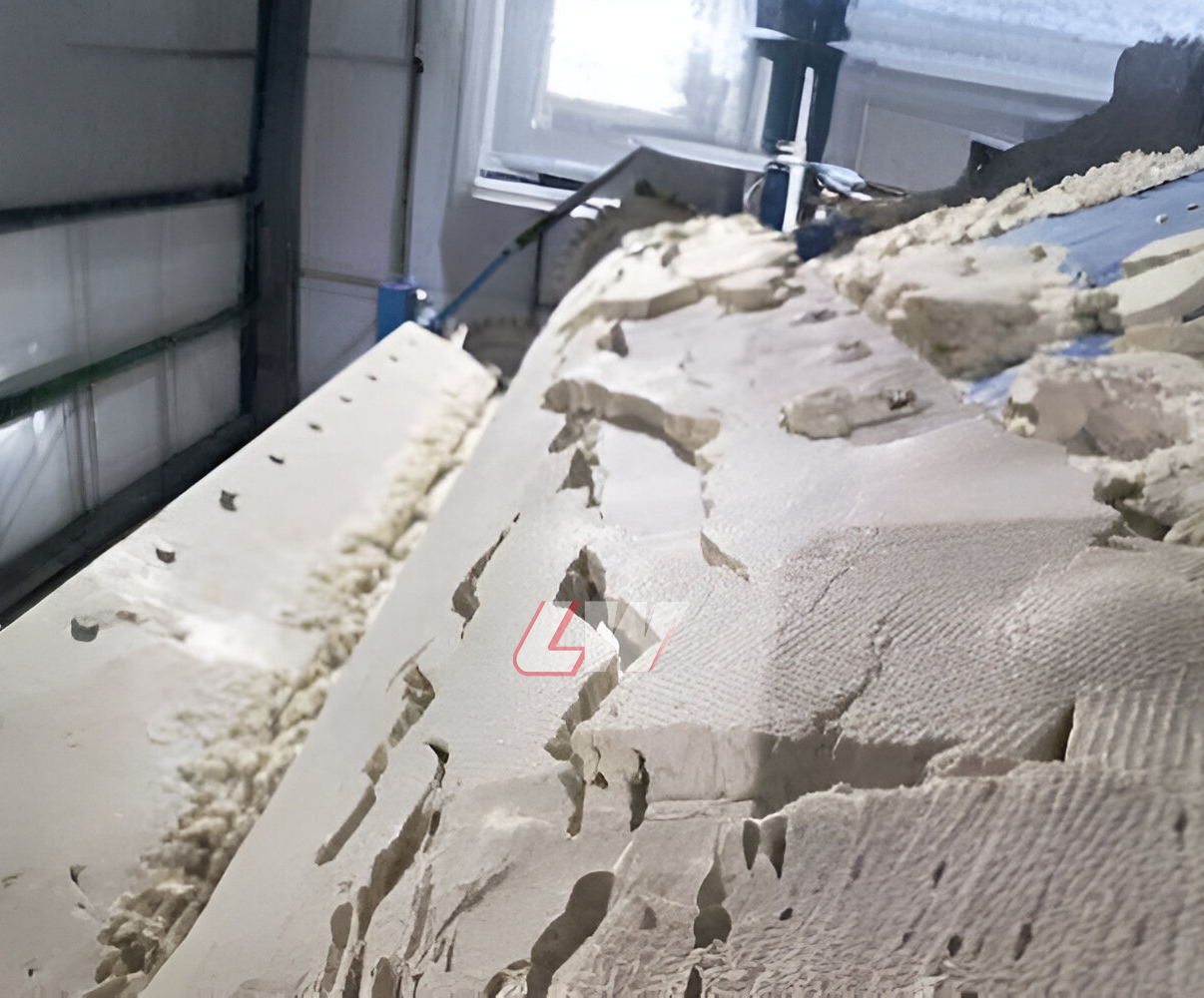
A vacuum belt filter press pulls liquid down through a travelling filter cloth instead of squeezing it between rollers. Slurry is fed at one end, vacuum boxes draw filtrate through the cloth along the full belt length, and counter-current wash stages displace mother liquor out of the cake. What leaves the machine is a washed cake at one end and clear filtrate at the other — continuously, not in batches.
One Cloth, One Pull Direction
The whole machine is a single horizontal surface. An endless filter cloth travels the length of the frame, slurry is laid on at the feed end, and every zone under the cloth either drains, pulls, washes or discharges. Nothing wraps, nothing squeezes.
- 1Conditioned sludge feed. Flocculated slurry is distributed across the full cloth width. Nothing presses it — the vacuum does the work from below.
- 2Gravity drainage. Free water falls through the cloth into the tray before any vacuum is applied, so the vacuum system only handles the water that matters.
- 3Vacuum boxes. Boxes under the cloth hold negative pressure, pulling water through the cloth and holding the cake down on the belt as it moves.
- 4Counter-current wash. Wash water sprayed onto the cake displaces liquor stage by stage into the box beneath it — clean water last, dirty liquor first.
- 5Cake discharge. A doctor blade lifts the dewatered cake off at the end roller, where the cloth changes direction. The cake leaves the machine in one pass.
- 6Filtrate manifold. Liquor collected from each box steps back toward the feed end, so the cleanest wash liquor meets the cleanest cake.
Set per project: cloth speed, vacuum level, box arrangement and wash ratio follow a bench filtration test on your slurry — the drawing shows the working principle, not a fixed setting.
Two Constructions, One Pull Direction
The LW-V vacuum belt filter press is built in two constructions. Both lay the cake on an open cloth and pull liquid down through it — the difference is whether the vacuum zone stands still under the cloth or travels with the cake.
Fixed vacuum boxes
The belt travels; the vacuum zone stands still.
- How it works: boxes are bolted to the frame under the cloth, and a water-lubricated strip carries the seal between box and belt.
- What follows: every box works continuously along its length while the cloth glides over it, so there is nothing reciprocating under the cake.
- Wear side: the strip and the belt are the consumables, and the water film that seals the box also lubricates the sliding contact.
Reciprocating vacuum pan
The vacuum travels with the cake, then resets.
- How it works: the pan moves forward with the cloth under vacuum; at the limit switch the valve releases it and a cylinder pulls it back into position in about half a second.
- What follows: vacuum acts only where the pan sits, so pans are built in sections that cover the filtration length the duty needs.
- Timing: the limit switch and the vacuum switch valve set the stroke, while the cloth itself keeps running.
Both are built, and LW-V covers the two. Which construction is quoted is settled together with the filtration area, the wash stages and the cloth, because it follows the duty and the site rather than a catalogue default. The working drawing above shows the zones both builds share.
Pull, Not Squeeze — What the Direction of the Force Changes
Gentle on the particles
Negative pressure pulls water through the cloth from below; no roller ever presses the cake. Fragile flocs, crystals and friable solids keep their structure instead of being squeezed into a blind layer, so the cloth keeps taking filtrate through the whole run.
The cake lies open on the cloth
On a vacuum belt filter press the cake is always accessible from above. Wash water goes exactly where it is needed, in as many stages as the duty requires — a layout that stays out of reach on a press where the cake is clamped between two belts. This is why cake washing is the vacuum build’s home ground.
Continuous, not cyclical
Feed in, cake out, with no filling, squeezing, opening and re-closing between cycles. The machine filters for every running hour, so a given slurry flow is handled by a smaller installed area than a batch press cycle of the same duty.
The Wash Runs Backwards — On Purpose
Wash water enters at the discharge end, where the cake is already at its cleanest. Each stage collects the liquor displaced out of the cake and passes it one stage forward, against the direction of the cake. Fresh water meets the cleanest cake; the dirtiest liquor leaves under the feed zone.
Fresh water, last stage. The final wash meets a cake that has already been displaced twice, so a small rinse flow finishes the job.
Every stage forwards its liquor. What stage 3 pulls out of the cake becomes the wash liquor of stage 2 — solubles travel forward, water travels backward.
One discharge point. Mother liquor leaves under the feed zone at its strongest, ready to return to the process or to the thickener instead of diluting clean water.
Fractions stay separate. Mother liquor and each wash liquor leave through their own outlets, so a strong stream is never diluted into a weak one. On a duty matched by leaf test, staged washing keeps driving the soluble residue in the cake down for as long as the duty needs — the figure comes from the wash ratio and the material, not from a standard rating.
Belt Widths from 500 to 4000 mm — Set by the Feed and the Duty
Belt width is confirmed against your industry, your feed and the conditions on site. The range covers 500 to 4000 mm. Filtration area comes from a bench leaf test on your slurry, and the frame is built to that figure.
Width, area and wash stages are confirmed for your duty before the proposal is issued, so the figures you receive are the ones for your material.
What fixes the area: a bench leaf test measures how fast your slurry forms cake and how wash water moves through it. The result sets filtration area, wash stages and cloth choice together, and the quotation is built on that measurement.
What is set with the machine: filtrate discharge — high-level gravity overflow or automatic zero-level, matched to the site’s drainage height — drive, cloth, and where a drier cake is needed a drying zone acting on the last part of the travel, so the product leaves the filter drier instead of going on to a separate dryer.
The Belt Carries the Vacuum — the Cloth Does the Filtering
Two endless elements run on this vacuum belt filter press, and they are not the same thing. A rubber drainage belt under the cake carries the vacuum and takes the drive; a separate woven cloth lies on top of it and does the filtering. Keeping the two apart is what makes the rest of the machine make sense.
The rubber drainage belt
- Moulded, not assembled. Belt body and drainage grooves are vulcanised in a single pass, which is where the tensile strength and the service life come from.
- It carries the vacuum. Liquid pulled through the cloth runs along the belt grooves to the manifold, and the strip between belt and box seals that sliding contact while lubricating it with water.
- It never touches the cake. The cloth lifts clear of the belt at the head pulley, so the cake releases cleanly and the belt comes back on the return side to be washed.
The filter cloth
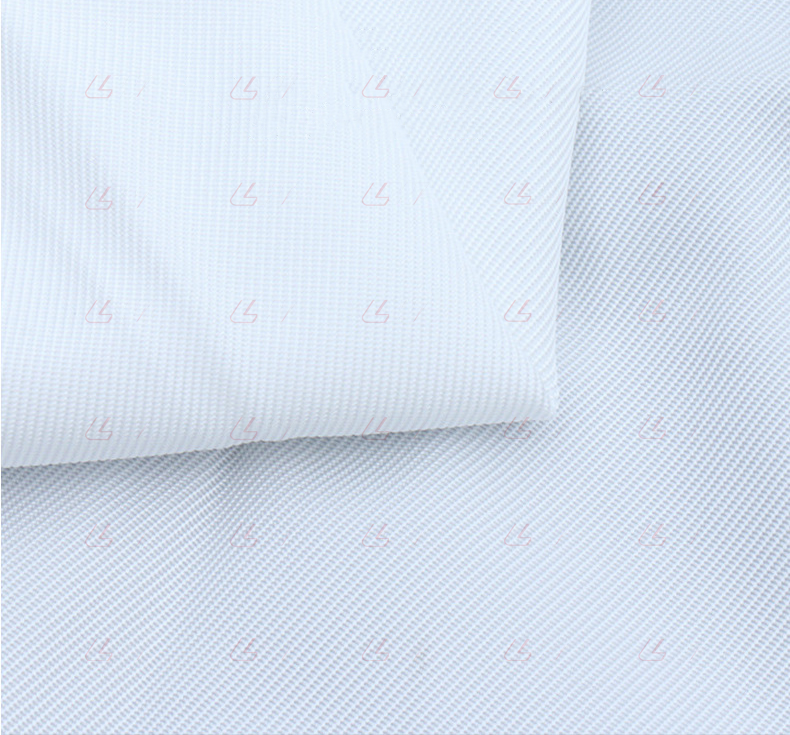
- Selection by slurry, not by catalogue. Weave, permeability and material are matched to particle size, temperature and chemistry — the same leaf test that sizes the area also screens the cloth.
- Regeneration on every revolution. Spray wash on the return side clears the cloth before it comes back under the feed, so capacity holds across the run instead of decaying between shutdowns.
- Tracking that corrects itself. Pneumatic correction keeps the cloth centred on the framing, which protects the cloth edges and keeps the vacuum seal even along the boxes.
Both are wear parts, and both are stocked. The belt is specified with the machine; the cloth is matched to your slurry and re-specified when the duty changes — which is why it is screened on the same leaf test that fixes the area. Neither is a consumable the plant has to invent locally.
Five Details That Carry the Vacuum
A vacuum belt filter press only works as well as its seal holds, so most of the engineering in this machine is about keeping negative pressure where it belongs and keeping the cloth moving with minimum wear.
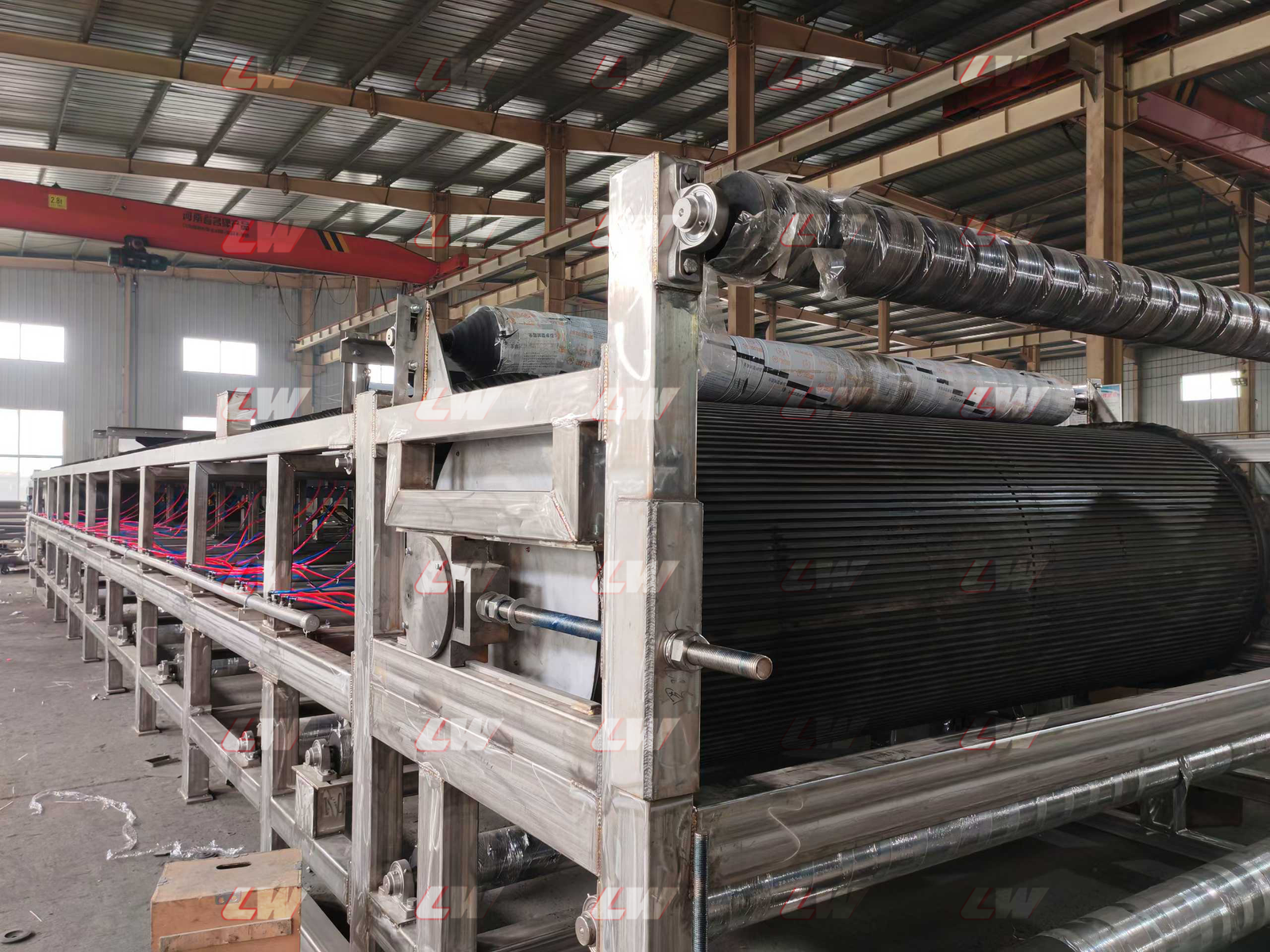
Endless rubber drainage belt
Vulcanised and moulded in one pass, with the drainage grooves formed into the belt rather than cut into it — high tensile strength and a service life measured in years of continuous running.
Water-sealed vacuum interface
A friction strip runs between the vacuum boxes and the belt, sealed and lubricated with water. It holds the vacuum level where the work happens and keeps the rubber belt from wearing against the box edge.
Discharge matched to the site
Filtrate leaves by gravity overflow where there is height to drain to, or by automatic zero-level discharge where there is not — the same machine either way, selected per installation.
Modular frame
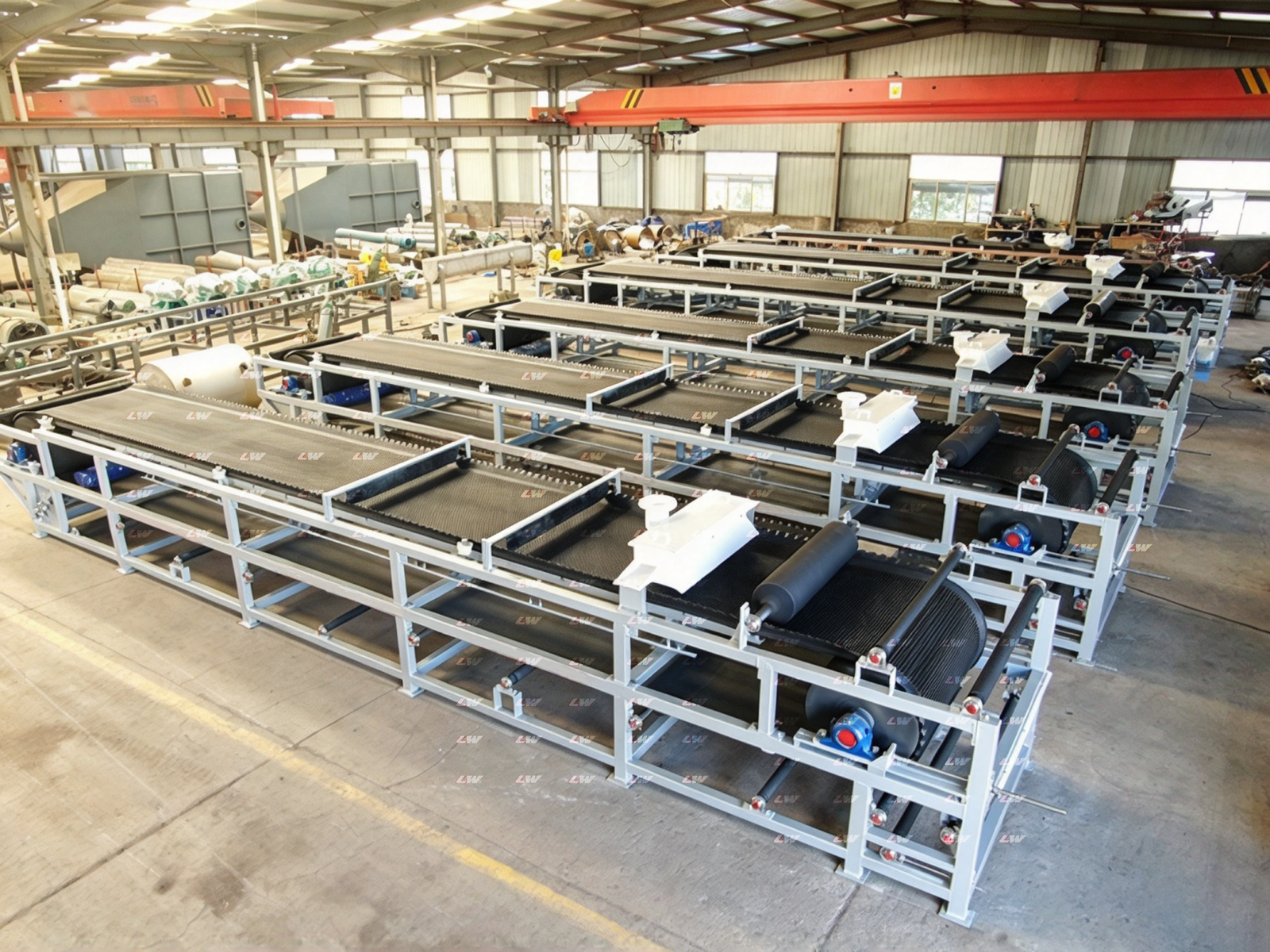
The machine is built from standard sections, so area is added in modules rather than redesigned per project. It ships in sections and is assembled on the foundation — the way large-area machines reach constrained buildings.
DCS-ready control
Local and remote automatic operation, so the vacuum plant slots into the same control room discipline as the rest of the process line. Belt speed is set by a variable-frequency drive, so throughput is trimmed to the feed without changing the machine.
Duties Where the Wash and the Filtrate Matter as Much as the Cake
Environmental remediation and pulp and paper duties round out the list. What the applications below share is a filtrate or a wash specification that decides the economics — cake dryness alone would not justify the machine.
Flue-gas desulfurization
FGD gypsum is washed to remove chlorides before it can be sold or stored. The vacuum belt filter press washes the gypsum cake in stages and returns the filtrate to the absorber — the duty this machine class is measured on in power plants.
Mining and mineral processing
Concentrates and fine tailings are washed and dewatered in one pass on the same cloth. Counter-current washing recovers soluble values into the liquor instead of losing them with the wash water, and the cake stacks for transport or dry stacking.
Chemical and coal-chemical
Process slurries where the liquor is the product, or where the cake must be washed clean of reaction chemicals before drying. Multi-stage washing on an open cake does both without re-slurrying.
Food and pharmaceutical
Starches, proteins and fermentation products filtered and washed to food-grade or pharma-grade standards. The open cake, gentle pull and washable cloth keep the product path inspectable and cleanable.
Where the sludge is biological and wash is not required, one of the belt filter presses in the LW Series usually does the job with a smaller footprint — the technology selection guide walks through that decision.
Frames, Belts and Cloth — Assembled and Tested Here
A vacuum belt filter press only performs as well as its seal holds, so the assembly steps that decide flatness and seal quality stay in one building: frame alignment, belt fitting, box sealing and a wet acceptance run before dispatch.
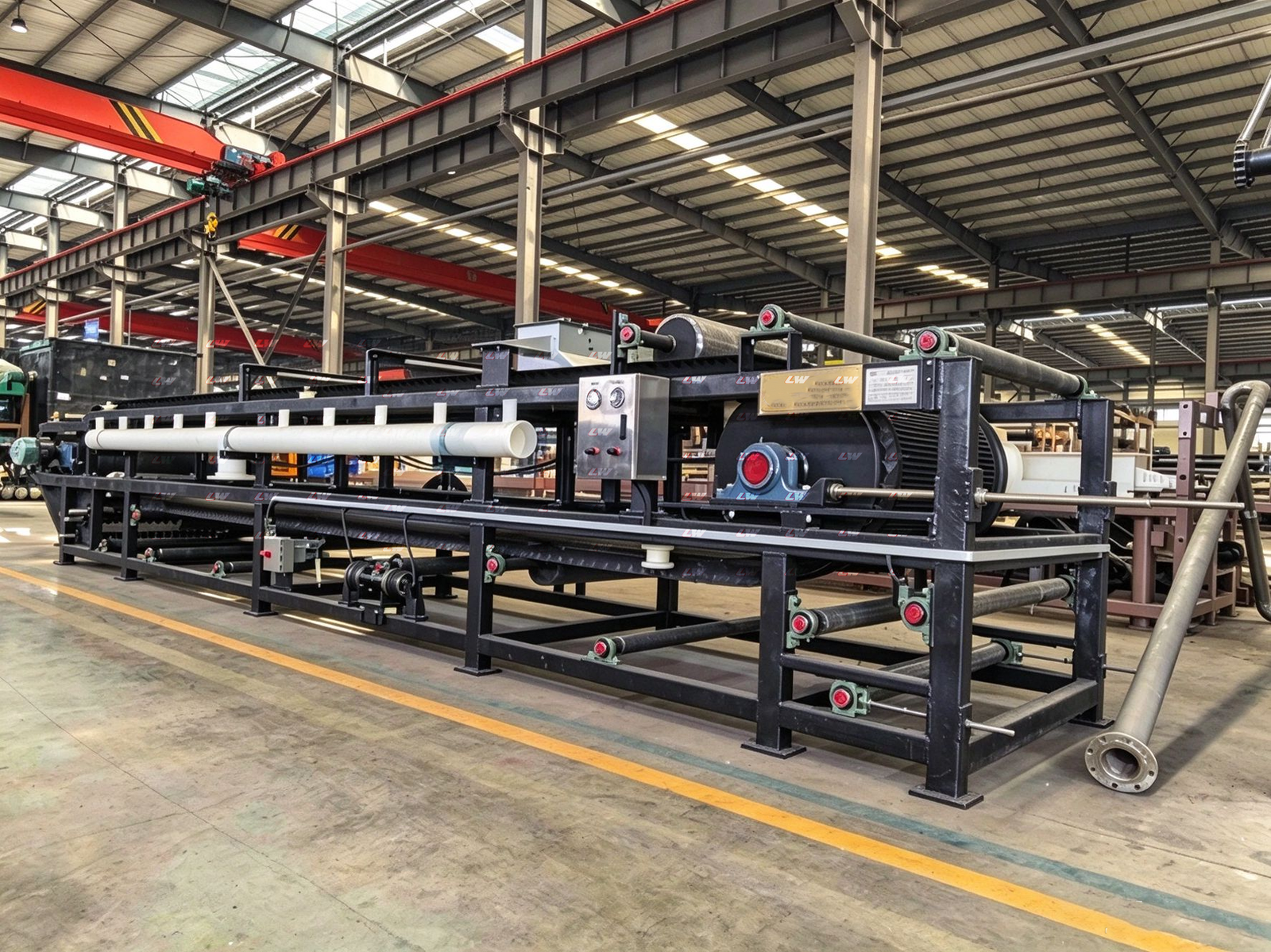
Every machine runs under water before it leaves: vacuum level at the boxes, seal behaviour along the belt, cloth tracking, wash coverage and the discharge knife. The team that assembled the unit supports commissioning on site and holds the spares and the 2-year warranty afterwards. Meet the engineering team, or read the inspection steps each unit passes before load-out.
Frequently Asked Questions
Q1. How does a vacuum belt filter press work?
Flocculated slurry is fed onto a travelling filter cloth. Free water drains by gravity first; then vacuum boxes under the cloth pull the remaining liquid through the cloth while the cake rides on top. Wash water can be sprayed onto the open cake in several counter-current stages, and the finished cake is lifted off by a doctor blade at the end roller. The machine runs continuously — there is no fill-and-press cycle.
Q2. Does the machine use moving vacuum pans or fixed vacuum boxes?
Both constructions are built, and LW-V covers the two. With fixed boxes, the cloth and cake travel over boxes bolted to the frame, sealed against the belt by a water-lubricated strip, and the vacuum zone stands still. With the reciprocating build, a vacuum pan travels forward with the cloth under vacuum, releases at the limit switch and is pulled back by a cylinder before it picks up again. Which one is quoted is settled with the area, the wash stages and the cloth, because it follows the duty and the site rather than a catalogue default.
Q3. What cake moisture can it reach?
It depends on the material, and we do not quote one number for every slurry. Fast-draining mineral and crystalline solids reach their practical limit on this machine class; fine biological sludge dries less than a pressing machine would achieve. The honest way to find your number is a bench leaf test on the actual slurry, which we run before any machine is sized.
Q4. When is vacuum specified instead of a pressing belt filter press?
The vacuum build is typical where cake washing drives the economics — FGD gypsum, mineral concentrates, chemical and food-grade products — or where the slurry is too fine and too abrasive for a pressing cloth to survive. Where sludge is biological and washing is not required, a pressing belt press or a screw press usually does the job in a smaller footprint.
Q5. How many wash stages can the machine carry?
The wash zone is built from modular stages, and the number is set by how far the solubles have to be displaced — determined by the wash ratio from your bench test. Counter-current arrangement means each added stage uses its liquor to feed the stage before it, so extra stages add wash efficiency without adding much water consumption.
Q6. What does the filtrate look like?
Solids are retained on the cloth, so filtrate clarity is high from the first vacuum box onward. The counter-current arrangement means the dirtiest liquor leaves under the feed zone and the cleanest filtrate comes from the final wash — which is what makes filtrate recycling back into the process practical.
Q7. How is the cloth kept clean?
A spray wash on the return side regenerates the cloth on every revolution, and pneumatic tracking keeps it centred so the edges are not scuffed against the framing. Cloth is a stocked wear part: the plant replaces it on site without dismantling the machine.
Q8. What sizes does the LW-V series cover?
Belt widths run from 500 to 4000 mm, and the exact figure is confirmed against your industry, your feed and the site conditions. Filtration area on top of the belt is fixed by a bench leaf test on your slurry, and because the frame is modular the area is set case by case.
Q9. How is a vacuum belt filter press selected for my slurry?
From a bench leaf test: filtration rate, cake formation time and wash behaviour measured on your slurry set the area, the number of wash stages and the cloth together. Send the slurry source, solids and particle size, the wash requirement and where the cake goes, and the proposal comes back with the sized machine.
More background: the LW Series belt filter press range or the technology selection guide.
Send Us the Slurry — We Will Size the Area
The filtration area, the wash stages and the cloth are all fixed by one bench test on your slurry. Tell us what you are filtering and what the wash has to achieve, and we will come back with a sized vacuum belt filter press — or with the one question that needs answering first.
- Slurry source and solids
- Particle size
- Wash requirement
- Filtrate destination
- Where the cake goes
Other Machines in the Range
Where continuous washing is not the driver, one of these usually fits better.
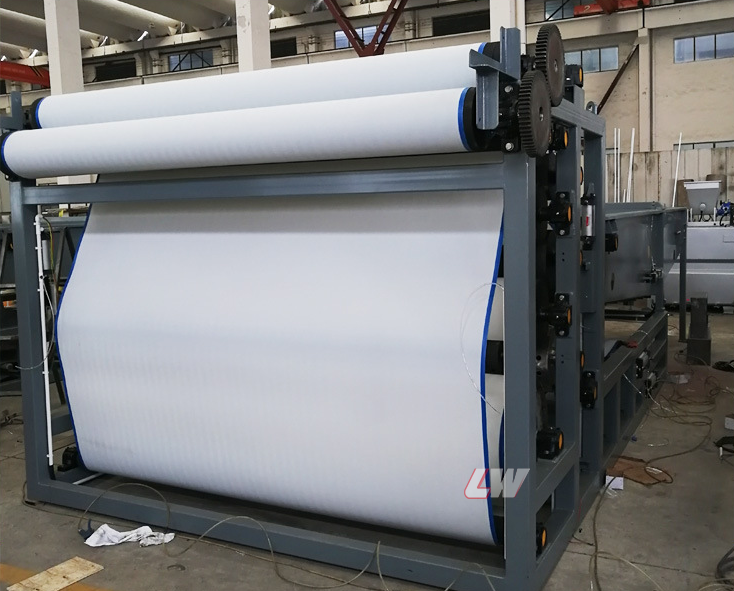
High-Pressure Belt Press
LW-H and LW-HT, for cake at 30–40% dry solids or better.
View high-pressure press
Comparing technologies? Start with sludge dewatering equipment or the technology selection guide.