LWRD series · two constructions · 10 μm – 2.5 mm

Rotary Drum Filter — Gravity-Driven Filtration from 10 μm to 2.5 mm, Internal or External Feed

A rotary drum filter is a self-cleaning fine filter: a rotating drum covered in fine mesh panels turns continuously in the liquid, water passes through the mesh, and the captured solids are washed off by an automatic backwash spray before they can blind the surface. Gravity does the separation and plant water does the cleaning, so the list of powered duties stays short — which is why the rotary drum filter has become the standard polishing and pre-treatment machine on municipal and industrial wastewater, aquaculture recirc systems and food processing water loops. The LWRD range covers that job in two series — a standard series rated 20 micron to 2.5 mm and a precision series for 10–20 micron polishing — each available with internal-feed or external-feed construction to match the solids in your water.
Self-cleaning backwashthe mesh is washed as the drum turns — no stop-and-clean routine
10 μm – 2.5 mm mediatwo series — standard wedge-wire or mesh 20 μm–2.5 mm, precision 10–20 μm — panels changed individually without touching the frame
Two powered dutiesthe drum drive and the backwash pump — gravity does the separation
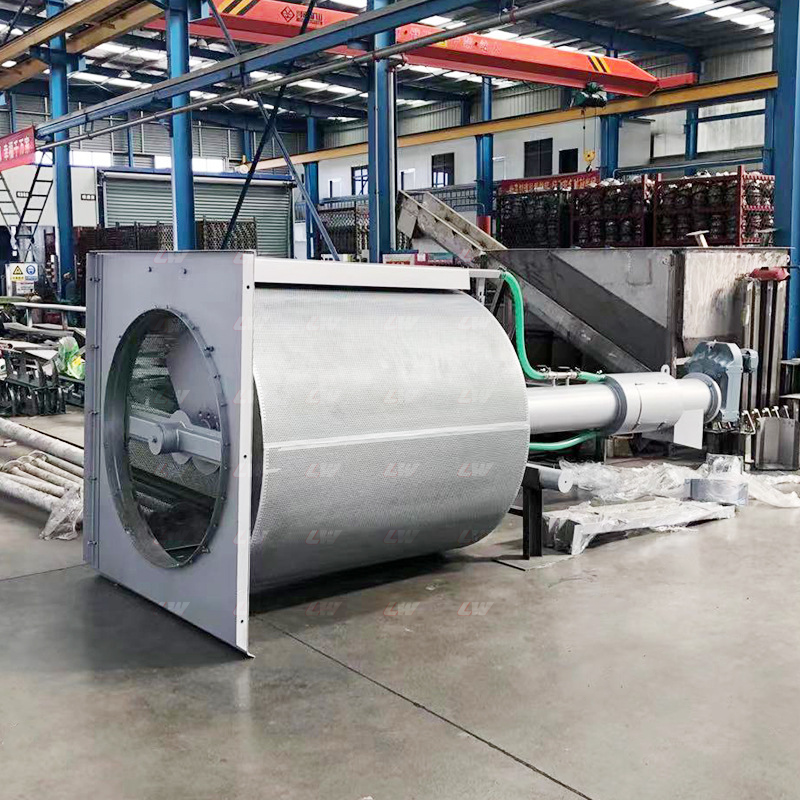
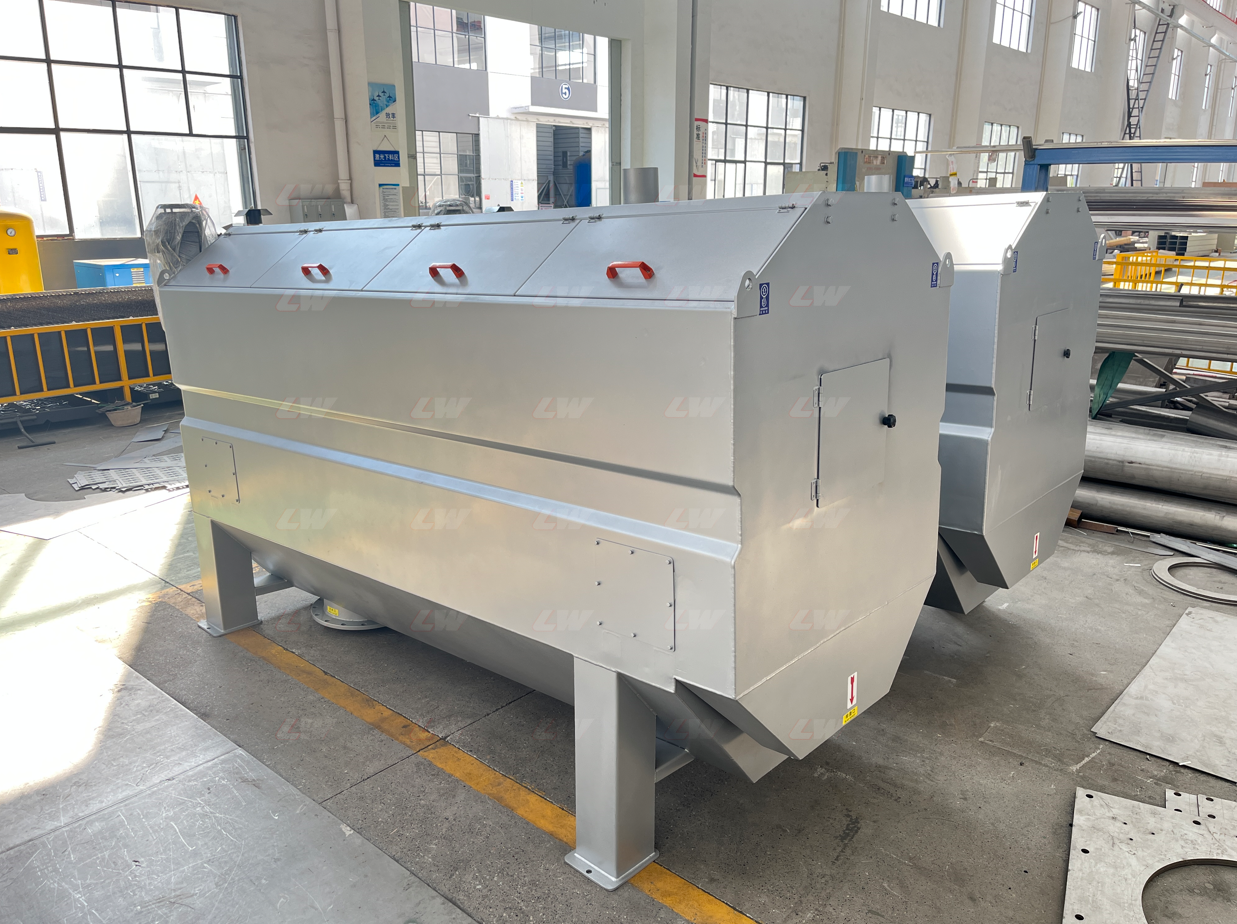
Loway LWRD rotary drum filter unit in stainless steel, shown from the side with access covers and support frame
A finished LWRD rotary drum filter at the Loway works: stainless tank, mesh drum and drive end on a skid-mounted frame.
Terminology, made clear

Rotary Drum Screen, Drum Filter or Vacuum Drum Filter?

These three machines get mixed up more often than they should — they all rotate, they are all cylindrical, and the same word gets used for more than one of them. The real difference is what each one does to the solids.

Screening

Rotary drum screen

A coarser rotating screen for removing trash, fibres and debris — intake protection, primary screening and protection of downstream units such as MBR systems.

Typical role: first line of defence before finer treatment.

See the rotary drum screen page →
This machine

Rotary drum filter

A rotary drum filter is a self-cleaning fine filter working the 10 μm – 2.5 mm band in two series, gravity-fed, with no vacuum and no cloth. Solids are held on the mesh and washed off — the goal is clear water, not a dry cake.

Typical role: TSS polishing on municipal and industrial wastewater, RAS solids control, process-water loops.

You are on this page
Dewatering

Rotary vacuum drum filter

A vacuum-assisted drum that pulls liquid through a cloth and forms an actual cake. Different job: it concentrates high-solids slurries instead of polishing large flows of dilute water.

Typical role: slurries and dewatering — a different selection conversation.

Compare separation technologies →

In practice the boundary is the mesh and the duty: if your liquid is a large flow with dilute suspended solids and the target is clean water, you are in rotary drum filter territory; if it is a thick slurry that must leave as a cake you can handle, the vacuum or filter-press route fits instead. If you arrived searching for a drum screen, that machine is on its own page — both are built at the Loway works, so either can be sized against your duty.

Where it sits

Fine Filtration Is Its Own Band — Where This Machine Sits

Every solid-liquid separation step has a particle range it handles best. A rotary drum filter works the band between coarse screening and membrane filtration: mesh ratings from 10 microns up to 2.5 mm, at flows that would make a filter press impractical — and a rotary drum filter serves that band without ever stopping. The LWRD range covers it in two series: standard, 20 μm – 2.5 mm, and precision, 10–20 μm.

This machine — LWRD, two series Rotary drum filter — standard series 20 μm – 2.5 mm general-duty fine filtration · wedge-wire or mesh · auto backwash precision series 10 – 20 μm Membrane / ultrafiltration below 1 μm 2.5 mm 1 mm 300 μm 100 μm 20 μm 10 μm 1 μm particle size decreases from left to right — band positions are indicative, exact cut is set by mesh selection
Coarse removal — above 2.5 mmBar screens and coarse strainers catch rags, plastics and grit. They protect pumps, but they do not polish water.
Rotary drum screensThe upstream sibling: a rotating screen built for debris and fibre at high flow. Its band overlaps the top of this machine’s range, so when a duty lands between screen and filter, the water-quality target decides — that machine has its own page.
Rotary drum filter — this machine, 10 μm – 2.5 mmTwo series cover the band: the standard series works 20 μm to 2.5 mm general-duty filtration, the precision series works 10–20 μm high-flow polishing. Gravity-fed, backwashed automatically — this is where TSS polishing on wastewater and RAS solids control happen.
Membrane & ultrafiltration — below 1 micronDissolved and colloidal matter. A different technology with different economics — a drum filter is often the guard that keeps membranes from fouling.
Working principle

Rotary Drum Filter Working Principle: Filter, Ride Out, Wash, Repeat

The cycle runs continuously while the drum turns. A rotary drum filter never shuts down to clean itself — the washing zone and the filtering zone exist at the same time, on different parts of the same rotating surface.

1 · Feed to the tank liquid level rotating drum mesh panels on the surface 3–4 · Solids ride out, backwash drops them into the trough solids trough 5 · Filtered water out 2 · Water through the mesh, solids stay on it
1
Feed enters the tank. Liquid flows into the filter tank by gravity or low-head pumping and surrounds the lower part of the drum.
2
The mesh does the filtering. As the drum turns, water passes through the fine mesh panels and the suspended solids are held back. Which side of the drum the feed enters on is set by the arrangement built for your duty.
3
Solids ride out of the liquid. Captured material is carried clear of the liquid as the drum rotates — it never packs up in place.
4
Backwash lifts the solids off. Spray nozzles wash the loaded mesh from above, and the solids drop into the collection trough.
5
Filtered water leaves. Water passes out of the tank to the next process step. On a rotary drum filter the mesh returns to the liquid already clean.
Two constructions

Internal Feed or External Feed — Built to Match Your Solids

The same drum, mesh and backwash are available in two feed arrangements. The difference is which side of the mesh does the filtering, and it is decided by what your water carries.

Internal feed

Water enters inside the drum

Feed flows axially into the drum; filtered water passes outward through the mesh and solids collect on the inner surface, where the spray washes them into an internal collection trough. A compact footprint, often with a screw-assisted discharge inside the drum.

Typical duty: algae and floating-matter removal on raw water, RAS aquaculture, fine TSS polishing on municipal and industrial wastewater. Head loss: 50–150 mm — the lower of the two, so civil works stay shallow. Note: on very high solids loads, material can accumulate inside the drum — flagged from your feed analysis.

External feed

Water flows in from outside

Feed flows around the outside of the drum and filtered water passes inward into the drum core; solids collect on the outer surface, are washed off at the top and drop into a discharge hopper below. Fewer parts sit in the water and cleaning access is simpler.

Typical duty: hair, fibre and pulp-carrying effluent — paper-mill, slaughterhouse, textile and MBR pre-protection run best on this arrangement. Head loss: 80–180 mm. Note: hard coarse particles can strike the mesh — a coarse pre-screen upstream is advised.

Both arrangements are built at the Loway works. Send the feed analysis and we will confirm which construction your duty takes.

Key components

Six Parts Do All the Work

A rotary drum filter has no cloth to tension, no vacuum system and no pumps in the process stream. On wastewater duty that decides more than anything else: availability comes down to six components, and all six are accessible from outside the tank.

01

Mesh panels

The rotary drum filter medium: wedge-wire or woven mesh panels clamped around the drum in sections, rated from 10 microns to 2.5 mm depending on the series. Panels are changed individually, so a rating change is a maintenance job, not a rebuild.

02

Backwash spray bar

A spray bar above the drum washes each panel the moment it leaves the liquid. Nozzles are outside the process, so they stay serviceable without draining the tank.

03

Solids trough

The washed-off solids fall into a trough that carries them out of the machine. It is open and visible — you can see what the filter caught.

04

Tank, seals and weirs

The stainless tank sets the liquid level around the drum. Seals between drum and tank keep the flow going through the mesh instead of around it.

05

Drum drive

One geared drive turns the drum at low speed — typically 1–4 r/min, with variable-frequency control where the load swings.

06

Level control and PLC

A level sensor in the tank starts and stops the drum and backwash automatically as the load changes, with overload protection and alarms — the machine runs unattended.
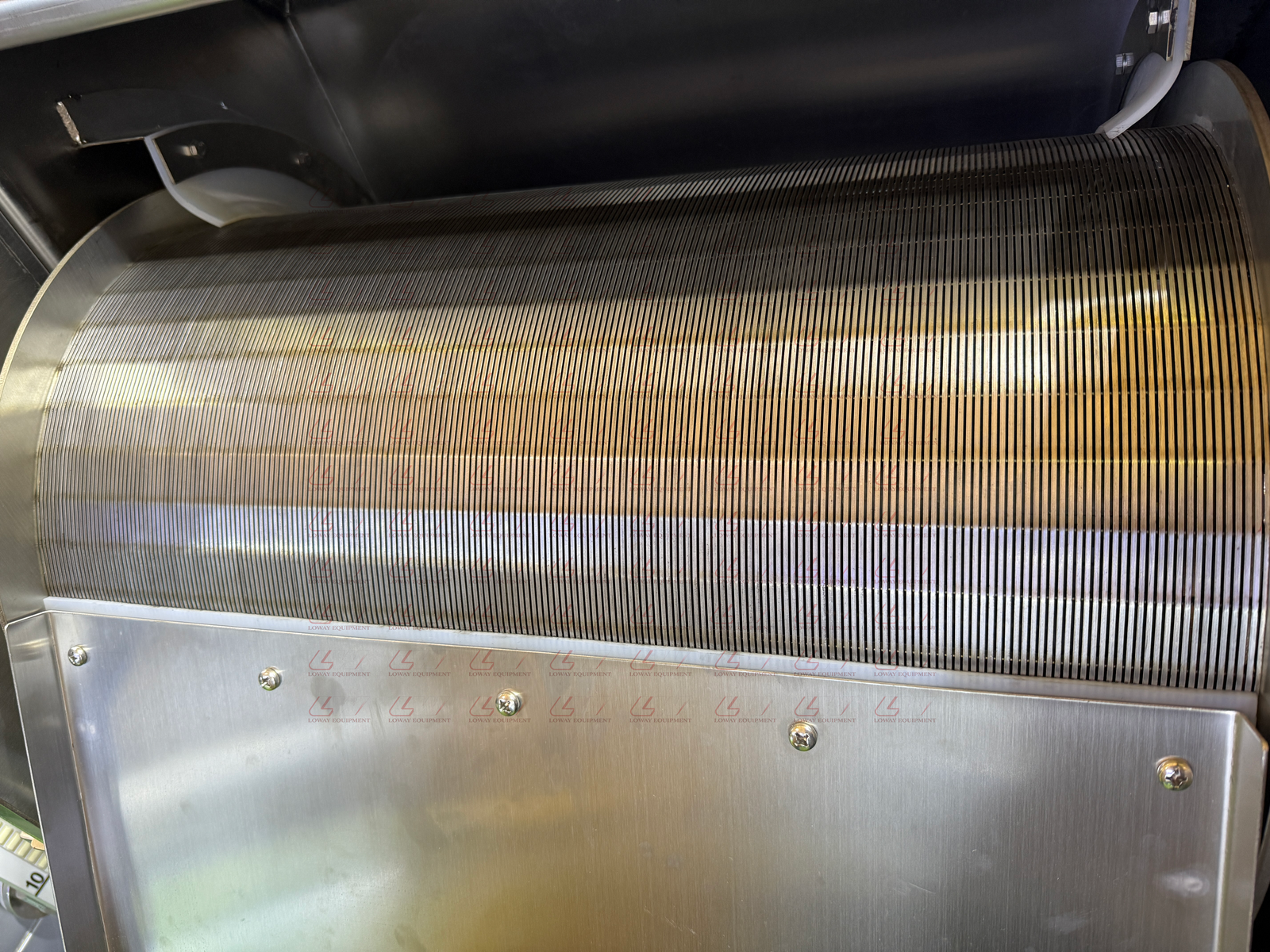
Inside a Loway rotary drum filter, showing the wedge-wire mesh panels clamped in sections around the drum
Inside the drum: the filtering medium is wedge-wire mesh panel sections, each one removable on its own clamp ring.
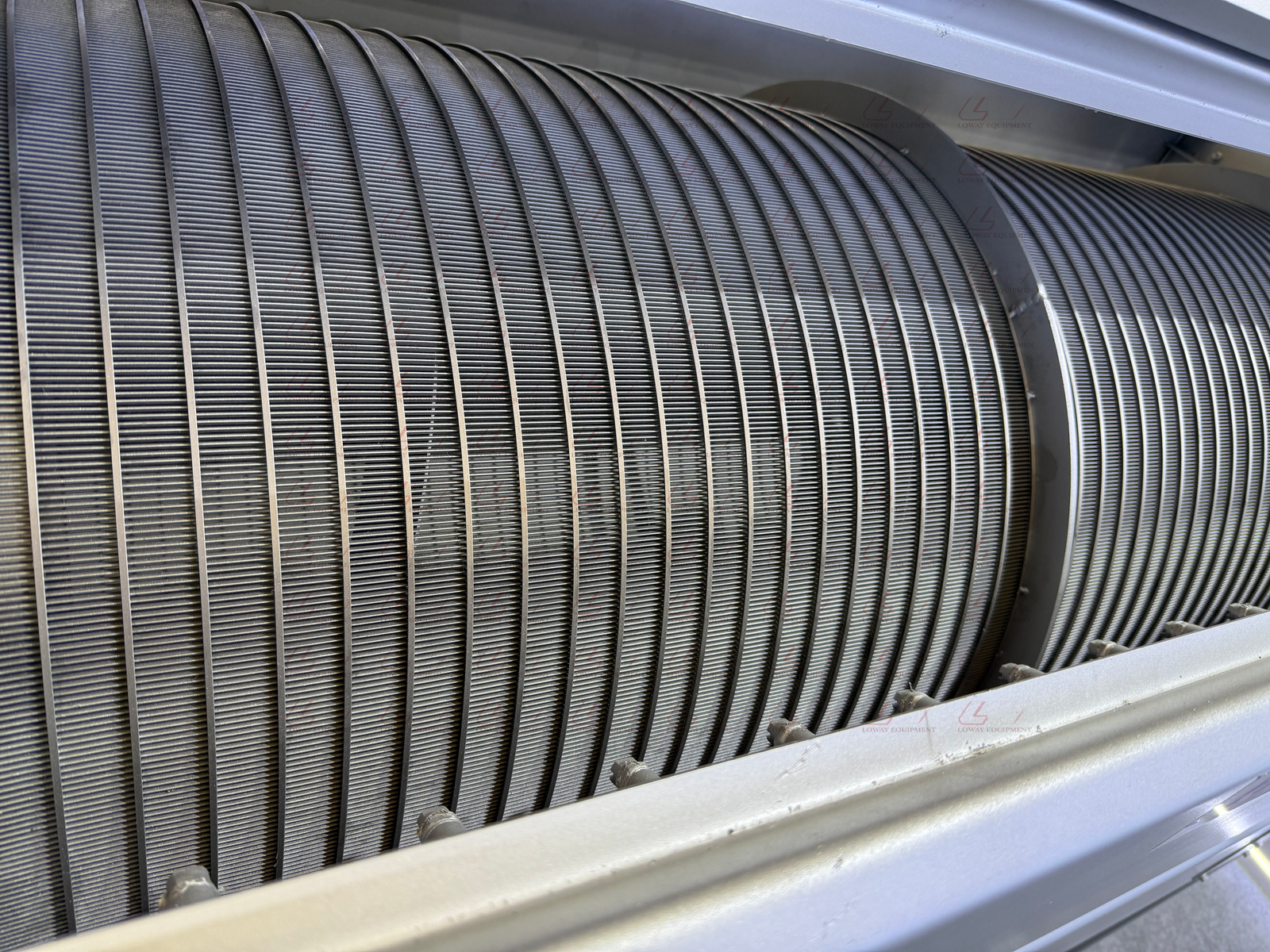
Close view of the wedge-wire mesh surface on a Loway rotary drum filter
The mesh surface that does the fine cut, and the backwash spray that clears each panel before it returns to the liquid.
Typical duties

Three Duties Where a Rotary Drum Filter Is the Default Choice
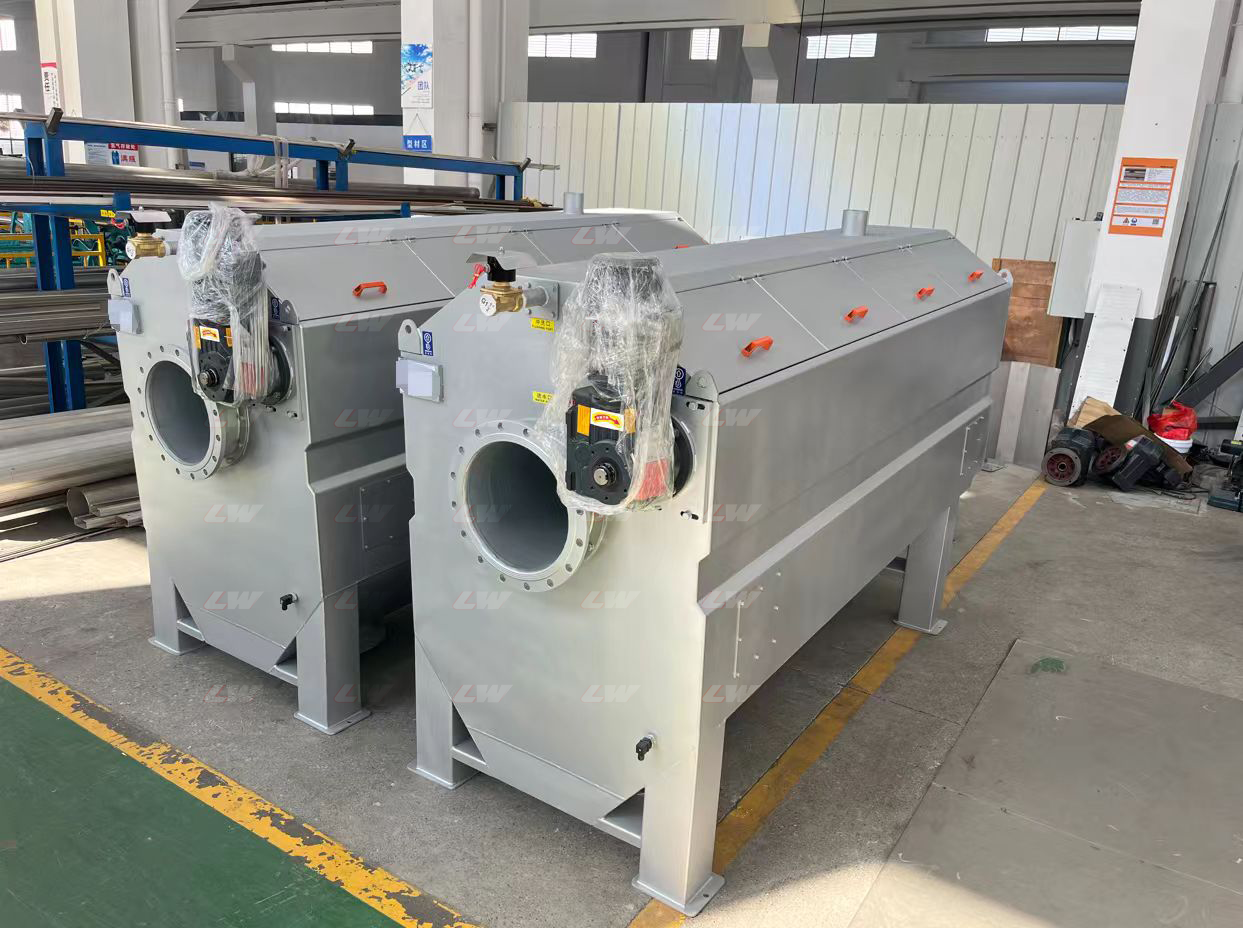
Loway rotary drum filter unit at the works, showing the feed flange, drive end and access covers

Municipal and industrial wastewater

Polishing after primary treatment, or pre-treatment ahead of biological stages and dewatering equipment. On municipal and industrial wastewater the rotary drum filter strips the suspended load that would otherwise be carried into the next process, and runs unattended as part of the plant’s front line.

Loway rotary drum filter unit built for aquaculture duty, showing the drum, drive end and tank on the support frame

Aquaculture and RAS

Recirculating systems live on this machine: it takes out feed waste and faecal solids continuously, which is what keeps oxygen demand down and fish healthy. Fine mesh ratings and gentle flow handling are the reasons RAS designers specify a rotary drum filter rather than a coarse screen.

Detail of the fine mesh surface on a Loway rotary drum filter, rated for fine solids removal in food and process water duty

Food and process water

Wash water loops, effluent with recoverable solids, and closed process streams that must stay clean and enclosed. A 316L build and a fine mesh rating are what let a rotary drum filter hold this kind of duty. Send the water analysis and we will confirm the rating.

Selection

Four Inputs Decide the Machine

A rotary drum filter is sized from your duty. The LWRD series runs from 20 to 1,250 m³/h (480 to 30,000 m³/d) across two series; which one your project lands on — and what the machine is built from — comes from four inputs.

Flow and loading

Daily flow, peak flow and how steady it is. Sizing starts here — a steady low flow and a storm peak lead to different answers.

Solids in the feed

TSS concentration and what the particles are. Fibrous, gritty and biological solids behave differently on the same mesh.

Mesh selection

The rating that meets your water quality target while still releasing during backwash. The rating is confirmed against your feed and your water-quality target.

Material and site

304 as standard, 316L where corrosion calls for it. Plus what surrounds the machine: indoor or outdoor, winterising, layout constraints.

480 m³/d30,000 m³/d

Two series cover that span — a single compact rotary drum filter on a fish farm through to multi-drum trains on municipal and industrial works. The model for your project is confirmed against your flow, your TSS and the site conditions.

Series data

LWRD precision series — 10–20 μm, high-flow polishing

ModelFlow (m³/d)Flow (m³/h)Filter area (m²)Drum (mm)Overall L × W × H (mm)Inlet / outletDrive (kW)Backwash pump (kW)Backwash (bar)
LWRD-20001,000–2,50042–1041.5Ø1,000 × 1,0002,500 × 1,400 × 1,800DN2000.551.56–7
LWRD-30002,500–4,000104–1671.8Ø1,200 × 1,2002,700 × 1,600 × 2,000DN2500.552.26–7
LWRD-50004,000–6,000167–2503.0Ø1,300 × 1,5003,000 × 1,700 × 2,200DN3500.753.06–7
LWRD-100006,000–10,000250–4176.0Ø1,400 × 2,5004,000 × 1,800 × 2,300DN5000.754.06–7
LWRD-1500010,000–15,000417–6259.0Ø1,400 × 3,0004,500 × 1,800 × 2,300DN6001.14.06–7
LWRD-2000015,000–20,000625–83312.0Ø1,400 × 4,5006,000 × 1,800 × 2,300DN7001.55.56–7
LWRD-2500020,000–25,000833–1,04215.0Ø1,500 × 4,6006,100 × 1,900 × 2,500DN7001.55.56–7
LWRD-3000025,000–30,0001,042–1,25018.0Ø1,500 × 5,5007,000 × 1,900 × 2,500DN8001.57.56–7

Nominal series figures for 10–20 μm media at 6–7 bar backwash pressure. The model, media rating and materials of your rotary drum filter are confirmed against your flow, your TSS and the site conditions before the proposal is issued.

Series data

LWRD standard series — 20 μm – 2.5 mm, general-duty fine filtration

General parameters — both constructions

ParameterRangeNotes
Filtration principlegravity screeningno vacuum, no negative pressure, no feed pump
Mesh mediawedge-wire or woven meshpanel-built, sections changed individually
MaterialSS304 / SS316L316L for seawater and corrosive effluent
Filtration rating20 μm – 2.5 mmcommon ratings: 50, 80, 100, 150 μm; finer 10–20 μm on the precision series
ControlPLC + level sensorautomatic start/stop, fault alarm, optional remote signal output
Backwash mediumfiltered plant waternormally recycled to the head of the plant
Backwash pressure0.3–0.4 MPaprecision series runs 6–7 bar
Backwash consumption0.5–3% of throughputautomatic — filtration continues during washing
Drum speed1–4 r/minvariable-frequency drive
SS removal60–95%depends on feed TSS and mesh rating

Internal-feed models

ModelDrum Ø × L (mm)Flow (m³/h)Drive motorHead loss
LWRD-600Ø600 × 1,00020–750.37 kW50–150 mm
LWRD-800Ø800 × 1,50050–2500.55 kW50–150 mm
LWRD-800LØ800 × 2,00080–4000.75 kW50–150 mm

External-feed models

ModelDrum Ø × L (mm)Flow (m³/h)Drive motorHead loss
LWRD-600Ø600 × 1,00030–800.37 kW80–180 mm
LWRD-800Ø800 × 1,20080–1600.55 kW80–180 mm
LWRD-1000Ø1,000 × 1,400160–2600.75 kW80–180 mm

Flows are rated on clean water at low feed TSS; actual wastewater capacity falls with feed solids and fibre load, and larger non-standard drum sizes are available. The model, mesh rating and materials of your rotary drum filter are confirmed against your flow, your TSS and the site conditions before the proposal is issued.

316L for corrosive duties Heated, insulated covers for outdoor installs Level-controlled automatic backwash Multi-drum trains Skid-mounted builds Solids collection cart 1–4 r/min variable-speed drum Internal or external feed construction
Request a sized proposal General arrangement drawings, electrical data and layout are issued with every proposal.
Running cost

Why the Running Cost Stays Low

Gravity does the separation

Water flows through the mesh under head, not under pump pressure. There is no vacuum system to run, which is the largest single difference between this machine’s operating cost and a vacuum drum filter’s — a vacuum unit pays continuously to pull a cake; here the only powered duties are turning the drum and running the backwash pump.

The machine cleans itself

Backwash runs automatically as the drum turns, using plant water. Nobody opens the machine to clean the mesh, so the labour line stays near zero and a rotary drum filter never stops for cleaning.

Wear parts are few and outside the process

Mesh panels, spray nozzles and seals — that is the wear list. Panels are changed section by section without dismantling the drum, and nozzles sit above the water line where they can be serviced in minutes. Wear parts are stocked at the Loway parts page.

Scope of duty

What a Rotary Drum Filter Does — and Does Not — Do

Honest scope, because the machine is often miscast. A rotary drum filter removes suspended solids — that is the whole job, and within that job it is excellent. Four boundaries to know before you specify one.

Dissolved pollution passes through

Suspended solids are what the mesh catches. Dissolved COD, ammonia and colour need biological or chemical treatment downstream — a rotary drum filter is pre-treatment and polishing, not a treatment plant in itself.

Grease and sticky solids blind the mesh

Oils and sticky sludge coat the mesh faster than the backwash can clear it. Where the feed carries them, the build is specified with more frequent backwash or an upstream grease trap — flagged from your water analysis, not discovered on site.

Colloids are too small for any mesh

Very fine colloidal particles pass straight through a micron-rated panel. When water must go clearer still, the rotary drum filter is usually the guard that protects the settling stage or membranes doing that final work.

Mesh is a wear part

Abrasive feeds wear panel wire over time. Panels are changed section by section without dismantling the drum, and wear parts are stocked so the wear never becomes downtime.

Manufacturer

Rotary Drum Filter Manufacturer: How Loway Builds the Machine
1
Drum build The drum is rolled, welded and trued before any mesh goes on — roundness here decides how evenly the mesh loads later.
2
Mesh fitting Panels are fitted section by section with their clamp rings, so a single panel can be replaced in service without touching its neighbours.
3
Spray and trough assembly Backwash bar, nozzles and the collection trough are set up and aligned over the drum they will serve.
4
Wet run before dispatch Every rotary drum filter is filled and run before it leaves the works: rotation, backwash and discharge are proven on water, and the results ship with the machine.
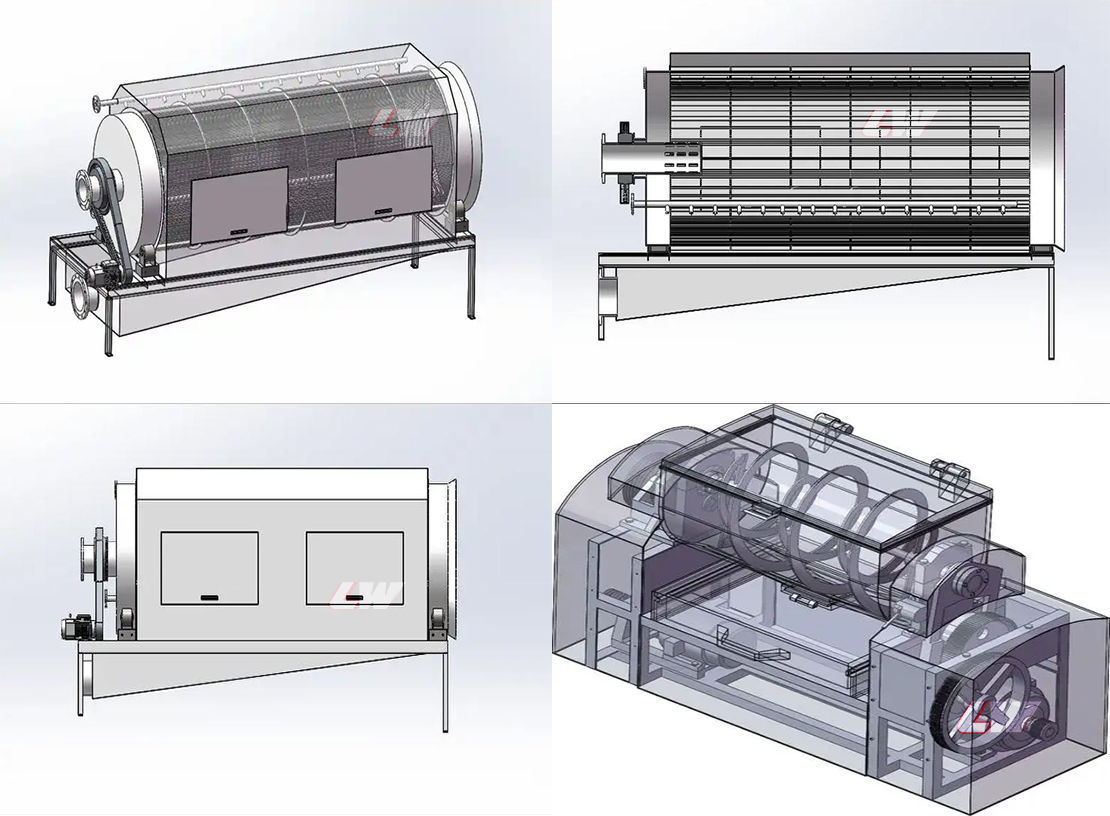
Loway rotary drum filter machine design: general arrangement, cross-section and detail views of the drum and drive assembly
LWRD rotary drum filter design package: assembly, section and detail drawings used for manufacture and approval.
FAQ

Frequently Asked Questions

What determines the price of a rotary drum filter?

Four inputs set the quotation: flow, solids loading, mesh rating and material of construction. Send us what you have from your process data and we will return a priced technical proposal.

How does a rotary drum filter work?

A rotating drum covered in fine mesh panels turns in the liquid. Water passes through the mesh, solids stay on the surface, and an automatic backwash spray washes them into a collection trough as each panel leaves the liquid. Filtration and cleaning happen at the same time, so the flow never stops.

Which applications fit this machine best?

A rotary drum filter fits continuous flows with dilute suspended solids, from compact single units to large municipal trains: wastewater polishing and pre-treatment, RAS aquaculture, and food or process-water loops. Where the feed is a thick slurry that must leave as a dry cake, a filter press or vacuum unit is the better route — we confirm the match against your duty before quoting.

Which mesh sizes are available?

Rotary drum filter mesh is rated from 10 microns to 2.5 mm across the two LWRD series: 20 μm – 2.5 mm on the standard series and 10–20 μm on the precision series, selected against your solids and water-quality target. Ratings are panel choices, so they can be changed later if your process changes.

Does a rotary drum filter need a vacuum pump?

No. This machine is a gravity screen filter — water passes through the mesh under a small head difference and there is no vacuum system in it at all. It is a different machine from the rotary vacuum drum filter, which pulls a cake against a cloth under vacuum for dewatering duty.

Can the mesh panels be replaced individually?

Yes. The mesh is built in sections clamped around the drum, so a damaged or worn panel is changed on its own without dismantling the drum — and a rating change is a panel swap, not a rebuild.

Internal feed or external feed — which construction do I need?

The feed arrangement follows the solids: high-fibre feeds such as paper-mill, slaughterhouse and textile effluent run best on the external-feed build, where solids collect on the outside of the mesh and cleaning access is simplest. Lower-solids polishing and RAS duty usually takes the internal-feed build. We confirm the arrangement from your feed analysis.

How much backwash water does the machine use?

On the standard series, backwash consumes 0.5–3% of the treated flow, using filtered plant water at 0.3–0.4 MPa, and the wash water is normally recycled to the head of the plant.

What maintenance does the machine need?

The wear list is short: mesh panels, spray nozzles and seals. Nozzles sit above the water line and panels are changed section by section without dismantling the drum. Common wear parts are stocked for fast shipment — see the parts page.

What information should I send to size one?

Flow rate, TSS concentration, the application and the installation conditions (indoor or outdoor, climate, space limits). Those four inputs are enough for a first rotary drum filter proposal; the rest is refined during detailed engineering.

What warranty and support come with the machine?

Warranty terms are stated clearly in every quotation. As the manufacturer we support the machine directly: commissioning guidance, lifetime technical contact by email, phone and video, and stocked replacement parts so a worn panel or nozzle does not stop your plant.

Send Us Your Flow, Your TSS and Your Duty

A sized proposal for a rotary drum filter starts with four numbers from your process. Send what you have — as the manufacturer we will come back with a machine that fits your wastewater duty, or with the one question that needs answering first.

  • Flow (m³/d or m³/h)
  • Feed TSS (mg/L)
  • Target filtration rating
  • Internal or external feed preference
  • Medium (fresh effluent or seawater)
  • Need a Proposal for Your Dewatering Project?

    Our engineers reply with a sizing recommendation and quotation within 24–48 hours.

    Need detailed specs?