
Rotary Bar Screen (Multi-Rake Type)
Engineered to handle high solid loads in deep channels. The industry-standard choice for protecting municipal headworks and large pumping stations.
The Heavy-Duty Solution for Coarse & Medium Screening
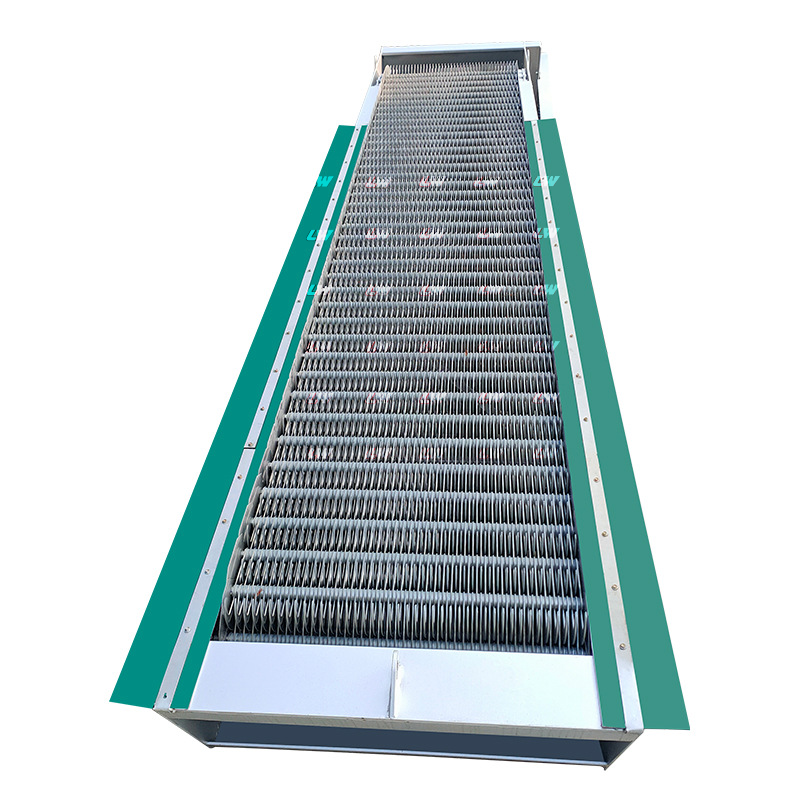
The Loway Rotary Bar Screen (also known as a Multi-Rake Screen or Chain-Driven Screen) is designed for the continuous removal of large floating debris. Unlike static screens that clog easily, our multi-rake mechanism actively penetrates the grid to extract solids, ensuring consistent flow rates and preventing upstream flooding—even during storm events.
Key Specs
- Gap Size: 5mm – 50mm
- Channel Width: 500mm – 3000mm+ (Customizable)
- Material: SS304 / SS316L / Duplex Steel
How It Works
The system consists of a stationary bar rack and a moving cleaning mechanism comprised of multiple rake teeth mounted on heavy-duty drive chains.
- Interception: Waste water flows through the stationary grid. Solids larger than the gap size (e.g., branches, bottles, rags) are intercepted on the bar face.
- Lifting: The drive chain rotates continuously. The rake teeth mesh with the grid bars, scraping the debris from the bottom of the channel and lifting it upwards.
- Discharge: As the rakes reach the top discharge point, the debris falls via gravity into a screw conveyor or dumpster. A distinct “wiper” mechanism ensures no residue remains on the rake teeth.
- Self-Cleaning: The teeth penetrate deeply into the grid slots during every cycle, preventing the buildup of grease or sludge (blinding) that typically affects other screen types.
Engineered for Reliability
Jam-Free Design:
Equipped with an electromechanical overload protection device. If a blockage occurs (e.g., a metal log enters the channel), the motor cuts off instantly to protect the drive chain and shafts.
Low Head Loss:
The hydrodynamic profile of the teardrop-shaped bars maximizes flow throughput while minimizing hydraulic resistance.
Heavy-Duty Chain:
We use high-tensile strength roller chains designed specifically for wet and corrosive environments, reducing the frequency of chain tensioning adjustments.
Fully Enclosed (Optional):
For odor control and operator safety, the upper section can be fully enclosed in stainless steel housing.
Manufacturing Quality & Standards
At Loway Equipment, durability is not an option; it is a standard. Every Rotary Bar Screen undergoes rigorous manufacturing processes to ensure a 15+ year service life in harsh sewage environments.
Precision Laser Cutting:
All frame components and rake teeth are laser-cut to ensure dimensional accuracy within 0.1mm. This guarantees smooth chain operation and prevents "tooth skipping."
Certified Welding:
Our welders are certified to international standards (ISO). We utilize full-penetration welding for the main frame to withstand high hydraulic pressure without deformation.
Surface Treatment (Pickling & Passivation):
After welding, every stainless steel unit undergoes a complete acid pickling and passivation process. This restores the corrosion-resistant oxide layer, preventing premature rusting at weld seams—a common failure point in inferior competitors.
Factory Acceptance Test (FAT):
No equipment leaves our factory without a dry-run test. We simulate operation for 24 continuous hours to inspect chain tension, motor amps, and noise levels.
Standard Specifications
Parameter | Specification |
Model Series | Loway-RBS |
Slot / Gap Size | 5mm, 10mm, 20mm, 30mm, 50mm (Customizable) |
Channel Width (W) | 400mm up to 4000mm |
Discharge Height (H) | 800mm up to 10,000mm (Suitable for deep wells) |
Installation Angle | 60° – 85° (Standard is 75°) |
Material Construction | Frame & Bars: SS304 / SS316L |
Rake Teeth Material | SS304 / SS316L or High-Strength Nylon (Optional) |
Drive Motor | IP55 / IP67, SEW / Nord / Equivalent |
Control System | PLC Automatic (Time / Level Differential Control) |
Ask for a Custom Proposal Send us your channel dimensions and flow rate. Our engineers will provide a General Arrangement (GA) drawing and a quotation within 24 hours.
Applications of the Rotary Bar Screen
This equipment is the primary defense mechanism in the “Headworks” stage.

Municipal Sewage Treatment Plants:
Inlet channels receive raw sewage.
Stormwater Pumping Stations:
Handling surges of water mixed with branches and trash.
Industrial Water Intakes:
Protecting process water pumps from river/lake debris.
Power Plants:
Cooling water intake screening.
Paper & Pulp Mills:
Removal of large plastic rejects and wires.
Technical FAQ: Rotary Bar Screens
Have More Questions? Our technical team is ready to provide detailed, personalized guidance.
Q1: How do you prevent waste from bypassing the screen on the sides?
This is a common concern. Loway screens are equipped with heavy-duty neoprene or EPDM rubber side seals attached to the frame. These seals press tightly against the channel walls, ensuring that 100% of the flow passes through the screen bars, not around them.
Q2: What is the advantage of a "Multi-Rake" system over a "Single Rake" (Climber) screen?
Speed and Efficiency. A Climber screen has one rake that takes time to travel down and up. During heavy storm flows, the screen can get overwhelmed before the rake returns. Our Multi-Rake system has multiple rakes attached to the chain, cleaning the bar rack continuously (every few seconds), making it far superior for high-load applications.
Q3: Can the screen be pivoted out of the channel for maintenance?
Yes. We can design the frame with pivot supports at the top operating floor level. This allows the entire unit to be tilted out of the channel for easier inspection of the underwater chain guide or bearings without needing a crane or confined space entry.
Q4: Does the equipment require a recess (cut-out) in the concrete channel?
Ideally, yes. A small recess allows the frame to sit flush with the channel walls. However, if you have an existing channel with no recess, we can provide flow guide baffles to smooth the flow into the screen and prevent turbulence.
Q5: How does the automation logic work?
The PLC control panel typically monitors a Level Differential Sensor.
- Stage 1: As debris builds up, the upstream water level rises.
- Stage 2: When the difference between upstream and downstream levels reaches a set point (e.g., 100mm), the screen starts running.
- Stage 3: Once the screen is clean and levels equalize, it stops.
- Backup: A timer also runs the screen periodically to prevent sediment buildup.
Q6: What happens if a large object (like a log) jams the rake?
We use a dual-protection system. First, an electronic torque limiter monitors motor current; if it spikes, the motor stops and reverses to try to clear the jam. If that fails, a mechanical shear pin will break to physically disconnect the drive, protecting the gearbox from catastrophic damage.
Q7: Can you provide the screen in SS316L for seawater intake?
Yes. For desalination plants or coastal power stations, we manufacture the entire unit using AISI 316L or Duplex 2205 Stainless Steel to prevent chloride corrosion. We also offer sacrificial anodes for cathodic protection if required.
Q8: What is the typical lead time for a custom-sized unit?
Since channel dimensions vary, we build to order. Typically, production takes 4 to 6 weeks after drawing approval. We provide the GA (General Arrangement) drawing within 3 business days of your order.